
Logo in white on red background since 2016 |
|

Headquarters in Kyoto, Japan |
|
|
Trade name |
Nintendo |
|---|---|
|
Native name |
任天堂株式会社 |
|
Romanized name |
Nintendō kabushiki gaisha |
| Formerly |
|
| Type | Public company KK |
|
Traded as |
|
| ISIN | JP3756600007 |
| Industry |
|
| Founded | 23 September 1889; 133 years ago in Shimogyō-ku, Kyoto, Japan |
| Founder | Fusajiro Yamauchi |
| Headquarters | 11–1 Kamitoba Hokodatecho,
Minami-ku, Kyoto |
|
Area served |
Worldwide |
|
Key people |
|
| Products | List of products |
|
Production output |
(2021) |
| Brands |
Video game series
|
| Services |
|
| Revenue |  ¥1.695 trillion (US$13.923 billion) (2022) ¥1.695 trillion (US$13.923 billion) (2022) |
|
Operating income |
¥592.760 billion (US$4.869 billion) (2022) |
|
Net income |
¥477.714 billion (US$3.924 billion) (2022) |
| Total assets |  ¥2.662 trillion (US$21.866 billion) (2022) ¥2.662 trillion (US$21.866 billion) (2022) |
| Total equity | ¥2.069 trillion (US$16.995 billion) (2022) |
| Owner | The Master Trust Bank of Japan, Ltd. (17.63%)
Nintendo (10.35%)[1] Public Investment Fund (8.26%) |
|
Number of employees |
7,136[a] (2022) |
| Divisions |
|
| Subsidiaries |
List
|
| Website | nintendo.com |
| Footnotes / references [2][3][4][5][6] |
Nintendo Co., Ltd.[b] is a Japanese multinational video game company headquartered in Kyoto. It develops, publishes and releases both video games and video game consoles.
Nintendo was founded in 1889 as Nintendo Karuta[c] by craftsman Fusajiro Yamauchi and originally produced handmade hanafuda playing cards. After venturing into various lines of business during the 1960s and acquiring a legal status as a public company, Nintendo distributed its first console, the Color TV-Game, in 1977. It gained international recognition with the release of Donkey Kong in 1981 and the Nintendo Entertainment System and Super Mario Bros. in 1985.
Since then, Nintendo has produced some of the most successful consoles in the video game industry, such as the Game Boy, the Super Nintendo Entertainment System, the Nintendo DS, the Wii, and the Switch. It has created numerous major franchises, including Mario, Donkey Kong, The Legend of Zelda, Pokémon, Kirby, Metroid, Fire Emblem, Animal Crossing, Splatoon, Star Fox, Xenoblade Chronicles, and Super Smash Bros. Nintendo’s mascot, Mario, is internationally recognized. The company has sold more than 5.4 billion video games and over 800 million hardware units globally as of 2022.
Nintendo has multiple subsidiaries in Japan and abroad, in addition to business partners such as the Pokémon Company and HAL Laboratory. Nintendo and its staff have received awards including Emmy Awards for Technology & Engineering, Game Awards, Game Developers Choice Awards, and British Academy Games Awards. It is one of the wealthiest and most valuable companies in the Japanese market.
History
1889–1972: Early history
1889–1932: Origin as a playing card business

Original Nintendo headquarters (1889–1930) and workshop in Shimogyō-ku, Kyoto, c. 1889. The right section was eventually rebuilt (pictured below), and the left section was reportedly demolished in 2004.
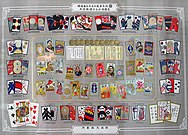
Nintendo was founded as Nintendo Karuta[d] on 23 September 1889[7] by craftsman Fusajiro Yamauchi in Shimogyō-ku, Kyoto, Japan, as an unincorporated establishment, to produce and distribute Japanese playing cards, or karuta (かるた, from Portuguese carta [«card»]), most notably hanafuda (花札, «flower cards»).[2][3][4][8][9][10] The name «Nintendo» is commonly assumed to mean «leave luck to heaven»,[11][10] but the assumption lacks historical validation; it can alternatively be translated as «the temple of free hanafuda«.[8] Hanafuda cards had become popular after Japan banned most forms of gambling in 1882, though tolerated hanafuda. Sales of hanafuda cards were popular with the yakuza-ran gaming parlors in Kyoto. Other card manufacturers had opted to leave the market not wanting to be associated with criminal ties, but Yamauchi persisted without such fears to become the primary producer of hanafuda within a few years.[12] With the increase of the cards’ popularity, Yamauchi hired assistants to mass-produce to satisfy the demand.[13] Even with a favorable start, the business faced financial struggle due to operating in a niche market, the slow and expensive manufacturing process, high product price, alongside long durability of the cards, which impacted sales due to the low replacement rate.[14] As a solution, Nintendo produced a cheaper and lower-quality line of playing cards, Tengu, while also conducting product offerings in other cities such as Osaka, where card game profits were high. In addition, local merchants were interested in the prospect of a continuous renewal of decks, thus avoiding the suspicions that reusing cards would generate.[15]
According to Nintendo, the business’ first western-style card deck was put on the market in 1902,[3][4] although other documents postpone the date to 1907, shortly after the Russo-Japanese War.[16] Although the cards were initially meant for export, they quickly gained popularity not only abroad but also in Japan.[3][4] During this time, the business styled itself as Marufuku Nintendo Card Co.[17] The war created considerable difficulties for companies in the leisure sector, which were subject to new levies such as the Karuta Zei («playing cards tax»).[18] Nintendo subsisted and, in 1907, entered into an agreement with Nihon Senbai—later known as the Japan Tobacco—to market its cards to various cigarette stores throughout the country.[19] A Nintendo promotional calendar from the Taishō era dated to 1915 indicates that the business was named Yamauchi Nintendo,[e] but still used the Marufuku Nintendo Co. brand for its playing cards.[20]
Japanese culture stipulated that for Nintendo to continue as a family business after Yamauchi’s retirement, Yamauchi had to adopt his son-in-law so that he could take over the business. As a result, Sekiryo Kaneda adopted the Yamauchi surname in 1907 and headed the business in 1929. By that time, Nintendo was the largest playing card business in Japan.[21]
1933–1968: Incorportation, expansion, and diversification
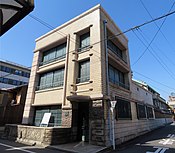
Former Nintendo headquarters (1933–1959), rebuilt from the right section of the original building

English company information plate in the former Nintendo headquarters
In 1933, Sekiryo Kaneda established the company as a general partnership named Yamauchi Nintendo & Co., Ltd.,[f][4] investing in the construction of a new corporate headquarters located next to the original building,[22] near the Toba-kaidō train station.[23] Because Sekiryo’s marriage to Yamauchi’s daughter produced no male heirs, he planned to adopt his son-in-law Shikanojo Inaba, an artist in the company’s employ and the father of his grandson Hiroshi, born in 1927. However, Inaba abandoned his family and the company, so Hiroshi was made Sekiryo’s eventual successor.[24]
World War II negatively impacted the company as Japanese authorities prohibited the diffusion of foreign card games, and as the priorities of Japanese society shifted, its interest in recreational activities waned. During this time, Nintendo was partly supported by a financial injection from Hiroshi’s wife Michiko Inaba, who came from a wealthy family.[25] In 1947, Sekiryo founded the distribution company Marufuku Co., Ltd.,[g] responsible for Nintendo’s sales and marketing operations, which would eventually go on to become the present-day Nintendo Co., Ltd., in Higashikawara-cho, Imagumano, Higashiyama-ku, Kyoto.[3][4][8]


1949 New Year Nintendo staff commemoration
In 1950, due to Sekiryo’s deteriorating health,[26] Hiroshi Yamauchi assumed the presidency and headed manufacturing operations.[3][4] His first actions involved several important changes in the operation of the company: in 1951, he changed the company name to Nintendo Playing Card Co., Ltd.,[h][3][4][27] and in the following year, he centralized the manufacturing facilities dispersed in Kyoto, which led to the expansion of the offices in Kamitakamatsu-cho, Fukuine, Higashiyama-ku, Kyoto.[3][4][28] In 1953, Nintendo became the first company to succeed in mass-producing plastic playing cards in Japan.[3][4] Some of the company’s employees, accustomed to a more cautious and conservative leadership, viewed the new measures with concern, and the rising tension led to a call for a strike. However, the measure had no major impact, as Hiroshi resorted to the dismissal of several dissatisfied workers.[29]
In 1959, Nintendo moved its headquarters to Kamitakamatsu-cho, Fukuine, Higashiyama-ku, Kyoto. The company entered into a partnership with The Walt Disney Company to incorporate its characters into playing cards, which opened it up to the children’s market and resulted in a boost to Nintendo’s playing card business.[3][4][27] Nintendo automated the production of Japanese playing cards using backing paper, and also developed distribution system that allowed it to offer its products in toy stores.[3][22] By 1961, the company had established a Tokyo branch in Chiyoda, Tokyo,[3] and sold more than 1.5 million card packs, holding a high market share, for which it relied on televised advertising campaigns.[30] In 1962, Nintendo became a public company by listing stock on the second section of the Osaka Securities Exchange and on the Kyoto Stock Exchange.[3][4] In the following year, the company adopted its current name, Nintendo & Co., Ltd.,[i] and started manufacturing games in addition to playing cards.[3][4]
In 1964, Nintendo earned ¥150 million.[31] Although the company was experiencing a period of economic prosperity, the Disney cards and derived products made it dependent on the children’s market. The situation was exacerbated by the falling sales of its adult-oriented playing cards caused by Japanese society gravitating toward other hobbies such as pachinko, bowling, and nightly outings.[30] When Disney card sales began to decline, Nintendo realized that it had no real alternative to alleviate the situation.[31] After the 1964 Tokyo Olympics, Nintendo’s stock price plummeted to its lowest recorded level of ¥60.[32][33]
In 1965, Nintendo hired Gunpei Yokoi to maintain the assembly-line machines used to manufacture its playing cards.[34]
1969–1972: Classic and electronic toys
Yamauchi’s experience with the previous initiatives led him to increase Nintendo’s investment in a research and development department in 1969, directed by Hiroshi Imanishi, a long-time employee of the company.[4] Yokoi was moved to the newly-created department and was responsible for coordinating various projects.[22] Yokoi’s experience in manufacturing electronic devices led Yamauchi to put him in charge of the company’s games department, and his products would be mass-produced.[35] During this period, Nintendo built a new production plant in Uji, just outside of Kyoto,[4] and distributed classic tabletop games such as chess, shogi, go, and mahjong, and other foreign games under the Nippon Game brand.[36] The company’s restructuring preserved a couple of areas dedicated to playing card manufacturing.[37]
In 1970, the company’s stock listing was promoted to the first section of the Osaka Stock Exchange,[3][4] and the reconstruction and enlargement of its corporate headquarters was completed.[4] The year represented a watershed moment in Nintendo’s history as it released Japan’s first electronic toy—the Beam Gun, an optoelectronic pistol designed by Masayuki Uemura.[4] In total, more than a million units were sold.[22] Nintendo partnered with Magnavox to provide a light gun controller based on the Beam Gun design for the company’s new home video game console, the Magnavox Odyssey, in 1971.[38] Other popular toys released at the time include the Ultra Hand, the Ultra Machine, the Ultra Scope, and the Love Tester, all designed by Yokoi. More than 1.2 million units of Ultra Hand were sold in Japan.[13]
1973–present: History in electronics
1973–1978: Early video games and Color TV-Game

The growing demand for Nintendo’s products led Yamauchi to further expand the offices, for which he acquired the surrounding land and assigned the production of cards to the original Nintendo building. Meanwhile, Yokoi, Uemura, and new employees such as Genyo Takeda, continued to develop innovative products for the company.[22] The Laser Clay Shooting System was released in 1973 and managed to surpass bowling in popularity. Though Nintendo’s toys continued to gain popularity, the 1973 oil crisis caused both a spike in the cost of plastics and a change in consumer priorities that put essential products over pastimes, and Nintendo lost several billion yen.[39]
In 1974, Nintendo released Wild Gunman, a skeet shooting arcade simulation consisting of a 16 mm image projector with a sensor that detects a beam from the player’s light gun. Both the Laser Clay Shooting System and Wild Gunman were successfully exported to Europe and North America.[4] However, Nintendo’s production speeds were still slow compared to rival companies such as Bandai and Tomy, and their prices were high, which led to the discontinuation of some of their light gun products.[40] The subsidiary Nintendo Leisure System Co., Ltd., which developed these products, was closed as a result of the economic impact dealt by the oil crisis.[41]

Yamauchi, motivated by the successes of Atari and Magnavox with their video game consoles,[22] acquired the Japanese distribution rights for the Magnavox Odyssey in 1974,[35] and reached an agreement with Mitsubishi Electric to develop similar products between 1975 and 1978, including the first microprocessor for video games systems, the Color TV-Game series, and an arcade game inspired by Othello.[4] During this period, Takeda developed the video game EVR Race,[42] and Shigeru Miyamoto joined Yokoi’s team with the responsibility of designing the casing for the Color TV-Game consoles.[43] In 1978, Nintendo’s research and development department was split into two facilities, Nintendo Research & Development 1 and Nintendo Research & Development 2, respectively managed by Yokoi and Uemura.[44][45]
Shigeru Miyamoto brought distinctive sources of inspiration, including the natural environment and regional culture of Sonobe, popular culture influences like Westerns and detective fiction, along with folk Shinto practices and family media.[46][47][48][49] These would each be seen in most of Nintendo’s major franchises which developed following Miyamoto’s creative leadership.[50]
1979–1987: Game and Watch, arcade games, and Nintendo Entertainment System


Two key events in Nintendo’s history occurred in 1979: its American subsidiary was opened in New York City, and a new department focused on arcade game development was created. In 1980, one of the first handheld video game systems, the Game & Watch, was created by Yokoi from the technology used in portable calculators.[4][39] It became one of Nintendo’s most successful products, with over 43.4 million units sold worldwide during its production period, and for which 59 games were made in total.[51]

Nintendo entered the arcade video game market with Sheriff and Radar Scope, released in Japan in 1979 and 1980 respectively. Sheriff, also known as Bandido in some regions, marked the first original video game made by Nintendo, was published by Sega and developed by Genyo Takeda and Shigeru Miyamoto.[50][52][53] While Radar Scope, rivaled Galaxian in Japanese arcades but failed to find an audience overseas and created a financial crisis for the company.[54] To try to find a more successful game, they put Miyamoto in charge of their next arcade game design, leading to the release of Donkey Kong in 1981, one of the first platform video games that allowed the player character to jump.[55] The character, Jumpman, would later become Mario and Nintendo’s official mascot. Mario was named after Mario Segale, the landlord of Nintendo’s offices in Tukwila, Washington.[56] Donkey Kong was a financial success for Nintendo both in Japan and overseas, and led Coleco to fight Atari for licensing rights for porting to home consoles and personal computers.[54]
In 1983, Nintendo opened a new production facility in Uji and was listed on the first section of the Tokyo Stock Exchange.[4] Uemura, taking inspiration from the ColecoVision,[57] began creating a new video game console that would incorporate a ROM cartridge format for video games as well as both a central processing unit and a picture processing unit.[4][58][59] The Family Computer, or Famicom, was released in Japan in July 1983 along with three games adapted from their original arcade versions: Donkey Kong, Donkey Kong Jr. and Popeye.[60] Its success was such that in 1984, it surpassed the market share held by Sega’s SG-1000.[61] At this time, Nintendo adopted a series of guidelines that involved the validation of each game produced for the Famicom before its distribution on the market, agreements with developers to ensure that no Famicom game would be adapted to other consoles within two years of its release, and restricting developers from producing more than five games per year for the Famicom.[62]
In the early 1980s, several video game consoles proliferated in the United States, as well as low-quality games produced by third-party developers,[63] which oversaturated the market and led to the video game crash of 1983.[64] Consequently, a recession hit the American video game industry, whose revenues went from over $3 billion to $100 million between 1983 and 1985.[65] Nintendo’s initiative to launch the Famicom in America was also impacted. To differentiate the Famicom from its competitors in America, Nintendo rebranded it as an entertainment system and its cartridges as Game Paks, and with a design reminiscent of a VCR.[59] Nintendo implemented a lockout chip in the Game Paks for control on its third party library to avoid the market saturation that had occurred in the United States.[66] The result is the Nintendo Entertainment System, or NES, which was released in North America in 1985.[4] The landmark games Super Mario Bros. and The Legend of Zelda were produced by Miyamoto and Takashi Tezuka. Composer Koji Kondo reinforced the idea that musical themes could act as a complement to game mechanics rather than simply a miscellaneous element.[67] Production of the NES lasted until 1995,[68] and production of the Famicom lasted until 2003.[69] In total, around 62 million Famicom and NES consoles were sold worldwide.[70] During this period, Nintendo created a copyright infringement protection in the form of the Official Nintendo Seal of Quality, added to their products so that customers may recognize their authenticity in the market.[71] By this time, Nintendo’s network of electronic suppliers had extended to around thirty companies, including Ricoh (Nintendo’s main source for semiconductors) and the Sharp Corporation.[22]
1988–1992: Game Boy and Super Nintendo Entertainment System
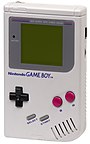
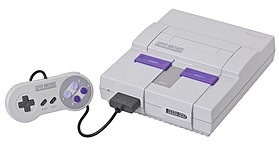
In 1988, Gunpei Yokoi and his team at Nintendo R&D1 conceived the Game Boy, the first handheld video game console made by Nintendo. Nintendo released the Game Boy in 1989. In North America, the Game Boy was bundled with the popular third-party game Tetris after a difficult negotiation process with Elektronorgtechnica.[72] The Game Boy was a significant success. In its first two weeks of sale in Japan, its initial inventory of 300,000 units sold out, and in the United States, an additional 40,000 units were sold on its first day of distribution.[73] Around this time, Nintendo entered an agreement with Sony to develop the Super Famicom CD-ROM Adapter, a peripheral for the upcoming Super Famicom capable of playing CD-ROMs.[74] However, the collaboration did not last as Yamauchi preferred to continue developing the technology with Philips, which would result in the CD-i,[75] and Sony’s independent efforts resulted in the creation of the PlayStation console.[76]
The first issue of Nintendo Power magazine, which had an annual circulation of 1.5 million copies in the United States, was published in 1988.[77] In July 1989, Nintendo held the first Nintendo Space World trade show with the name Shoshinkai for the purpose of announcing and demonstrating upcoming Nintendo products.[78] That year, the first World of Nintendo stores-within-a-store, which carried official Nintendo merchandise, were opened in the United States. According to company information, more than 25% of homes in the United States had an NES in 1989.[77]
In the late 1980s, Nintendo’s dominance slipped with the appearance of NEC’s PC Engine and Sega’s Mega Drive, 16-bit game consoles with improved graphics and audio compared to the NES.[79] In response to the competition, Uemura designed the Super Famicom, which launched in 1990. The first batch of 300,000 consoles sold out in hours.[80] The following year, as with the NES, Nintendo distributed a modified version of the Super Famicom to the United States market, titled the Super Nintendo Entertainment System.[81] Launch games for the Super Famicom and Super NES include Super Mario World, F-Zero, Pilotwings, SimCity, and Gradius III.[82] By mid-1992, over 46 million Super Famicom and Super NES consoles had been sold.[4] The console’s life cycle lasted until 1999 in the United States,[83] and until 2003 in Japan.[69]
In March 1990, the first Nintendo World Championship was held, with participants from 29 American cities competing for the title of «best Nintendo player in the world».[77][84] In June 1990, the subsidiary Nintendo of Europe was opened in Großostheim, Germany; in 1993, subsequent subsidiaries were established in the Netherlands (where Bandai had previously distributed Nintendo’s products), France, the United Kingdom, Spain, Belgium, and Australia.[4] In 1992, Nintendo acquired a majority stake in the Seattle Mariners baseball team, and sold most of its shares in 2016.[85][86] Nintendo ceased manufacturing arcade games and systems in September 1992.[87][88] In 1993, Star Fox was released, which marked an industry milestone by being the first video game to make use of the Super FX chip.[4]
The proliferation of graphically violent video games, such as Mortal Kombat, caused controversy and led to the creation of the Interactive Digital Software Association and the Entertainment Software Rating Board, in whose development Nintendo collaborated during 1994. These measures also encouraged Nintendo to abandon the content guidelines it had enforced since the release of the NES.[89][90] Commercial strategies implemented by Nintendo during this time include the Nintendo Gateway System, an in-flight entertainment service available for airlines, cruise ships and hotels,[91] and the «Play It Loud!» advertising campaign for Game Boys with different-colored casings. The Advanced Computer Modeling graphics used in Donkey Kong Country for the Super NES and Donkey Kong Land for the Game Boy were technologically innovative, as was the Satellaview satellite modem peripheral for the Super Famicom, which allowed the digital transmission of data via a communications satellite in space.[4]
1993–1998: Nintendo 64, Virtual Boy, and Game Boy Color
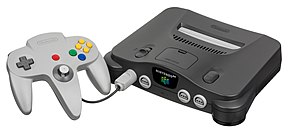
In mid-1993, Nintendo and Silicon Graphics announced a strategic alliance to develop the Nintendo 64.[92][93] NEC, Toshiba, and Sharp also contributed technology to the console.[94] The Nintendo 64 was marketed as one of the first consoles to be designed with 64-bit architecture.[95] As part of an agreement with Midway Games, the arcade games Killer Instinct and Cruis’n USA were ported to the console.[96][97] Although the Nintendo 64 was planned for release in 1995, the production schedules of third-party developers influenced a delay,[98][99] and the console was released in June 1996 in Japan, September 1996 in the United States and March 1997 in Europe. By the end of its production in 2002, around 33 million Nintendo 64 consoles were sold worldwide,[70] and it is considered one of the most recognized video game systems in history.[100] 388 games were produced for the Nintendo 64 in total,[101] some of which – particularly Super Mario 64, The Legend of Zelda: Ocarina of Time, and GoldenEye 007 – have been distinguished as some of the greatest of all time.[102]

In 1995, Nintendo released the Virtual Boy, a console designed by Gunpei Yokoi with stereoscopic graphics. Critics were generally disappointed with the quality of the games and red-colored graphics, and complained of gameplay-induced headaches.[103] The system sold poorly and was quietly discontinued.[104] Amid the system’s failure, Yokoi formally retired from Nintendo.[105] In February 1996, Pocket Monsters Red and Green, known internationally as Pokémon Red and Blue, developed by Game Freak was released in Japan for the Game Boy, and established the popular Pokémon franchise.[106]: 191 The game went on to sell 31.37 million units,[107] with the video game series exceeding a total of 300 million units in sales as of 2017.[108] In 1997, Nintendo released the Rumble Pak, a plug-in device that connects to the Nintendo 64 controller and produces a vibration during certain moments of a game.[4]
In 1998, the Game Boy Color was released. In addition to backward compatibility with Game Boy games, the console’s similar capacity to the NES resulted in select adaptations of games from that library, such as Super Mario Bros. Deluxe.[109] Since then, over 118.6 million Game Boy and Game Boy Color consoles have been sold worldwide.[110]
1999–2003: Game Boy Advance and GameCube

In May 1999, with the advent of the PlayStation 2,[111] Nintendo entered an agreement with IBM and Panasonic to develop the 128-bit Gekko processor and the DVD drive to be used in Nintendo’s next home console.[112] Meanwhile, a series of administrative changes occurred in 2000, when Nintendo’s corporate offices were moved to the Minami-ku neighborhood in Kyoto, and Nintendo Benelux was established to manage the Dutch and Belgian territories.[4]

Nintendo headquarters since 2000
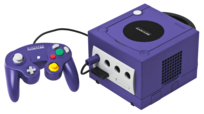
In 2001, two new Nintendo consoles were introduced: the Game Boy Advance, which was designed by Gwénaël Nicolas with stylistic departure from its predecessors,[113][114] and the GameCube.[115] During the first week of the Game Boy Advance’s North American release in June 2001, over 500,000 units were sold, making it the fastest-selling video game console in the United States at the time.[116] By the end of its production cycle in 2010, more than 81.5 million units had been sold worldwide.[110] As for the GameCube, even with such distinguishing features as the miniDVD format of its games and Internet connectivity for a few games,[117][118] its sales were lower than those of its predecessors, and during the six years of its production, 21.7 million units were sold worldwide.[119] An innovative product developed by Nintendo during this time was the Nintendo e-Reader, a Game Boy Advance peripheral that allows the transfer of data stored on a series of cards to the console.[4]
In 2002, the Pokémon Mini was released. Its dimensions were smaller than that of the Game Boy Advance and it weighed 70 grams, making it the smallest video game console in history.[4] Nintendo collaborated with Sega and Namco to develop Triforce, an arcade board to facilitate the conversion of arcade titles to the GameCube.[120] Following the European release of the GameCube in May 2002,[121] Hiroshi Yamauchi announced his resignation as the president of Nintendo, and Satoru Iwata was selected by the company as his successor. Yamauchi would remain as advisor and director of the company until 2005,[122] and he died in 2013.[123] Iwata’s appointment as president ended the Yamauchi succession at the helm of the company, a practice that had been in place since its foundation.[124][125]
In 2003, Nintendo released the Game Boy Advance SP, an improved version of the Game Boy Advance with a foldable case, an illuminated display, and a rechargeable battery. By the end of its production cycle in 2010, over 43.5 million units had been sold worldwide.[110] Nintendo also released the Game Boy Player, a peripheral that allows Game Boy and Game Boy Advance games to be played on the GameCube.
2004–2009: Nintendo DS and Wii


In 2004, Nintendo released the Nintendo DS, which featured such innovations as dual screens – one of which being a touchscreen – and wireless connectivity for multiplayer play.[4][126] Throughout its lifetime, more than 154 million units were sold, making it the most successful handheld console and the second bestselling console in history.[110] In 2005, Nintendo released the Game Boy Micro, the last system in the Game Boy line.[4][109] Sales did not meet Nintendo’s expectations,[127] with 2.5 million units being sold by 2007.[128] In mid-2005, the Nintendo World Store was inaugurated in New York City.[129]

Nintendo’s next home console was conceived in 2001, although development commenced in 2003, taking inspiration from the Nintendo DS.[130] Nintendo also considered the relative failure of the GameCube, and instead opted to take a «Blue Ocean Strategy» by developing a reduced performance console in contrast to the high-performance consoles of Sony and Microsoft to avoid directly competing with them.[131] The Wii was released in November 2006,[132] with a total of 33 launch games.[133] With the Wii, Nintendo sought to reach a broader demographic than its seventh-generation competitors,[134] with the intention of also encompassing the «non-consumer» sector.[135] To this end, Nintendo invested in a $200 million advertising campaign.[136] The Wii’s innovations include the Wii Remote controller, equipped with an accelerometer system and infrared sensors that allow it to detect its position in a three-dimensional environment with the aid of a sensor bar;[137][138] the Nunchuk peripheral that includes an analog controller and an accelerometer;[139] and the Wii MotionPlus expansion that increases the sensitivity of the main controller with the aid of gyroscopes.[140] By 2016, more than 101 million Wii consoles had been sold worldwide,[141] making it the most successful console of its generation, a distinction that Nintendo had not achieved since the 1990s with the Super NES.[142]
Several accessories were released for the Wii from 2007 to 2010, such as the Wii Balance Board, the Wii Wheel and the WiiWare download service. In 2009, Nintendo Iberica S.A. expanded its commercial operations to Portugal through a new office in Lisbon.[4] By that year, Nintendo held a 68.3% share of the worldwide handheld gaming market.[143] In 2010, Nintendo celebrated the 25th anniversary of Mario’s debut appearance, for which certain allusive products were put on sale. The event included the release of Super Mario All-Stars 25th Anniversary Edition and special editions of the Nintendo DSi XL and Wii.[144]
2010–2016: Nintendo 3DS, Wii U, and mobile ventures
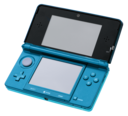

Following an announcement in March 2010,[145] Nintendo released the Nintendo 3DS in 2011. The console produces stereoscopic effects without 3D glasses.[146] By 2018, more than 69 million units had been sold worldwide;[147] the figure increased to 75 million by the start of 2019.[141] In 2011, Nintendo celebrated the 25th anniversary of The Legend of Zelda with the orchestra concert tour The Legend of Zelda: Symphony of the Goddesses and the video game The Legend of Zelda: Skyward Sword.[148]
In 2012 and 2013, two new Nintendo game consoles were introduced: the Wii U, with high-definition graphics and a GamePad controller with near-field communication technology,[149][150] and the Nintendo 2DS, a version of the 3DS that lacks the clamshell design of Nintendo’s previous handheld consoles and the stereoscopic effects of the 3DS.[151] With 13.5 million units sold worldwide,[141] the Wii U is the least successful video game console in Nintendo’s history.[152] In 2014, a new product line was released consisting of figures of Nintendo characters called amiibos.[4]
On 25 September 2013, Nintendo announced its acquisition of a 28% stake in PUX Corporation, a subsidiary of Panasonic, for the purpose of developing facial, voice, and text recognition for its video games.[153] Due to a 30% decrease in company income between April and December 2013, Iwata announced a temporary 50% cut to his salary, with other executives seeing reductions by 20%–30%.[154] In January 2015, Nintendo ceased operations in the Brazilian market due in part to high import duties. This did not affect the rest of Nintendo’s Latin American market due to an alliance with Juegos de Video Latinoamérica.[155] Nintendo reached an agreement with NC Games for Nintendo’s products to resume distribution in Brazil by 2017,[156] and by September 2020, the Switch was released in Brazil.[157]
On 11 July 2015, Iwata died of bile duct cancer, and after a couple of months in which Miyamoto and Takeda jointly operated the company, Tatsumi Kimishima was named as Iwata’s successor on 16 September 2015.[158] As part of the management’s restructuring, Miyamoto and Takeda were respectively named creative and technological advisors.[159]
The financial losses caused by the Wii U, along with Sony’s intention to release its video games to other platforms such as smart TVs, motivated Nintendo to rethink its strategy concerning the production and distribution of its properties.[160] In 2015, Nintendo formalized agreements with DeNA and Universal Parks & Resorts to extend its presence to smart devices and amusement parks respectively.[161][162][163]

In March 2016, Nintendo’s first mobile app for the iOS and Android systems, Miitomo, was released.[164] Since then, Nintendo has produced other similar apps, such as Super Mario Run, Fire Emblem Heroes, Animal Crossing: Pocket Camp, Mario Kart Tour, and Pokémon Go, the last being developed by Niantic and having generated $115 million in revenue for Nintendo.[165] The theme park area Super Nintendo World opened at Universal Studios Japan in 2020.[166] In March 2016, the loyalty program My Nintendo replaced Club Nintendo.[167]
The NES Classic Edition was released in November 2016. The console is a version of the NES based on emulation, HDMI, and the Wii remote.[168] Its successor, the Super NES Classic Edition, was released in September 2017.[169] By October 2018, around ten million units of both consoles combined had been sold worldwide.[170]
2017–present: Nintendo Switch and expansion to other media
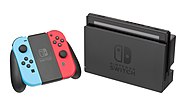
In «TV mode», with the Joy-Con attached to a grip and the main unit docked

In «Handheld mode», with the Joy-Con attached to its sides
The Wii U’s successor in the eighth generation of video game consoles, the Nintendo Switch, was released in March 2017. The Switch features a hybrid design as a home and handheld console, Joy-Con controllers that each contain an accelerometer and gyroscope, and the simultaneous wireless networking of up to eight consoles.[171] To expand its library, Nintendo entered alliances with several third-party and independent developers;[172][173] by February 2019, more than 1,800 Switch games had been released.[174] Worldwide sales of the Switch exceeded 55 million units by March 2020.[175] In April 2018, the Nintendo Labo line was released, consisting of cardboard accessories that interact with the Switch and the Joy-Con controllers.[176] More than one million units of the Nintendo Labo Variety Kit were sold in its first year on the market.[177]
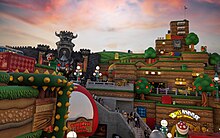
In 2018, Shuntaro Furukawa replaced Kimishima as company president,[178] and in 2019, Doug Bowser succeeded Nintendo of America president Reggie Fils-Aimé.[179] In April 2019, Nintendo formed an alliance with Tencent to distribute the Nintendo Switch in China starting in December.[180]

Nintendo’s Tokyo branch office, located in the 8th floor, since 2020
In early 2020, Plan See Do, a hotel and restaurant development company, announced that it would refurbish the former Nintendo headquarters from the 1930s as a hotel, with plans to add 20 guest rooms, a restaurant, bar, and gym. The building is owned by Yamauchi Co., Ltd., an asset management company of Nintendo’s founding family.[181] The hotel later opened in April 2022, with 18 guest rooms, and named Marufukuro in a homage to Nintendo’s previous name — Marufuku.[182][183][184] In April 2020, Reuters reported that ValueAct Capital had acquired over 2.6 million shares in Nintendo stock worth US$1.1 billion over the course of a year, giving them an overall stake of 2% in Nintendo.[185] Although the COVID-19 pandemic caused delays in the production and distribution of some of Nintendo’s products, the situation «had limited impact on business results»; in May 2020, Nintendo reported a 75% increase in income compared to the previous fiscal year, mainly contributed by the Nintendo Switch Online service.[186] The year saw some changes to the company’s management: outside director Naoki Mizutani retired from the board, and was replaced by Asa Shinkawa; and Yoshiaki Koizumi was promoted to senior executive officer, maintaining its role as deputy general manager of Nintendo EPD.[186] By August, Nintendo was named the richest company in Japan.[187] In June 2021, the company announced plans to convert its former Uji Ogura plant, where it had manufactured playing and hanafuda cards, into a museum tentatively named «Nintendo Gallery», targeted to open by March 2024.[188][189] In the following year, historic remains of a Yayoi period village were discovered in the construction site.[190]
Nintendo co-produced an animated film The Super Mario Bros. Movie alongside Universal Pictures and Illumination, with Miyamoto and Illumination CEO Chris Meledandri acting as producers.[191][192] In 2021, Furukawa indicated Nintendo’s plan to create more animated projects based on their work outside the Mario film,[193] and by 29 June, Melendandri joined the board of directors as a non-executive outside director.[194][195] According to Furukawa, the company’s expansion toward animated production is to keep «[the] business [of producing video games] thriving and growing», realizing the «need to create opportunities where even people who do not normally play on video game systems can come into contact with Nintendo characters». That day, Miyamoto said that «[Melendandri] really came to understand the Nintendo point of view» and that «asking for [his] input, as an expert with many years of experience in Hollywood, will be of great help to» Nintendo’s transition into film production.[196] Later, in July 2022, Nintendo acquired Dynamo Pictures, a Japanese CG company founded by Hiroshi Hirokawa on 18 March 2011. Dynamo had worked with Nintendo on digital shorts in the 2010s, including for the Pikmin series, and Nintendo said that Dynamo would continue their goal of expanding into animation. Following the completion of the acquisition in October 2022, Nintendo renamed Dynamo as Nintendo Pictures.[197][198]
In February 2022, Nintendo announced the acquisition of SRD Co., Ltd. (Systems Research and Development) after 40 years, a major contributor of Nintendo’s first-party games such as Donkey Kong and The Legend of Zelda until the 1990s, and then support studio since.[199] In May 2022, Reuters reported that Saudi Arabia’s Public Investment Fund had purchased a 5% stake in Nintendo,[200] and by January 2023, its stake in the company had increased to 6.07%.[201] It was raised to 7.08% by February 2023, and in the same week by 8.26%, making it the biggest external investor.[202][203]
The Super Mario Bros. Movie was released on April 5, 2023, and has grossed over $1 billion worldwide, making it the highest-grossing film of 2023 and setting box-office records for the biggest worldwide opening weekend for an animated film and the highest-grossing film based on a video game.[204]
Products
Nintendo’s central focus is the research, development, production, and distribution of entertainment products—primarily video game software and hardware and card games. Its main markets are Japan, America, and Europe, and more than 70% of its total sales come from the latter two territories.[205] As of 2022, Nintendo has sold more than 5.4 billion video games and over 800 million hardware units.[206]
Toys and cards
Video game consoles
Since the launch of the Color TV-Game in 1977, Nintendo has produced and distributed home, handheld, dedicated and hybrid consoles. Each has a variety of accessories and controllers, such as the NES Zapper, the Game Boy Camera, the Super NES Mouse, the Rumble Pak, the Wii MotionPlus, the Wii U Pro Controller, and the Switch Pro Controller.
Video games
Nintendo’s first electronic games are arcade games. EVR Race (1975) was the company’s first electromechanical game, and Donkey Kong (1981) was the first platform game in history. Since then, both Nintendo and other development companies have produced and distributed an extensive catalog of video games for Nintendo’s consoles. Nintendo’s games are sold in both removable media formats such as optical disc and cartridge, and online formats which are distributed via services such as the Nintendo eShop and the Nintendo Network.
Corporate structure
Directors and executive officers
Board of directors
| Role | Name | Details |
|---|---|---|
| Representative Director and President | Shuntaro Furukawa | — |
| Representative Director, Fellow | Shigeru Miyamoto | — |
| Director, Senior Managing Executive Officer | Shinya Takahashi |
|
| Director, Managing Executive Officer | Satoru Shibata |
|
| Director, Senior Executive Officer | Ko Shiota |
|
| Outside Director | Chris Meledandri | CEO of Illumination Entertainment[195] |
| Director | Takuya Yoshimura |
|
| Outside Director | Katsuhiro Umeyama | Member of the Audit and Supervisory Committee[207] |
| Masao Yamazaki | Member of the Audit and Supervisory Committee[207] | |
| Asa Shinkawa | Member of the Audit and Supervisory Committee[207] |
Executive officers
| Role | Name | Details |
|---|---|---|
| Senior Executive Officer | Satoshi Yamato | President of Nintendo Sales Co., Ltd.[209] |
| Hirokazu Shinshi | General manager of the Manufacturing division[209] | |
| Yoshiaki Koizumi | Deputy general manager of Entertainment Planning & Development division[186] | |
| Executive Officer | Takashi Tezuka | Senior officer of Entertainment Planning & Development division[209] |
| Hajime Murakami |
|
|
| Yusuke Beppu |
|
|
| Kentaro Yamagishi |
|
|
| Doug Bowser | President of Nintendo of America[208] | |
| Stephan Bole | President of Nintendo of Europe[208] |
Divisions
Nintendo’s internal research and development operations are divided into three main divisions:
- Nintendo Entertainment Planning & Development (or EPD), the main software development and production division of Nintendo, which focuses on video game and software development, production, and supervising;
- Nintendo Platform Technology Development (or PTD), which focuses on home and handheld video game console hardware development; and
- Nintendo Business Development (or NBD), which focuses on refining business strategy for dedicated game system business and is responsible for overseeing the smart device arm of the business.
Entertainment Planning and Development (EPD)
The Nintendo Entertainment Planning & Development division is the primary software development, production, and supervising division at Nintendo, formed as a merger between their former Entertainment Analysis & Development and Software Planning & Development divisions in 2015. Led by Shinya Takahashi, the division holds the largest concentration of staff at the company, housing more than 800 engineers, producers, directors, coordinators, planners, and designers.
Platform Technology Development (PTD)
The Nintendo Platform Technology Development division is a combination of Nintendo’s former Integrated Research & Development (or IRD) and System Development (or SDD) divisions. Led by Ko Shiota, the division is responsible for designing hardware and developing Nintendo’s operating systems, developer environment, and internal network, and maintenance of the Nintendo Network.
Business Development (NBD)
The Nintendo Business Development division was formed following Nintendo’s foray into software development for smart devices such as mobile phones and tablets. It is responsible for refining Nintendo’s business model for the dedicated video game system business, and overseeing development for smart devices.
Branches
Nintendo Co., Ltd.
Headquartered in Kyoto, Japan since the beginning, Nintendo Co., Ltd. oversees the organization’s global operations and manages Japanese operations specifically. The company’s two major subsidiaries, Nintendo of America and Nintendo of Europe, manage operations in North America and Europe respectively. Nintendo Co., Ltd.[210] moved from its original Kyoto location to a new office in Higashiyama-ku, Kyoto, in 2000; this became the research and development building when the head office relocated to its present location in Minami-ku, Kyoto.[211]
-

-

1933-1959, in Shimogyō-ku, Kyoto
-




Nintendo of America

Nintendo of America headquarters in Redmond, Washington
Nintendo founded its North American subsidiary in 1980 as Nintendo of America (NoA). Hiroshi Yamauchi appointed his son-in-law Minoru Arakawa as president, who in turn hired his own wife and Yamauchi’s daughter Yoko Yamauchi as the first employee. The Arakawa family moved from Vancouver, British Columbia to select an office in Manhattan, New York, due to its central status in American commerce. Both from extremely affluent families, their goals were set more by achievement than money—and all their seed capital and products would now also be automatically inherited from Nintendo in Japan, and their inaugural target is the existing $8 billion-per-year coin-op arcade video game market and largest entertainment industry in the US, which already outclassed movies and television combined. During the couple’s arcade research excursions, NoA hired gamer youths to work in the filthy, hot, ratty warehouse in New Jersey for the receiving and service of game hardware from Japan.[212]
In late 1980, NoA contracted the Seattle-based arcade sales and distribution company Far East Video, consisting solely of experienced arcade salespeople Ron Judy and Al Stone. The two had already built a decent reputation and a distribution network, founded specifically for the independent import and sales of games from Nintendo because the Japanese company had for years been the under-represented maverick in America. Now as direct associates to the new NoA, they told Arakawa they could always clear all Nintendo inventory if Nintendo produced better games. Far East Video took NoA’s contract for a fixed per-unit commission on the exclusive American distributorship of Nintendo games, to be settled by their Seattle-based lawyer, Howard Lincoln.[212]
Based on favorable test arcade sites in Seattle, Arakawa wagered most of NoA’s modest finances on a huge order of 3,000 Radar Scope cabinets. He panicked when the game failed in the fickle market upon its arrival from its four-month boat ride from Japan. Far East Video was already in financial trouble due to declining sales and Ron Judy borrowed his aunt’s life savings of $50,000, while still hoping Nintendo would develop its first Pac-Man-sized hit. Arakawa regretted founding the Nintendo subsidiary, with the distressed Yoko trapped between her arguing husband and father.[213]
Amid financial threat, Nintendo of America relocated from Manhattan to the Seattle metro to remove major stressors: the frenetic New York and New Jersey lifestyle and commute, and the extra weeks or months on the shipping route from Japan as was suffered by the Radar Scope disaster. With the Seattle harbor being the US’s closest to Japan at only nine days by boat, and having a lumber production market for arcade cabinets, Arakawa’s real estate scouts found a 60,000-square-foot (5,600 m2) warehouse for rent containing three offices—one for Arakawa and one for Judy and Stone.[214] This warehouse in the Tukwila suburb was owned by Mario Segale after whom the Mario character would be named, and was initially managed by former Far East Video employee Don James.[215] After one month, James recruited his college friend Howard Phillips as assistant, who soon took over as warehouse manager.[216][217][218][219][220][221] The company remained at fewer than 10 employees for some time, handling sales, marketing, advertising, distribution, and limited manufacturing[222]: 160 of arcade cabinets and Game & Watch handheld units, all sourced and shipped from Nintendo.
Arakawa was still panicked over NoA’s ongoing financial crisis. With the parent company having no new game ideas, he had been repeatedly pleading for Yamauchi to reassign some top talent away from existing Japanese products to develop something for America—especially to redeem the massive dead stock of Radar Scope cabinets. Since all of Nintendo’s key engineers and programmers were busy, and with NoA representing only a tiny fraction of the parent’s overall business, Yamauchi allowed only the assignment of Gunpei Yokoi’s young assistant who had no background in engineering, Shigeru Miyamoto.[223]
NoA’s staff—except the sole young gamer Howard Phillips—were uniformly revolted at the sight of the freshman developer Miyamoto’s debut game, which they had imported in the form of emergency conversion kits for the overstock of Radar Scope cabinets.[215] The kits transformed the cabinets into NoA’s massive windfall gain of $280 million from Miyamoto’s smash hit Donkey Kong in 1981–1983 alone.[224][225] They sold 4,000 new arcade units each month in America, making the 24-year-old Phillips «the largest volume shipping manager for the entire Port of Seattle».[220] Arakawa used these profits to buy 27 acres (11 ha) of land in Redmond in July 1982[226] and to perform the $50 million launch of the Nintendo Entertainment System in 1985 which revitalized the entire video game industry from its devastating 1983 crash.[227][228] A second warehouse in Redmond was soon secured, and managed by Don James. The company stayed at around 20 employees for some years.
The organization was reshaped nationwide in the following decades, and those core sales and marketing business functions are now directed by the office in Redwood City, California. The company’s distribution centers are Nintendo Atlanta in Atlanta, Georgia, and Nintendo North Bend in North Bend, Washington. As of 2007, the 380,000-square-foot (35,000 m2) Nintendo North Bend facility processes more than 20,000 orders a day to Nintendo customers, which include retail stores that sell Nintendo products in addition to consumers who shop Nintendo’s website.[229] Nintendo of America operates two retail stores in the United States: Nintendo New York on Rockefeller Plaza in New York City, which is open to the public; and Nintendo Redmond, co-located at NoA headquarters in Redmond, Washington, which is open only to Nintendo employees and invited guests. Nintendo of America’s Canadian branch, Nintendo of Canada, is based in Vancouver, British Columbia with a distribution center in Toronto.[230] Nintendo Treehouse is NoA’s localization team, composed of around 80 staff who are responsible for translating text from Japanese to English, creating videos and marketing plans, and quality assurance.[231]
Nintendo of America announced in October 2021 that it will be closing its offices in Redwood City, California and Toronto and merging their operations with their Redmond and Vancouver offices.[232]
Nintendo of Europe
Nintendo’s European subsidiary was established in June 1990,[233] based in Großostheim, Germany.[234] The company handles operations across Europe (excluding Scandinavia, where operations are handled by Bergsala),[235] as well as South Africa.[233] Nintendo of Europe’s United Kingdom branch (Nintendo UK)[236] handles operations in that country and in Ireland from its headquarters in Windsor, Berkshire. In June 2014, NOE initiated a reduction and consolidation process, yielding a combined 130 layoffs: the closing of its office and warehouse, and termination of all employment, in Großostheim; and the consolidation of all of those operations into, and terminating some employment at, its Frankfurt location.[237][238] As of July 2018, the company employs 850 people.[239] In 2019, NoE signed with Tor Gaming Ltd. for official distribution in Israel.[240]
Nintendo of Europe headquarters
-

Former Nintendo of Europe headquarters in Großostheim, Germany, until 2014
-

Current Nintendo of Europe headquarters in Frankfurt, Germany
-

Nintendo Iberica office in Lisbon, Portugal


Nintendo Australia
Nintendo’s Australian subsidiary is based in Melbourne. It handles the publishing, distribution, sales, and marketing of Nintendo products in Australia and New Zealand. It also manufactures some Wii games locally.
Nintendo of Korea
Nintendo’s South Korean subsidiary was established on 7 July 2006, and is based in Seoul.[241] In March 2016, the subsidiary was heavily downsized due to a corporate restructuring after analyzing shifts in the current market, laying off 80% of its employees, leaving only ten people, including CEO Hiroyuki Fukuda. This did not affect any games scheduled for release in South Korea, and Nintendo continued operations there as usual.[242][243]
Subsidiaries
Although most of the research and development is being done in Japan, there are some R&D facilities in the United States, Europe, and China that are focused on developing software and hardware technologies used in Nintendo products. Although they all are subsidiaries of Nintendo (and therefore first-party), they are often referred to as external resources when being involved in joint development processes with Nintendo’s internal developers by the Japanese personnel involved. This can be seen in the Iwata Asks interview series.[244] Nintendo Software Technology (NST) and Nintendo Technology Development (NTD) are located in Redmond, Washington, United States, while Nintendo European Research & Development (NERD) is located in Paris, France, and Nintendo Network Service Database (NSD) is located in Kyoto, Japan.
Most external first-party software development is done in Japan, because the only overseas subsidiaries are Retro Studios in the United States (acquired in 2002)[245] and Next Level Games in Canada (acquired in 2021).[246] Although these studios are all subsidiaries of Nintendo, they are often referred to as external resources when being involved in joint development processes with Nintendo’s internal developers by the Nintendo Entertainment Planning & Development (EPD) division. 1-Up Studio and NDcube are located in Tokyo, Japan, and Monolith Soft has one studio located in Tokyo and another in Kyoto.
Nintendo also established The Pokémon Company alongside Creatures and Game Freak to manage the Pokémon brand. Similarly, Warpstar Inc. was formed through a joint investment with HAL Laboratory, which was in charge of the Kirby: Right Back at Ya! animated series. Both companies are investments from Nintendo, with Nintendo holding 32% of the shares of The Pokémon Company and 50% of the shares of Warpstar Inc.
In total there are 25 subsidiaries reported by the company with 21 being known as of March 2022 via the Annual Report:[247]
- Nintendo of America Inc.
- Nintendo of Canada Ltd.
- Nintendo of Europe SE[248]
- Nintendo RU LLC.
- Nintendo Australia Pty Limited
- Nintendo of Korea Co. Ltd.
- Nintendo (Hong Kong) Limited
- Nintendo Sales Co., Ltd. (Japan)
- Nintendo Technology Development Inc.
- Nintendo Software Technology Corporation
- Retro Studios, Inc
- Next Level Games Inc
- Nintendo European Research and Development SAS
- iQue (China) Ltd
- NDCUBE Co., Ltd
- 1-UP Studio Inc
- MONOLITH SOFTWARE INC.
- Mario Club Co., Ltd.
- SRD Co., Ltd.
- Nintendo Pictures
- Nintendo Systems Co., Ltd. (80%)[249]
Additional distributors
Bergsala
Bergsala, a third-party company based in Sweden, exclusively handles Nintendo operations in the Nordic region. Bergsala’s relationship with Nintendo was established in 1981 when the company sought to distribute Game & Watch units to Sweden, which later expanded to the NES console by 1986. Bergsala were the only non-Nintendo owned distributor of Nintendo’s products,[250] until 2019 when Tor Gaming gained distribution rights in Israel.
Tencent
Nintendo has partnered with Tencent to release Nintendo products in China, following the lifting of the country’s console ban in 2015. In addition to distributing hardware, Tencent helps with the governmental approval process for video game software.[251]
Tor Gaming
In January 2019, Ynet and IGN Israel reported that negotiations about official distribution of Nintendo products in the country were ongoing.[240] After two months, IGN Israel announced that Tor Gaming Ltd., a company established in earlier 2019, gained a distribution agreement with Nintendo of Europe, handling official retailing beginning at the start of March,[252] followed by opening an official online store the next month.[253] In June 2019, Tor Gaming launched an official Nintendo Store at Dizengoff Center in Tel Aviv, making it the second official Nintendo Store worldwide, 13 years after NYC.[254]
Marketing
Nintendo of America has engaged in several high-profile marketing campaigns to define and position its brand. One of its earliest and most enduring slogans was «Now you’re playing with power!», used first to promote its Nintendo Entertainment System.[255] It modified the slogan to include «SUPER power» for the Super Nintendo Entertainment System, and «PORTABLE power» for the Game Boy.[256]
Its 1994 «Play It Loud!» campaign played upon teenage rebellion and fostered an edgy reputation.[257] During the Nintendo 64 era, the slogan was «Get N or get out».[256] During the GameCube era, the «Who Are You?» suggested a link between the games and the players’ identities.[258] The company promoted its Nintendo DS handheld with the tagline «Touching is Good».[259] For the Wii, they used the «Wii would like to play» slogan to promote the console with the people who tried the games including Super Mario Galaxy and Super Paper Mario.[260] The Nintendo 3DS used the slogan «Take a look inside».[261] The Wii U used the slogan «How U will play next».[262] The Nintendo Switch uses the slogan «Switch and Play» in North America, and «Play anywhere, anytime, with anyone» elsewhere.[263]
Trademark
During the peak of Nintendo’s success in the video game industry in the 1990s, its name was ubiquitously used to refer to any video game console, regardless of the manufacturer. To prevent its trademark from becoming generic, Nintendo pushed the term «game console», and succeeded in preserving its trademark.[264][265]
Logos
Used since the 1960s, Nintendo’s most recognizable logo is the racetrack shape, especially the red-colored wordmark typically displayed on a white background, primarily used in the Western markets from 1985 to 2006. In Japan, a monochromatic version that lacks a colored background is on Nintendo’s own Famicom, Super Famicom, Nintendo 64, GameCube, and handheld console packaging and marketing. Since 2006, in conjunction with the launch of the Wii, Nintendo changed its logo to a gray variant that lacks a colored background inside the wordmark, making it transparent. Nintendo’s official, corporate logo remains this variation.[266] For consumer products and marketing, a white variant on a red background has been used since 2016, and has been in full effect since the launch of the Nintendo Switch in 2017.
-

1889–1950
-

1950–1960
-

1960–1965
-

1965–1967
-

1967–1968
-

1968–1970
-

1970–1972
-

1972-1975
-
1975–2006
-
2006–2016
-

2016–present







Policy
Content guidelines
For many years, Nintendo had a policy of strict content guidelines for video games published on its consoles. Although Nintendo allowed graphic violence in its video games released in Japan, nudity and sexuality were strictly prohibited. Former Nintendo president Hiroshi Yamauchi believed that if the company allowed the licensing of simply games, the company’s image would be forever tarnished.[267] Nintendo of America went further in that games released for Nintendo consoles could not feature nudity, sexuality, profanity (including racism, sexism or slurs), blood, graphic or domestic violence, drugs, political messages, or religious symbols—with the exception of widely unpracticed religions, such as the Greek Pantheon.[268] The Japanese parent company was concerned that it may be viewed as a «Japanese Invasion» by forcing Japanese community standards on North American and European children. Past the strict guidelines, some exceptions have occurred: Bionic Commando (though swastikas were eliminated in the US version), Smash TV and Golgo 13: Top Secret Episode contain human violence, the latter also containing implied sexuality and tobacco use; River City Ransom and Taboo: The Sixth Sense contain nudity, and the latter also contains religious images, as do Castlevania II and III.
A known side effect of this policy is the Genesis version of Mortal Kombat having more than double the unit sales of the Super NES version, mainly because Nintendo had forced publisher Acclaim to recolor the red blood to look like white sweat and replace some of the more gory graphics in its release of the game, making it less violent.[269] By contrast, Sega allowed blood and gore to remain in the Genesis version (though a code is required to unlock the gore). Nintendo allowed the Super NES version of Mortal Kombat II to ship uncensored the following year with a content warning on the packaging.[270]
Video game ratings systems were introduced with the Entertainment Software Rating Board (ESRB) of 1994 and the Pan European Game Information of 2003, and Nintendo discontinued most of its censorship policies in favor of consumers making their own choices. Today, changes to the content of games are done primarily by the game’s developer or, occasionally, at the request of Nintendo. The only clear-set rule is that ESRB AO-rated games will not be licensed on Nintendo consoles in North America,[271] a practice which is also enforced by Sony and Microsoft, its two greatest competitors in the present market. Nintendo has since allowed several mature-content games to be published on its consoles, including Perfect Dark, Conker’s Bad Fur Day, Doom, Doom 64, BMX XXX, the Resident Evil series, Killer7, the Mortal Kombat series, Eternal Darkness: Sanity’s Requiem, BloodRayne, Geist, Dementium: The Ward, Bayonetta 2, Devil’s Third, and Fatal Frame: Maiden of Black Water.
Certain games have continued to be modified, however. For example, Konami was forced to remove all references to cigarettes in the 2000 Game Boy Color game Metal Gear Solid (although the previous NES version of Metal Gear and the subsequent GameCube game Metal Gear Solid: The Twin Snakes both included such references), and maiming and blood were removed from the Nintendo 64 port of Cruis’n USA.[272] Another example is in the Game Boy Advance game Mega Man Zero 3, in which one of the bosses, called Hellbat Schilt in the Japanese and European releases, was renamed Devilbat Schilt in the North American localization. In North America releases of the Mega Man Zero games, enemies and bosses killed with a saber attack do not gush blood as they do in the Japanese versions. However, the release of the Wii was accompanied by several even more controversial games, such as Manhunt 2, No More Heroes, The House of the Dead: Overkill, and MadWorld, the latter three of which were initially published exclusively for the console.
License guidelines
Nintendo of America also had guidelines before 1993 that had to be followed by its licensees to make games for the Nintendo Entertainment System, in addition to the above content guidelines.[267] Guidelines were enforced through the 10NES lockout chip.
- Licensees were not permitted to release the same game for a competing console until two years had passed.
- Nintendo would decide how many cartridges would be supplied to the licensee.
- Nintendo would decide how much space would be dedicated such as for articles and advertising in the Nintendo Power magazine.
- There was a minimum number of cartridges that had to be ordered by the licensee from Nintendo.
- There was a yearly limit of five games that a licensee may produce for a Nintendo console.[273] This rule was created to prevent market over-saturation, which had contributed to the video game crash of 1983.
The last rule was circumvented in several ways; for example, Konami, wanting to produce more games for Nintendo’s consoles, formed Ultra Games and later Palcom to produce more games as a technically different publisher.[267] This disadvantaged smaller or emerging companies, as they could not afford to start additional companies. In another side effect, Square Co. (now Square Enix) executives have suggested that the price of publishing games on the Nintendo 64[274] along with the degree of censorship and control that Nintendo enforced over its games,[citation needed] most notably Final Fantasy VI, were factors in switching its focus towards Sony’s PlayStation console.
In 1993, a class action suit was taken against Nintendo under allegations that their lockout chip enabled unfair business practices. The case was settled, with the condition that California consumers were entitled to a $3 discount coupon for a game of Nintendo’s choice.[275]
Intellectual property protection
Nintendo has generally been proactive to assure its intellectual property in both hardware and software is protected. Nintendo’s protection of its properties began as early as the arcade release of Donkey Kong which was widely cloned on other platforms, a practice common to the most popular arcade games of the era. Nintendo did seek legal action to try to stop release of these unauthorized clones, but estimated they still lost $100 million in potential sales to these clones.[276] Nintendo also fought off a claim in 1983 by Universal Pictures that Donkey Kong was a derivative element of their King Kong in Universal City Studios, Inc. v. Nintendo Co., Ltd.; notably, Nintendo’s lawyer, John Kirby, became the namesake of Kirby in honor of the successful defense.
Nintendo became more proactive as they entered the Famicom/NES period. Nintendo had witnessed the events of a flooded game market that occurred in the United states in the early 1980s that led to the 1983 video game crash, and with the Famicom had taken business steps, such as controlling the cartridge production process, to prevent a similar flood of video game clones.[277] However, the Famicom had lacked any lockout mechanics, and numerous unauthorized bootleg cartridges were made across the Asian regions. Nintendo took to creating its «Nintendo Seal of Quality» stamped on the games it made to dissuade consumers from purchasing these bootlegs, and as it prepared the Famicom for entry to Western regions as the NES, incorporated a lock-out system that only allowed authorized game cartridges they manufactured to be playable on the system. After the NES’s release, Nintendo took legal action against companies that attempted to reverse-engineer the lockout mechanism to make unauthorized games for the NES. While Nintendo was successful to prevent reverse engineering of the lockout chip in the case Atari Games Corp. v. Nintendo of America Inc., they failed to prevent devices like Game Genie from being used to provide cheat codes for players in the case Lewis Galoob Toys, Inc. v. Nintendo of America, Inc..[278][279] Nintendo settled with the rental chain Blockbuster in Nintendo of America, Inc. v. Blockbuster Entertainment Corp. after they began including photocopies of Nintendo’s game manuals in rented games.
Nintendo has used emulation by itself or licensed from third parties to provide means to re-release games from their older platforms on newer systems, with Virtual Console, which re-released classic games as downloadable titles, the NES and Super NES library for Nintendo Switch Online subscribers, and with dedicated consoles like the NES and Super NES Classic Editions. However, Nintendo has taken a hard stance against unlicensed emulation of its video games and consoles, stating that it is the single largest threat to the intellectual property rights of video game developers.[280] Further, Nintendo has taken action against fan-made games which have used significant facets of their IP, issuing cease & desist letters to these projects or Digital Millennium Copyright Act (DMCA)-related complaints to services that host these projects.[281] The company has also taken legal action against those that made modchips for its hardware; notably, in 2020 and 2021, Nintendo took action against Team Xecuter which had been making modchips for Nintendo’s consoles since 2013, after members of that team were arrested by the United States Department of Justice.[282]
In a related action, Nintendo sent a cease and desist letter to the organizers of the 2020 The Big House Super Smash Bros. tournament that was held entirely online due to the COVID-19 pandemic that year. Nintendo had taken issue with the tournament using emulated versions of Super Smash Bros. Melee which had included a user mod for networked play, as this would have required ripping a copy of Melee to play, an action they do not condone.[283]
Fangames that reuse or recreate Nintendo assets also have been targeted by Nintendo typically through cease and desist letters or DMCA-based takedown to shut down these projects.[284] Full Screen Mario, a web browser-based version of Super Mario Bros., was shut down in 2013 after Nintendo issued a ceased and desist letter.[285] Over five hundred fangames hosted at Game Jolt, including AM2R, a remake of Metroid II: Return of Samus, were shut down by Nintendo in 2016.[286] Other notable fan projects that have been taken down include Pokémon Uranium, a fangame based on the Pokémon series in 2016.[287] Super Mario 64 Online, an online multiplayer version of Super Mario 64 in 2017,[288] and Metroid Prime 2D, a demake of Metroid Prime, in 2021.[289] Nintendo has defended these actions as necessary to protect its intellectual property, stating «just as Nintendo respects the intellectual property rights of others, we must also protect our own characters, trademarks and other content.»[288] In some cases, the developers of these fangames have repurposed their work into new projects. In the case of No Mario’s Sky, a mashup of Super Mario Bros. and No Man’s Sky, after Nintendo sought to terminate the project, the Mario content was stripped and the game renamed as DMCA’s Sky.[290]
In recent years, Nintendo has taken legal action against sites that knowingly distribute ROM images of its games. On 19 July 2018, Nintendo sued Jacob Mathias, the owner of distribution websites LoveROMs and LoveRetro, for «brazen and mass-scale infringement of Nintendo’s intellectual property rights».[291] Nintendo settled with Mathias in November 2018 for more than US$12 million along with relinquishing all ROM images in their ownership. While Nintendo is likely to have agreed to a smaller fine in private, the large amount was seen as a deterrent to prevent similar sites from sharing ROM images.[292] Nintendo won a separate suit against RomUniverse in May 2021, which also offered infringing copies of Nintendo DS and Switch games in addition to ROM images. The site owner was required to pay Nintendo $2.1 million in damages, and later given a permanent injunction preventing the site from operating in the future and requiring the owner to destroy all ROM copies.[293][294][295][296] Nintendo successfully won a suit in the United Kingdom in September 2019 to force the major Internet service providers in the country to block access to sites that offered copyright-infringing copies of Switch software or hacks for the Nintendo Switch to run unauthorized software.[297] Nintendo also took steps to use a DMCA strike to block a video segment by the YouTube channel Did You Know Gaming? covering an uncompleted Zelda game pitched to Nintendo by Retro Studios, though the channel later succeeded in reversing the strike.[citation needed]
Nintendo sought enforcement action against a hacker that for several years had infiltrated Nintendo’s internal database by various means including phishing to obtain plans for games and hardware for upcoming shows like E3. This was leaked to the Internet, impacting how Nintendo’s own announcements were received. Though the person was a minor when Nintendo brought the United States Federal Bureau of Investigation (FBI) to investigate, and had been warned by the FBI to desist, the person continued over 2018 and 2019 as an adult, posting taunts on social media. The perpetrator was arrested in July 2019, and the FBI found documents confirming the hacks, many unauthorized game files, and child pornography, leading to the perpetrator’s admission of guilt for all crimes in January 2020 and was sentenced to three years in prison.[298][299] Similarly, Nintendo alongside The Pokémon Company spent significant time to identify who had leaked information about Pokémon Sword and Shield several weeks before its planned Nintendo Directs, ultimately tracing the leaks back to a Portugal game journalist who leaked the information from official review copies of the game and subsequently severed ties with the publication.[300]
In 2021, Gary Bowser was sentenced to 40 months in prison and order to pay $14.5 million dollars in restitution for his role in a Nintendo hacking scheme.[301] Critics claim that the punishment was excessive, while others argue that it was necessary to send a message to deter other hackers and protect intellectual property rights.[302] Bowser’s recent release from jail has brought attention to the impact that the massive amount of money he owes in restitution may have on his life and livelihood, as he claims to have only been able to pay off a small fraction of the fine so far.[303] During the hacking scheme, Bowser personally made only $320,000 in profit.[304]
2020 data leaks
In May 2020, a major leak of documents occurred, including source code, designs, hardware drawings, documentation, and other internal information primarily related to the Nintendo 64, GameCube, and Wii. The leak may have been related to BroadOn, a company that Nintendo had contracted to help with the Wii’s design,[305] or to Zammis Clark, a Malwarebytes employee and hacker who pleaded guilty to infiltrating Microsoft’s and Nintendo’s servers between March and May 2018.[306][307]
A second and larger leak occurred in July 2020, which has been called the «Gigaleak» as it contains gigabytes of data, and is believed related to the May 2020 leak.[308] The leak includes the source code and prototypes for several early 1990s Super NES games including Super Mario Kart, Yoshi’s Island, Star Fox, and Star Fox 2, and it includes internal development tools and system software components. The veracity of the material was confirmed by Dylan Cuthbert, a programmer for Nintendo during that period.[309][310] The leak has the source code to several Nintendo 64 games including Super Mario 64 and The Legend of Zelda: Ocarina of Time, and the console’s operating system.[311] The leak contains personal files from Nintendo employees.[308]
Seal of Quality

Seal in NTSC regions

Seal in PAL regions
The gold sunburst seal was first used by Nintendo of America, and later Nintendo of Europe. It is displayed on any game, system, or accessory licensed for use on one of its video game consoles, denoting the game has been properly approved by Nintendo. The seal is also displayed on any Nintendo-licensed merchandise, such as trading cards, game guides, or apparel, albeit with the words «Official Nintendo Licensed Product.»[312]
In 2008, game designer Sid Meier cited the Seal of Quality as one of the three most important innovations in video game history, as it helped set a standard for game quality that protected consumers from shovelware.[313]
NTSC regions
In NTSC regions, this seal is an elliptical starburst named the «Official Nintendo Seal». Originally, for NTSC countries, the seal was a large, black and gold circular starburst. The seal read as follows: «This seal is your assurance that NINTENDO has approved and guaranteed the quality of this product.» This seal was later altered in 1988: «approved and guaranteed» was changed to «evaluated and approved». In 1989, the seal became gold and white, as it currently appears, with a shortened phrase, «Official Nintendo Seal of Quality». It was changed in 2003 to read «Official Nintendo Seal».[312]
The seal currently reads this:[314]
The official seal is your assurance that this product is licensed or manufactured by Nintendo. Always look for this seal when buying video game systems, accessories, games and related products.
PAL regions
In PAL regions, the seal is a circular starburst named the «Original Nintendo Seal of Quality.» Text near the seal in the Australian Wii manual states:
This seal is your assurance that Nintendo has reviewed this product and that it has met our standards for excellence in workmanship, reliability and entertainment value. Always look for this seal when buying games and accessories to ensure complete compatibility with your Nintendo product.[315]
Charitable projects
In 1992, Nintendo teamed with the Starlight Children’s Foundation to build Starlight Fun Center mobile entertainment units and install them in hospitals.[316] 1,000 Starlight Nintendo Fun Center units were installed by the end of 1995.[316] These units combine several forms of multimedia entertainment, including gaming, and serve as a distraction to brighten moods and boost kids’ morale during hospital stays.[317]
Environmental record
Nintendo has consistently been ranked last in Greenpeace’s «Guide to Greener Electronics» due to Nintendo’s failure to publish information.[318] Similarly, they are ranked last in the Enough Project’s «Conflict Minerals Company Rankings» due to Nintendo’s refusal to respond to multiple requests for information.[319]
Like many other electronics companies, Nintendo offers a recycling program for customers to mail in unused products. Nintendo of America claimed 548 tons of returned products in 2011, 98% of which became reused or recycled.[320]
Legacy
The Nintendo Difference: Nintendo’s Impact On Gaming
«Nearly every generation, Nintendo has led a charge of innovation that has fundamentally reshaped the gaming world. These innovations haven’t always been well received, but Nintendo’s fingerprints are so firmly etched into our industry, that the company is arguably the most important figure in it.»
Ben Reeves, Game Informer[321]
It is considered that Hiroshi Yamauchi’s strategic decisions, mainly to take Nintendo into the world of electronic games, ensured not only the success of his company, but the survival of the industry as a whole, as it «restored public confidence in electronic games after the gloomy collapse of the U.S. market in the early 1980s». The company was already the most successful in Japan by 1991, with its products having «redefined the way we play games» and its business model having prioritized title sales strategies over consoles, unlike what most distributors at the time were doing.[322]
Its social responsibility policy and philosophy focused on quality and innovation have already led to Nintendo being classified as a «consumer-centric manufacturer», something that has allowed it to differentiate itself from its direct competitors, Sony and Microsoft.[322] Forbes magazine has since 2013 included Nintendo in its list of the «World’s Best Employers», which takes into consideration work environment and staff diversity.[323][324] Time magazine in turn chose Nintendo in 2018 as one of the «50 Genius Companies» of the year, stating that «resurrection» has become a «habit» of the company and highlighting the success of the Nintendo Switch over the Wii U.[325] Its capital in 2018 exceeded ten billion yen and net sales were over nine billion dollars, mostly in the North American market,[326] making it one of Japan’s richest and most valuable companies.[327][187]
Nintendo characters have already had a huge impact on contemporary popular culture. Mario has gone from being just a corporate mascot to a «cultural icon,»[328] as well as one of the most famous characters in the industry. According to John Taylor of Arcadia Investment Corp. the character «is by far the biggest single property in electronic gaming.»[329] Other prominent company characters include Princess Peach, Pikachu, Link,[330] Donkey Kong, Kirby, and Samus Aran.[331]
See also
- Lewis Galoob Toys, Inc. v. Nintendo of America, Inc.
- Universal City Studios, Inc. v. Nintendo Co., Ltd.
Notes
- ^ 2,765 of the company’s 7,136 employees are employed by Nintendo Co., Ltd. directly. The remaining 4,371 are employed by its subsidiaries.
- ^ Japanese: 任天堂株式会社, Hepburn: Nintendō Kabushiki gaisha
- ^ Japanese: 任天堂骨牌, Hepburn: Nintendō Karuta, the characters ‘骨牌’ can also be read as ‘koppai’.
- ^ 任天堂骨牌, Nintendō Karuta
- ^ 山内任天堂, Yamauchi Nintendō,
- ^ 山内任天堂株式会社, Yamauchi Nintendō kabushiki gaisha
- ^ 丸福株式会社, Marufuku kabushiki gaisha
- ^ 任天堂骨牌株式会社, Nintendō Karuta kabushiki gaisha
- ^ 任天堂株式会社, Nintendō kabushiki gaisha
References
- ^ «IR Information : Stock Information — Status of Shares». Nintendo Co., Ltd.
- ^ a b «Corporate Information : Company Profile». Nintendo Co., Ltd. Archived from the original on 5 May 2019. Retrieved 11 January 2023.
- ^ a b c d e f g h i j k l m n o «Corporate Information : Company History». Nintendo Co., Ltd. Archived from the original on 30 July 2014. Retrieved 11 January 2023.
- ^ a b c d e f g h i j k l m n o p q r s t u v w x y z aa ab ac ad ae af ag ah ai aj «Nintendo History». Nintendo of Europe GmbH. Archived from the original on 24 January 2023. Retrieved 11 January 2023.
- ^ a b c d e f g «Consolidated Results for the Years Ended March 31, 2021 and 2022» (PDF). Nintendo Co., Ltd. 10 May 2022. Archived (PDF) from the original on 10 May 2022. Retrieved 12 January 2023.
- ^ «IR Information : Stock Information — Status of Shares». Nintendo Co., Ltd. Archived from the original on 21 September 2013. Retrieved 11 January 2023.
- ^ MacNeil, Jessica (23 September 2019). «Nintendo is founded, September 23, 1889». EDN. Archived from the original on 27 August 2020. Retrieved 12 January 2023.
- ^ a b c Ashcraft, Brian (3 August 2017). ««Nintendo» Probably Doesn’t Mean What You Think It Does». Kotaku. Archived from the original on 6 August 2020. Retrieved 12 January 2023.
- ^ Ashcraft, Brian (30 March 2022). «The Traditional Beauty Of Nintendo’s Playing Cards». Kotaku. Retrieved 12 January 2023.
- ^ a b Sheff 1999, p. 14.
- ^ Plunkett, Luke (5 December 2009). «Nintendo’s 1955 Cameo In The New York Times». Kotaku. Archived from the original on 1 July 2020. Retrieved 12 January 2023.
- ^ Bunting, Geoffrey (2 May 2022). «The birthplace of Nintendo». GamesIndustry.biz. Archived from the original on 23 January 2023. Retrieved 12 January 2023.
- ^ a b Modojo (11 September 2011). «Before Mario: Nintendo’s Playing Cards, Toys And Love Hotels». Business Insider. Archived from the original on 18 September 2021. Retrieved 12 January 2023.
- ^ Gorges 2015a, p. 16.
- ^ Gorges 2015a, p. 17.
- ^ Gorges 2015a, p. 19.
- ^ Voskuil, Geplaatst door Erik (10 September 2022). «Nintendo’s oldest playing cards? Marufuku No. 1». Archived from the original on 24 January 2023. Retrieved 13 January 2023.
- ^ Gorges 2015a, p. 20.
- ^ Gorges 2015a, p. 21.
- ^ Voskuil, Geplaatst door Erik (14 November 2014). «100 year old Nintendo promotional calendar». Archived from the original on 5 July 2020. Retrieved 12 January 2023.
- ^ Sheff 2011, pp. 31–32.
- ^ a b c d e f g Sheff 2011.
- ^ Peckham, Matt (3 December 2015). «President Tatsumi Kimishima on the Future of Nintendo». Time. Archived from the original on 28 August 2020. Retrieved 25 May 2020.
- ^ Gorges 2015a, p. 22.
- ^ Gorges 2015a, p. 23.
- ^ Gorges 2015a, p. 24.
- ^ a b Henderson, Luke (30 April 2018). «Meet the 6 Presidents of Nintendo’s 130 year history». Vooks. Archived from the original on 5 August 2020. Retrieved 25 May 2020.
- ^ Gorges 2015a, p. 25.
- ^ Gorges 2015a, p. 26.
- ^ a b Gorges 2015a, p. 28.
- ^ a b Gorges 2015a, p. 29.
- ^ Gregory, Tony (12 March 2013). Freelancers!: A Revolution in the Way We Work. ISBN 9781625166166. Archived from the original on 1 January 2016. Retrieved 9 May 2015.
- ^ Sutherland, Adam (15 January 2012). The Story of Nintendo. ISBN 9781448870431. Archived from the original on 1 January 2016. Retrieved 9 May 2015.
- ^ «Forgotten Giant: The Brilliant Life and Tragic Death of Gunpei Yokoi». Game Informer. Vol. 12, no. 105. January 2002. p. 116.
- ^ a b Malinsky, Gili (18 March 2019). «From playing cards to ‘Super Mario Bros.’, here’s Nintendo’s history». Business Insider. Archived from the original on 4 August 2020. Retrieved 25 May 2020.
- ^ Gorges 2015a, p. 32.
- ^ Gorges 2015a, p. 33.
- ^ Picard, Martin (December 2013). «The Foundation of Geemu: A Brief History of Early Japanese video games». Game Studies. Vol. 13, no. 2. ISSN 1604-7982. Archived from the original on 9 December 2020. Retrieved 14 April 2021.
- ^ a b Alt, Matt (12 November 2020). «How Gunpei Yokoi Reinvented Nintendo». Vice. Archived from the original on 13 November 2020. Retrieved 12 November 2020.
- ^ Gorges 2015a, p. 36.
- ^ Gorges 2015a, p. 183.
- ^ «Iwata Asks-Punch-Out!!». Nintendo. Archived from the original on 10 August 2009. Retrieved 7 July 2009.
- ^ «Famous Names in Gaming». CBS. Archived from the original on 11 May 2013. Retrieved 13 June 2010.
- ^ «Iwata Asks – Game & Watch 1: When Developers Did Everything». Nintendo. April 2010. Archived from the original on 5 October 2020. Retrieved 25 May 2020.
- ^ «Iwata Asks – Game & Watch 2: Using a Calculator Chip». Nintendo. April 2010. Archived from the original on 9 October 2020. Retrieved 25 May 2020.
- ^ Parkin, Simon (20 December 2020). «Shigeru Miyamoto Wants to Create a Kinder World». The New Yorker. ISSN 0028-792X. OCLC 1760231. Archived from the original on 18 October 2022. Retrieved 18 October 2022.
- ^ Kincaid, Chris (1 March 2015). «Shigeru Miyamoto: A Sketch». Japan Powered. Archived from the original on 18 October 2022. Retrieved 18 October 2022.
- ^ Walls, Jonathan L. (2011). The Legend of Zelda and Theology. Gray Matter Books. ISBN 978-0-9847790-0-0. OCLC 776690629.
- ^ Priestman, Chris (18 June 2015). «Miyamoto explains how he turned his love for a Japanese shrine into a videogame — Previously». Kill Screen. Archived from the original on 5 April 2022. Retrieved 18 October 2022.
- ^ a b deWinter, Jennifer (2015). «The Father of Modern Video Games». Shigeru Miyamoto : Super Mario Bros., Donkey Kong, The Legend of Zelda. Bloomsbury Academic. doi:10.5040/9781501312779.0006. ISBN 978-1-6289-2468-8. OCLC 907375810.
- ^ «Iwata Asks: Super Mario Bros. 25th Anniversary». Archived from the original on 9 October 2010. Retrieved 25 May 2020.
- ^ Bankhurst, Adam (30 October 2019). «Japanese Government Honors Nintendo’s Shigeru Miyamoto As Person of Cultural Merit». IGN. Archived from the original on 21 October 2022. Retrieved 21 October 2022.
- ^ Calvert, Darren (24 March 2015). «Before They Were Enemies, Sega And Nintendo Worked On One Of The Rarest Arcade Games Ever Made». Nintendo Life. Archived from the original on 18 October 2022. Retrieved 18 October 2022.
- ^ a b DeMaria, Rusel; Wilson, Johnny L. (2003). High Score!: The Illustrated History of Electronic Games (2 ed.). New York: McGraw-Hill/Osborne. p. 231. ISBN 0-07-223172-6.
- ^ Butler, Tom (20 January 2014). «The rise of the jump». Polygon. Archived from the original on 14 January 2016. Retrieved 25 May 2020.
- ^ Edwards, Benj (25 April 2010). «The True Face of Mario». Technologizer. Archived from the original on 25 June 2011. Retrieved 30 June 2011.
- ^ Takano, Masaharu (19 December 1994). «How the Famicom Was Born – Part 7». Nikkei Electronics. Archived from the original on 21 May 2020. Retrieved 25 May 2020.
- ^ Narcisse, Evan (16 October 2015). «How Nintendo Made the NES (And Why They Gave It A Gun)». Kotaku. Archived from the original on 21 May 2020. Retrieved 25 May 2020.
- ^ a b O’Kane, Sean (18 October 2015). «7 things I learned from the designer of the NES». The Verge. Archived from the original on 19 October 2015. Retrieved 25 May 2020.
- ^ Kent 2001, pp. 279, 285.
- ^ Marley, Scott (December 2016). «SG-1000». Retro Gamer. No. 163. Future Publishing. pp. 56–61.
- ^ Kent 2001, pp. 308, 372, 440–441.
- ^ Jones, Robert S. (12 December 1982). «Home Video Games Are Coming Under a Strong Attack». The Gainesville Sun. Archived from the original on 1 February 2021. Retrieved 18 November 2020.
- ^ Kleinfield, N.R. (17 October 1983). «Video Games Industry Comes Down To Earth». The New York Times. Archived from the original on 13 September 2018. Retrieved 25 May 2020.
- ^ Morris, Chris (10 September 2015). «Mario, the World’s Most Famous Video-Game Character, is 30 Years Old». Entrepreneur. Archived from the original on 5 August 2020. Retrieved 28 May 2020.
- ^ Takiff, Jonathan (20 June 1986). «Video Games Gain In Japan, Are Due For Assault On U.S.» The Vindicator. p. 2. Archived from the original on 2 February 2021. Retrieved 10 April 2012.
- ^ Schartmann, Andrew (2015). Koji Kondo’s Super Mario Bros. Soundtrack. New York: Bloomsbury. p. 30. ISBN 978-1-62892-853-2.
- ^ «Nintendo Entertainment System (NES) – 1985–1995». Classic Gaming. GameSpy. Archived from the original on 29 October 2012. Retrieved 20 December 2019.
- ^ a b «Nintendo to end Famicom and Super Famicom production». GameSpot. 30 May 2003. Archived from the original on 29 March 2014.
- ^ a b «Consolidated Sales Transition by Region» (PDF). First console by Nintendo. 27 January 2010. Archived from the original (PDF) on 24 February 2011. Retrieved 14 February 2010.
- ^ Velasco, J.J. (15 July 2013). «Historia de la Tecnología: 30 años de NES». hipertextual (in Spanish). Archived from the original on 19 September 2020. Retrieved 2 June 2020.
- ^ Hoad, Phil (2 June 2014). «Tetris: how we made the addictive computer game | Culture». The Guardian. Archived from the original on 21 June 2017. Retrieved 5 July 2014.
- ^ Fahs, Travis (27 July 2009). «IGN Presents the History of Game Boy». IGN. IGN Entertainment, Inc. p. 2. Archived from the original on 4 May 2015. Retrieved 2 October 2013.
- ^ Fahey, Rob (27 April 2007). «Farewell, Father». Eurogamer.net. Archived from the original on 17 August 2012. Retrieved 8 March 2012.
- ^ Shapiro, Eben (3 June 1991). «Nintendo-Philips Deal Is a Slap at Sony». The New York Times. Archived from the original on 7 April 2016. Retrieved 3 June 2020.
- ^ Nutt, Christian. «Birthday Memories: Sony PlayStation Turns 15». Gamasutra. Archived from the original on 14 February 2011. Retrieved 8 March 2012.
- ^ a b c «State of the Industry» (PDF). The Official 1990 World of Nintendo Buyers Guide. pp. 4–7. Archived (PDF) from the original on 8 November 2020. Retrieved 3 June 2020.
- ^ «Japanese Secrets!». chrismcovell.com. Archived from the original on 22 January 2017. Retrieved 9 January 2017.
- ^ Kent 2001, pp. 413–414.
- ^ Kent 2001, pp. 422–431.
- ^ Kent 2001, pp. 432.
- ^ Parish, Jeremy (14 November 2006). «Out to Launch: Wii». 1UP.com. Archived from the original on 4 August 2011. Retrieved 3 July 2007.
- ^ Reisinger, Don (21 January 2009). «Does the Xbox 360’s ‘Lack of Longevity’ Matter?». CNET. Archived from the original on 8 December 2015. Retrieved 23 October 2015.
- ^ Cifaldi, Frank (13 May 2015). «The Story of the First Nintendo World Championships – IGN». IGN. Archived from the original on 3 March 2018. Retrieved 9 November 2015.
- ^ Thiel, Art (5 July 2016), «New owner could mean quick changes for Seattle Mariners», crosscut.com, archived from the original on 15 August 2016, retrieved 27 July 2016
- ^ Robinson, Peter; Golum, Rob (28 April 2016), «Nintendo to Sell Mariners Stake to Stanton Ownership Group», www.bloomberg.com, archived from the original on 8 October 2016, retrieved 10 March 2017
- ^ «Nintendo Will No Longer Produce Coin-Op Equipment». Cashbox. 5 September 1992. Retrieved 10 December 2019.
- ^ «Nintendo Stops Games Manufacturing; But Will Continue Supplying Software». Cashbox. 12 September 1992. Retrieved 10 December 2019.
- ^ Barnholt, Ray (4 August 2006). «Purple Reign: 15 Years of the SNES». 1UP.com. p. 2. Archived from the original on 17 October 2012. Retrieved 14 June 2007.
- ^ Kent 2001, pp. 461–480.
- ^ Smith, Ernie (23 February 2017). «In-Flight Entertainment System History: Are You Not Entertained?». Tedium. Archived from the original on 18 April 2019. Retrieved 11 June 2020.
- ^ Cochrane, Nathan (1993). «PROJECT REALITY PREVIEW by Nintendo/Silicon Graphics». GameBytes. No. 21. taken from Vision, the SGI newsletter. Archived from the original on 18 August 2017. Retrieved 16 October 2017.
- ^ «Nintendo and Silicon Graphics join forces to create world’s most advanced video entertainment technology» (Press release). Silicon Graphics, Inc. 4 September 1993. Archived from the original on 7 July 1997. Retrieved 29 December 2014.
- ^ «Reality Check». GamePro. No. 56. March 1994. p. 184.
- ^ «Nintendo Ultra 64». Archived from the original on 4 February 2009. Retrieved 14 January 2009.
- ^ «Midway Takes Project Reality to the Arcades, Williams Buys Tradewest». GamePro. No. 59. June 1994. p. 182.
- ^ «Killer Instinct». arcadeHITS datObase. Archived from the original on 4 February 2009. Retrieved 14 January 2009.
- ^ Fisher, Lawrence M. (6 May 1995). «Nintendo Delays Introduction of Ultra 64 Video-Game Player». The New York Times. Archived from the original on 7 November 2014. Retrieved 23 January 2015.
- ^ «Ultra 64 «Delayed» Until April 1996?». Electronic Gaming Monthly. No. 72. Ziff Davis. July 1995. p. 26.
- ^ «Nintendo 64 Week: Day Two – Retro Feature at IGN». IGN. Archived from the original on 26 July 2011. Retrieved 4 March 2013.
- ^ «IGN N64: Editors’ Choice Games». IGN. Archived from the original on 9 May 2008. Retrieved 27 March 2008.
- ^ «Filter Face Off: Top 10 Best Game Consoles». g4tv.com. Archived from the original on 2 July 2017. Retrieved 3 May 2013.
- ^ Frischling, Bill (25 October 1995). «Sideline Play». The Washington Post. p. 11 – via ProQuest Historical Newspapers. Retrieved 24 May 2012.
- ^ Boyer, Steven (2009). «A Virtual Failure: Evaluating the Success of Nintendos Virtual Boy». Velvet Light Trap. No. 64. pp. 23–33. Retrieved 24 May 2012.
- ^ Snow, Blake (4 May 2007). «The 10 Worst-Selling Consoles of All Time». GamePro. Archived from the original on 7 June 2011. Retrieved 12 June 2010.
- ^ Hansen, Dustin (2016). Game On!: Video Game History from Pong and Pac-Man to Mario, Minecraft, and More. Feiwel & Friends. ISBN 978-1250080950.
- ^ «All-time best selling console games worldwide 2020». Statista. Archived from the original on 21 May 2018. Retrieved 3 July 2020.
- ^ Minotti, Mike (27 November 2017). «Pokémon passes 300 million games sold as it eyes Super Mario». VentureBeat. Archived from the original on 1 December 2017. Retrieved 3 July 2020.
- ^ a b Byford, Sam (19 April 2019). «Only Nintendo could kill the Game Boy». The Verge. Archived from the original on 20 April 2020. Retrieved 11 June 2020.
- ^ a b c d «Consolidated Sales Transition by Region» (PDF). Nintendo. 26 April 2016. Archived from the original (PDF) on 27 April 2016. Retrieved 23 October 2016.
- ^ Joseph, Regina (13 May 1999). «Nintendo pairs with IBM and Panasonic to head off Sony». Forbes. Archived from the original on 16 June 2020. Retrieved 15 June 2020.
- ^ «IBM, Nintendo Announce $1 Billion Technology Agreement». IBM. 12 May 1999. Archived from the original on 5 August 2020. Retrieved 15 June 2020.
- ^ Gameboy Advance | WORKS – CURIOSITY – キュリオシティ – Archived 26 July 2017 at the Wayback Machine. Retrieved 21 December 2015.
- ^ Van Tilburg, Caroline (2002). Curiosity: 30 Designs for Products and Interiors. Birkhauser Verlag AG. ISBN 978-3764367435. Archived from the original on 9 August 2021. Retrieved 18 November 2020.
- ^ «The Peripherals of the Game Boy Advance». IGN. 28 August 2000. Archived from the original on 6 August 2020. Retrieved 15 June 2020.
- ^ Eng, Paul (21 June 2001). «Game Boy Advance Breaks Sales Records». ABC. Archived from the original on 6 December 2017. Retrieved 5 December 2017.
- ^ «Gamecube: A Digital Wonder». IGN. 23 August 2000. Archived from the original on 25 June 2020. Retrieved 15 June 2020.
- ^ Bivens, Danny (31 October 2001). «GameCube Broadband/Modem Adapter – Feature». Nintendo World Report. Archived from the original on 6 April 2016. Retrieved 18 November 2017.
- ^ «Consolidated Sales Transition by Region» (PDF). Nintendo. June 2011. Archived from the original (PDF) on 27 October 2011. Retrieved 4 September 2011.
- ^ «GameCube Arcade Hardware Revealed». IGN. 18 February 2002. Archived from the original on 16 January 2020. Retrieved 15 June 2020.
- ^ «GameCube gets midnight launch». BBC News. 2 May 2002. Archived from the original on 2 May 2014. Retrieved 8 July 2013.
- ^ Walker, Trey (24 May 2002). «E3 2002: Yamauchi steps down». GameSpot. Archived from the original on 5 August 2020. Retrieved 15 June 2020.
- ^ «Nintendo visionary Hiroshi Yamauchi dies aged 85». BBC. 19 September 2013. Archived from the original on 19 September 2013. Retrieved 19 September 2013.
- ^ Kageyama, Yuri (12 July 2015). «Nintendo President Satoru Iwata Dies of Tumor». Tokyo, Japan. Associated Press. Archived from the original on 4 September 2015. Retrieved 12 July 2015.
- ^ Stack, Liam (13 July 2015). «Satoru Iwata, Nintendo Chief Executive, Dies at 55». The New York Times. Archived from the original on 15 July 2015. Retrieved 13 July 2015.
- ^ Harris, Craig (23 March 2004). «DS Touch Screen Innovation». IGN. Archived from the original on 4 August 2020. Retrieved 16 June 2020.
- ^ «Nintendo Co., Ltd. – Corporate Management Policy Briefing – Q&A». Nintendo Co., Ltd. p. 3. Archived from the original on 20 December 2008. Retrieved 6 December 2008.
The sales of Micro did not meet our expectations … However, toward the end of 2005, Nintendo had to focus almost all of our energies on the marketing of DS, which must have deprived the Micro of its momentum
- ^ Snow, Blake (30 July 2007). «The 10 Worst-Selling Handhelds of All Time». GamePro. Archived from the original on 12 October 2007. Retrieved 5 July 2008.
- ^ Frank, Allegra (6 January 2016). «Nintendo World getting its first makeover in a decade». Polygon. Archived from the original on 5 August 2020. Retrieved 16 June 2020.
- ^ «The Big Ideas Behind Nintendo’s Wii». 1 December 2006. Archived from the original on 1 December 2006. Retrieved 31 August 2018.
- ^ Fils-Aimé, Reggie (9 May 2007). «Perspective: Nintendo on the latest ‘technical divide’«. Nintendo. CNET. Archived from the original on 6 August 2009. Retrieved 29 October 2007.
- ^ «Nintendo to Sell Wii Console in November». Gadget Guru. Associated Press. Archived from the original on 29 June 2011. Retrieved 29 October 2006.
- ^ Rodriguez, Steven (14 November 2006). «The Twenty Wii Launch Games». Planet GameCube. Archived from the original on 30 September 2007. Retrieved 14 November 2006.
- ^ «Nintendo hopes Wii spells wiinner». USA Today. 15 August 2006. Archived from the original on 22 May 2011. Retrieved 16 August 2006.
- ^ Anthony, Scott D. (30 April 2008). «Nintendo Wii’s Growing Market of «Nonconsumers»«. Harvard Business Review. Archived from the original on 5 August 2020. Retrieved 18 June 2020.
- ^ Sliwinski, Alexander (12 November 2006). «Nintendo Wii marketing to exceed $200 million». Joystiq. Archived from the original on 16 May 2007. Retrieved 18 June 2020.
- ^ Wisniowski, Howard (9 May 2006). «Analog Devices And Nintendo Collaboration Drives Video Game Innovation With iMEMS Motion Signal Processing Technology». Analog Devices, Inc. Archived from the original on 25 June 2009. Retrieved 31 January 2009.
- ^ Castaneda, Karl (13 May 2006). «Nintendo and PixArt Team Up». Nintendo World Report. Archived from the original on 31 March 2012. Retrieved 24 February 2007.
- ^ Wales, Matt (22 May 2006). «Reports claim Wii to slap down 16 at launch». Computer and Video Games. Archived from the original on 24 May 2006. Retrieved 25 May 2006.
- ^ Stuart, Keith (17 July 2008). «More on Wii’s MotionPlus». The Guardian. Archived from the original on 23 September 2017. Retrieved 18 June 2020.
- ^ a b c «IR Information : Sales Data – Hardware and Software Sales Units». Nintendo Co., Ltd. Archived from the original on 24 October 2016. Retrieved 14 June 2016.
- ^ «Nintendo Wii Outsells All Other Game Consoles». PC World. Ziff Davis. 12 September 2007. Archived from the original on 2 September 2012. Retrieved 21 September 2012.
- ^ Hartley, Adam (14 October 2009). «Rumour: Nvidia Tegra-powered Nintendo handheld due 2010». TechRadar. Archived from the original on 5 August 2020. Retrieved 18 June 2020.
- ^ «Celebrate 25 years of Super Mario with two new bundles!». Nintendo. 11 October 2010. Archived from the original on 9 August 2021. Retrieved 18 June 2020.
- ^ «Launch of New Portable Game Machine» (PDF) (Press release). Minami-ku, Kyoto: Nintendo. 23 March 2010. Archived (PDF) from the original on 11 September 2019. Retrieved 23 March 2010.
- ^ Peckham, Matt (18 March 2011). «Nintendo 3DS Takes No-Glasses 3D Mainstream». PCWorld. Archived from the original on 5 August 2020. Retrieved 18 June 2020.
- ^ McWhertor, Michael (18 January 2018). «The Nintendo 3DS just had its best month in years». Polygon. Archived from the original on 5 August 2020. Retrieved 18 June 2020.
- ^ «Nintendo celebrates the 25th anniversary of The Legend of Zelda with symphony orchestra in London». Nintendo. 4 August 2011. Archived from the original on 9 August 2021. Retrieved 18 June 2020.
- ^ «Corporate Management Policy Briefing/Third Quarter Financial Results Briefing for Fiscal Year Ending March 2012». Nintendo.co.jp. 27 January 2012. Archived from the original on 17 February 2012. Retrieved 12 June 2012.
- ^ Totilo, Stephen (7 June 2011). «Zelda Games on the Wii U Could Look This Stunning». Kotaku. Archived from the original on 18 June 2020. Retrieved 18 June 2020.
- ^ Phillips, Tom (16 October 2013). «This is what the 2DS’ huge single LCD screen looks like». Eurogamer. Archived from the original on 30 October 2020. Retrieved 10 November 2013.
- ^ Hillier, Brenna (1 February 2017). «The Wii U has sold through 13.5 million units, making it officially Nintendo’s worst-selling console». VG247. Archived from the original on 13 June 2020. Retrieved 18 June 2020.
- ^ パナソニック・任天堂、ゲーム機操作法を共同開発. Nikkei (in Japanese). 25 September 2013. Archived from the original on 25 May 2014. Retrieved 25 May 2014.
- ^ «Nintendo executives take pay cuts after profits tumble». BBC News. 29 January 2014. Archived from the original on 2 June 2014. Retrieved 31 May 2014.
- ^ Good, Owen S. (10 January 2015). «Nintendo ends console and game distribution in Brazil, citing high taxes». Polygon. Archived from the original on 7 December 2019. Retrieved 5 February 2020.
- ^ Pastor, Alberto (27 May 2017). «Nintendo vuelve a tener presencia oficial en Brasil». 3D Juegos (in Portuguese). Archived from the original on 4 August 2020. Retrieved 18 June 2020.
- ^ Nogueira, Helena (18 September 2020). «Nintendo Switch Launches in Brazil, the First Nintendo Product to Go on Sale in the Country Since 2015». IGN. Archived from the original on 2 October 2020. Retrieved 18 September 2020.
- ^ Amano, Takashi (12 July 2015). «Satoru Iwata, Nintendo President Who Introduced Wii, Dies». Bloomberg News. Bloomberg L.P. Archived from the original on 13 July 2015. Retrieved 14 July 2015.
- ^ «Notice Regarding Personnel Change of a Representative Director and Role Changes of Directors» (PDF). Nintendo. 14 September 2015. Archived from the original (PDF) on 14 September 2015. Retrieved 14 September 2015.
- ^ «Nintendo shares plunge 18% on loss warning». BBC News. 20 January 2014. Archived from the original on 8 March 2021. Retrieved 19 June 2020.
- ^ Russell, Jon (17 March 2015). «Nintendo Partners With DeNA To Bring Its Games And IP To Smartphones». TechCrunch. Archived from the original on 18 March 2015. Retrieved 17 March 2015.
- ^ «March 17, Wed. 2015 Presentation Title». Nintendo. Archived from the original on 20 November 2018. Retrieved 26 October 2015.
- ^ Kohler, Chris (7 May 2015). «Nintendo, Universal Team Up For Theme Park Attractions». Wired. Condé Nast. Archived from the original on 9 May 2015. Retrieved 8 May 2015.
- ^ Kohler, Chris (28 October 2015). «Mii Avatars Star in Nintendo’s First Mobile Game This March». Wired. Condé Nast. Archived from the original on 30 October 2015. Retrieved 29 October 2015.
- ^ Wong, Joon Ian (26 October 2016). «Nintendo Pokémon Go profits: We finally know how much Nintendo made from Pokémon Go«. Quartz. Archived from the original on 4 August 2020. Retrieved 19 June 2020.
- ^ McWhertor, Michael (12 December 2016). «Nintendo’s first Universal Studios park attraction is called Super Nintendo World». Polygon. Archived from the original on 12 December 2016. Retrieved 18 December 2016.
- ^ McWhertor, Michael (6 February 2016). «Nintendo to launch mobile app Miitomo, My Nintendo rewards program in March». Polygon. Archived from the original on 4 July 2020. Retrieved 19 June 2020.
- ^ Webster, Andrew (14 July 2016). «Nintendo is releasing a miniature NES with 30 built-in games». The Verge. Archived from the original on 7 June 2019. Retrieved 14 July 2016.
- ^ Byford, Sam (26 June 2017). «Nintendo announces mini Super Famicom for Japan». The Verge. Archived from the original on 27 June 2017. Retrieved 26 June 2017.
- ^ Moyse, Chris (31 October 2018). «NES and SNES Classic consoles pass the 10 million global sales mark». Destructoid. Archived from the original on 3 August 2020. Retrieved 31 October 2018.
- ^ Choudhury, Saheli Roy (13 January 2017). «Nintendo Switch to launch globally on March 3, to cost $300 in the US». CNBC. Archived from the original on 14 January 2017. Retrieved 13 January 2017.
- ^ Peckham, Matt (6 February 2017). «The 8 Most Interesting Things Nintendo Told Us About Switch». Time. Archived from the original on 6 February 2017. Retrieved 6 February 2017.
- ^ Shae, Brian (29 December 2017). «How Nintendo Is Changing Its Approach To Indie Developers». Game Informer. Archived from the original on 30 December 2017. Retrieved 29 December 2017.
- ^ Doolan, Liam (11 February 2019). «More Than 1,800 Games Have Now Been Released On The Nintendo Switch». Nintendo Life. Archived from the original on 4 October 2019. Retrieved 19 June 2020.
- ^ «Consolidated Financial Highlights – Q4 FY2020» (PDF). Nintendo. 7 May 2020. Archived (PDF) from the original on 7 May 2020. Retrieved 7 May 2020.
- ^ McWhertor, Michael (17 January 2018). «Nintendo reveals Labo, a DIY ‘build-and-play experience’ for Switch». Polygon. Archived from the original on 18 January 2018. Retrieved 17 January 2018.
- ^ Craddock, Ryan (25 April 2019). «Nintendo Labo Variety Kit Surpasses One Million Sales». Nintendo Life. Archived from the original on 9 August 2020. Retrieved 19 June 2020.
- ^ Morris, Chris (26 April 2018). «Nintendo’s New President Marks Start of New Dynasty». Fortune. Archived from the original on 26 April 2018. Retrieved 26 April 2018.
- ^ Calvert, Darren (21 February 2019). «Reggie Fils-Aime Is Retiring After 15 Notable Years At Nintendo of America». Nintendo Life. Hookshot Media. Archived from the original on 21 February 2019. Retrieved 21 February 2019.
- ^ Kerr, Chris (4 December 2019). «Nintendo and Tencent have set a launch date for the Switch in China». Gamasutra. Informa. Archived from the original on 4 December 2019. Retrieved 4 December 2019.
- ^ Ashcraft, Brian (10 January 2020). «Nintendo’s Old Headquarters Will Be Turned Into A Hotel». Kotaku. Archived from the original on 2 July 2020. Retrieved 12 January 2023.
- ^ Ashcraft, Brian (31 March 2022). «The Old Nintendo Headquarters Hotel Looks Stunning Inside». Kotaku. Archived from the original on 12 January 2023. Retrieved 12 January 2023.
- ^ Imada, Kaila (30 March 2022). «Take a look inside the former Nintendo HQ – now a luxury hotel». Time Out Tokyo. Archived from the original on 12 January 2023. Retrieved 12 January 2023.
- ^ «About MARUFUKURO| Kyoto Gojo Hotel». marufukuro.com. Archived from the original on 12 January 2023. Retrieved 12 January 2023.
- ^ Herbst-Bayliss, Svea (21 April 2020). «Exclusive: ValueAct eyes Nintendo with stake of over $1.1 billion — letter». Reuters. Archived from the original on 12 January 2023. Retrieved 12 January 2023.
- ^ a b c «Consolidated Results for the Years Ended March 31, 2019 and 2020» (PDF). Nintendo Co., Ltd. 7 May 2020. Archived (PDF) from the original on 7 May 2020. Retrieved 19 June 2020.
- ^ a b Anderson, Megan (26 August 2020). «Nintendo Officially Named The Richest Company In Japan In 2020». TheGamer. Archived from the original on 3 November 2020. Retrieved 11 January 2023.
- ^ Bankhurst, Adam (2 June 2021). «Official ‘Nintendo Gallery’ Museum to Open in Japan by March 2024». IGN. Archived from the original on 2 June 2021. Retrieved 12 January 2023.
- ^ «News Release : Jun. 2, 2021 «Utilization of the land of the Nintendo Uji Ogura Plant»«. Nintendo Co., Ltd. 2 June 2021. Archived from the original on 8 April 2022. Retrieved 12 January 2023.
- ^ Whitehead, Thomas (22 April 2022). «Historic Village Remains Found On Nintendo Museum Construction Site». Nintendo Life. Archived from the original on 12 January 2023. Retrieved 12 January 2023.
- ^ Blair, Gavin J. (31 January 2018). «‘Mario’ Movie to Be Produced by Nintendo and Illumination». The Hollywood Reporter. Archived from the original on 6 March 2021. Retrieved 31 January 2018.
- ^ Craddock, Ryan (30 January 2020). «Illumination’s Mario Movie Is «Moving Along Smoothly», Aiming For 2022 Release». Nintendo Life. Archived from the original on 31 January 2020. Retrieved 31 January 2020.
- ^ «As Nintendo’s entertainment kingdom expands, it’s still about the games». 29 April 2021. Archived from the original on 30 June 2021. Retrieved 5 July 2021.
- ^ Ankers-Range, Adele (5 July 2021). «Nintendo Adds Despicable Me Producer to Its Board of Directors to Help It Make Movies». IGN. Archived from the original on 12 January 2023. Retrieved 12 January 2023.
- ^ a b «Consolidated Results for the Years Ended March 31, 2020 and 2021» (PDF). Nintendo Co., Ltd. 6 May 2021. Archived (PDF) from the original on 6 May 2021. Retrieved 6 May 2021.
- ^ «Q&A Summary» (PDF). Archived (PDF) from the original on 6 July 2021. Retrieved 5 July 2021.
- ^ «Nintendo to acquire visual content company Dynamo Pictures». 14 July 2022. Archived from the original on 14 July 2022. Retrieved 14 July 2022.
- ^ Batchelor, James (4 October 2022). «Nintendo completes Dynamo Pictures acquisition, relaunches as Nintendo Pictures». GamesIndustry.biz. Gamer Network. Archived from the original on 14 October 2022. Retrieved 4 October 2022.
- ^ Batchelor, James (24 February 2022). «Nintendo acquires long-running partner studio SRD Co Ltd». GamesIndustry.biz. Gamer Network. Archived from the original on 27 February 2022. Retrieved 26 February 2022.
- ^ Nussey, Sam; Azhar, Saeed (18 May 2022). «Saudi Arabia’s wealth fund takes 5% Nintendo stake». Reuters. Archived from the original on 12 January 2023. Retrieved 12 January 2023.
- ^ «Saudi Arabia’s wealth fund raises Nintendo stake to 6%». Reuters. 12 January 2023. Archived from the original on 12 January 2023. Retrieved 12 January 2023.
- ^ Phillips, Tom (15 February 2023). «Saudi Arabia reportedly increases Nintendo stake for second time in a month». Eurogamer.net. Retrieved 15 February 2023.
- ^ «Days after its last increase, Saudi Arabia yet again ups its Nintendo stake». VGC. 17 February 2023. Retrieved 18 February 2023.
- ^ Dellatto, Marisa (16 April 2023). «Weekend Box Office: Super Mario Bros. Movie Earns Over $180 Million Worldwide In Another Massive Weekend». Forbes. Archived from the original on 16 April 2023. Retrieved 16 April 2023.
- ^ «2018 Nintendo Financial Review» (PDF). Nintendo. p. 11. Archived (PDF) from the original on 5 August 2020. Retrieved 18 June 2020.
- ^ «Domestic sales of Splatoon 3 for Nintendo Switch surpass 3.45 million in first three days». www.nintendo.co.jp. 12 September 2022. Archived from the original on 16 September 2022. Retrieved 16 September 2022.
- ^ a b c d e f «Corporate Information : Directors/Executive Officers». Nintendo Co., Ltd. Archived from the original on 4 October 2022. Retrieved 14 January 2023.
- ^ a b c d e f g h i j k l m «Consolidated Results for the Years Ended March 31, 2018 and 2019» (PDF). Nintendo Co., Ltd. 25 April 2019. Archived (PDF) from the original on 3 October 2019. Retrieved 14 January 2023.
- ^ a b c d e Yoshimura, Takuya (26 April 2018). «Notice Regarding Changes of Representative Director and Other Management» (PDF). Nintendo Co., Ltd. Archived (PDF) from the original on 9 August 2021. Retrieved 14 January 2023.
- ^ «製品技術編(2)». 社長が訊く 任天堂で働くということ. Nintendo Co., Ltd. Archived from the original on 30 October 2011. Retrieved 1 January 2011.
- ^ «Fushimi Inari Taisha and Fox». Nintendo. 13 May 2018. Archived from the original on 13 May 2018. Retrieved 1 January 2011.
12. Former head office: Before Nintendo’s head office moved to Minami Ward, Kyoto City (its current location) in 2000, it was in Higashiyama Ward, Kyoto City. The former head office’s location is now occupied by Nintendo Kyoto Research Center.
- ^ a b Sheff 1994, pp. 94–103.
- ^ Sheff 1994, pp. 103–105.
- ^ Sheff 1994, pp. 105–106.
- ^ a b Sheff 1994, p. 109.
- ^ MGC 2019 – Howard Phillips and Frank Cifaldi Interview. Hair of the Dogcast. 1 May 2019. Archived from the original on 11 December 2021. Retrieved 10 July 2019 – via YouTube. 10:00, 11:50, 17:25.
- ^ McFerran, Damien (5 October 2012). «Ninterview: Howard «Gamemaster» Phillips». Nintendo Life. Archived from the original on 16 April 2019. Retrieved 15 April 2019.
- ^ Firestone, Mary (2011). Nintendo: The Company and Its Founders. ABDO. pp. 63–. ISBN 978-1-61714-809-5.
- ^ Sipchen, Bob (27 April 1990). «Nintendo Frenzy : Trends: America is in the grips of a computer-game craze. It may affect our future, some experts say». Los Angeles Times. ISSN 0458-3035. Archived from the original on 6 July 2019. Retrieved 6 July 2019.
- ^ a b Plunkett, Luke (28 August 2012). «One Man’s Journey From Warehouse Worker to Nintendo Legend». Kotaku. Archived from the original on 16 April 2019. Retrieved 15 April 2019.
- ^ Bishop, Todd (24 October 2012). «5 questions for ‘Gamemaster Howard’ of Nintendo fame». GeekWire. Archived from the original on 18 July 2019. Retrieved 18 July 2019.
- ^ Kent, Steven L. (16 June 2010). The Ultimate History of Video Games: Volume Two: from Pong to Pokemon and beyond…the story behind the craze that touched our lives and changed the world. Crown/Archetype. pp. 762–. ISBN 978-0-307-56087-2. Archived from the original on 6 August 2020. Retrieved 18 July 2019.
- ^ Sheff 1994, p. 106.
- ^ Sheff 1994, p. 111.
- ^ Ziesak, Jörg (2009). Wii Innovate – How Nintendo Created a New Market Through Strategic Innovation. GRIN Verlag. p. 2029. ISBN 978-3-640-49774-4. Archived from the original on 18 April 2016. Retrieved 9 April 2011.
Donkey Kong was Nintendo’s first international smash hit and the main reason behind the company’s breakthrough in the Northern American market. In the first year of its publication, it earned Nintendo 180 million US dollars, continuing with a return of 100 million dollars in the second year.
- ^ Sheff 1994, p. 113.
- ^ Good, Owen S. (31 October 2015). «Here’s how Nintendo announced the NES in North America almost 30 years ago». Polygon. Archived from the original on 3 July 2019. Retrieved 1 July 2019.
- ^ Cifaldi, Frank (19 October 2015). «In Their Words: Remembering the Launch of the Nintendo Entertainment System». IGN. Archived from the original on 2 July 2019. Retrieved 1 July 2019.
- ^ R.H. Brown Co. Inc. (2007). «Case Studies». Hytrol.com. Archived from the original on 17 August 2007. Retrieved 17 September 2008.
- ^ «Nintendo of Canada Ltd». D&B Business Directory. Archived from the original on 9 January 2022. Retrieved 18 February 2022.
- ^ Schreier, Jason (22 April 2014). «Nintendo’s Secret Weapon». Kotaku. Archived from the original on 2 August 2017. Retrieved 2 August 2017.
- ^ Peters, Jay (29 October 2021). «Nintendo is officially closing its Redwood City and Toronto offices». The Verge. Archived from the original on 30 October 2021. Retrieved 29 October 2021.
- ^ a b «History». Nintendo. Archived from the original on 4 September 2012. Retrieved 9 October 2012.
- ^ «Contact». Retrieved 24 July 2009.[dead link]
- ^ Skrebels, Joe (9 December 2019). «The Lie That Helped Build Nintendo». IGN. Archived from the original on 21 December 2019. Retrieved 20 October 2021.
- ^ «General Customer Service». Nintendo. 29 August 2012. Retrieved 9 October 2012.[dead link]
- ^ Pearson, Dan (6 June 2014). «130 jobs lost in Nintendo of Europe reshuffle». gamesindustry.biz. Archived from the original on 9 June 2014. Retrieved 9 June 2014.
- ^ «Nintendo to close European headquarters, lay off 130». USA Today. 6 June 2014. Archived from the original on 9 June 2014. Retrieved 9 June 2014.
- ^ «Deutschlands größte Spielehersteller 2018». GamesWirtschaft (in German). 2 July 2018. Archived from the original on 5 January 2019. Retrieved 5 January 2019.
- ^ a b ויטצ’בסקי, דניס (23 January 2019). «דיווח: נינטנדו צפויה להתחיל בייבוא רשמי לישראל». ynet (in Hebrew). Archived from the original on 29 September 2020. Retrieved 17 April 2020.
- ^ Loughrey, Paul (30 June 2006). «Nintendo establishes Korean subsidiary». gamesindustry.biz. Archived from the original on 4 December 2019. Retrieved 23 February 2011.
- ^ Ashcraft, Brian (29 March 2016). «Report: Nintendo of Korea Is Laying Off Most of Its Staff [Update]». Kotaku. Archived from the original on 27 October 2016. Retrieved 26 October 2016.
- ^ McFerran, Damien (29 March 2016). «Nintendo Of Korea Lays Off 80 Percent Of Its Staff Following Sustained Losses». Nintendo Life. Archived from the original on 27 October 2016. Retrieved 26 October 2016.
- ^ «Wii U: Internet Browser». Archived from the original on 13 May 2018. Retrieved 27 May 2014.
- ^ Satterfield, Shane (2 May 2002). «Nintendo makes Retro Studios a full subsidiary». GameSpot. Archived from the original on 25 January 2012. Retrieved 2 April 2011.
- ^ Kerr, Chris (5 January 2021). «Nintendo acquires Luigi’s Mansion 3 developer Next Level Games». Archived from the original on 5 January 2021. Retrieved 5 January 2021.
- ^ «Annual Report 2022» (PDF). Nintendo. 31 March 2022. Archived (PDF) from the original on 14 July 2022. Retrieved 15 September 2022.
- ^ «Notice Concerning Decision on the Intra-group Reorganization Plan» (PDF). Nintendo. 8 November 2022. Archived (PDF) from the original on 8 November 2022. Retrieved 8 November 2022.
- ^ «Notice of Establishment of Joint Venture Company with DeNA Co., Ltd. and added as a Specified Subsidiary» (PDF). Nintendo. 8 November 2022. Archived (PDF) from the original on 8 November 2022. Retrieved 8 November 2022.
- ^ Skrebels, Joe (9 December 2019). «The Lie That Helped Build Nintendo». IGN. Archived from the original on 21 December 2019. Retrieved 9 December 2019.
- ^ Mochizuki, Takashi; Li, Shan (18 April 2019). «Nintendo, With Tencent’s Help, to Sell Switch Console in China». The Wall Street Journal. Archived from the original on 6 December 2019. Retrieved 17 December 2019.
- ^ «לראשונה בישראל – תור גיימינג משיקה את נינטנדו בארץ ביבוא רשמי». IGN Israel (in Hebrew). 12 March 2019. Archived from the original on 5 August 2020. Retrieved 17 April 2020.
- ^ «עבור לדף המבוקש». www.nintendo.co.il. Archived from the original on 24 January 2021. Retrieved 28 February 2021.
- ^ «Nintendo 2nd worldwide store opens in Israel». Globes. 25 June 2019. Archived from the original on 5 August 2020. Retrieved 17 April 2020.
- ^ Koch, Cameron (21 July 2016). «Nintendo Brings Back Retro ‘Now You’re Playing With Power’ Slogan For New NES Classic Edition Ad». Tech Times. Archived from the original on 14 January 2021.
- ^ a b Arsenault, Dominic (2017). «Now You’re playing With Power … Super Power!». Super Power, Spoony Bards, and Silverware: The Super Nintendo Entertainment System. MIT Press. pp. 61–85. ISBN 9780262341493.
- ^ Elliott, Stuart (1 July 1994). «THE MEDIA BUSINESS: Advertising; Nintendo Turns Up the Volume in a Provocative Appeal to its Core Market: Teen-Age Males». The New York Times. p. D15.
- ^ «Nintendo Asks, ‘Who Are You?’ ; New Multimillion-Dollar Campaign Helps Players Explore Their ‘Inner Gamer’«. www.businesswire.com. 29 September 2003. Archived from the original on 20 September 2021. Retrieved 18 March 2020.
- ^ «Nintendo DS targets teens, young adults». NBC. Archived from the original on 24 September 2020. Retrieved 20 September 2021.
- ^ «NINTENDO’S ‘WII WOULD LIKE TO PLAY’ NAMED THE MOST EFFECTIVE MARKETING EFFORT AT EFFIE AWARDS». IGN. Archived from the original on 7 June 2008.
- ^ Nintendo (21 November 2011), Nintendo 3DS – Mario Kart 7 Trailer, archived from the original on 11 December 2021, retrieved 11 March 2017
- ^ Svetlik, Joe (5 November 2012). «Nintendo airs Wii U advert: shows «How U Will Play Next»«. CNET. Archived from the original on 20 September 2021. Retrieved 20 September 2021.
- ^ Nintendo (15 February 2017). Nintendo Switch – Switch and Play NYC Preview Tour. Archived from the original on 11 December 2021.
- ^ «‘Genericide’: When brands get too big». The Independent. 10 June 2011. Archived from the original on 2 March 2016. Retrieved 7 March 2016.
- ^ Plunkett, Luke (7 July 2014). «There’s No Such Thing As A Nintendo». Kotaku. Archived from the original on 25 August 2016. Retrieved 15 July 2016.
- ^ «任天堂株式会社:会社情報». 任天堂ホームページ. Archived from the original on 31 October 2019. Retrieved 8 November 2019.
- ^ a b c Sheff 1994, p. [page needed].
- ^ «Nintendo of America Content Guidelines». Filibustercartoons.com. Archived from the original on 26 May 2012. Retrieved 25 May 2011.
- ^ Fahs, Travis. «IGN Presents the History of Mortal Kombat – Retro Feature at IGN». IGN. Archived from the original on 17 October 2008. Retrieved 16 August 2010.
- ^ «Mortal Kombat II (1994) Amiga box cover art». MobyGames. Archived from the original on 8 November 2019. Retrieved 8 November 2019.
- ^ «Nintendo of America Customer Service – Nintendo Buyer’s Guide». Nintendo.com. Archived from the original on 6 June 2011. Retrieved 25 May 2011.
- ^ «IGN: Nintendo to censor Cruis’n». 8 October 1996. Archived from the original on 12 April 2009. Retrieved 24 July 2009.
- ^ Sheff 1994, p. 215.
- ^ Leone, Matt (9 January 2017). «Final Fantasy 7: An oral history». Polygon. Vox Media. Archived from the original on 9 January 2017. Retrieved 11 January 2017.
- ^ «Nintendo May Owe You $3». GamePro. No. 55. IDG. February 1994. p. 187.
- ^ Altice, Nathan (2015). «Chapter 2: Ports». I Am Error: The Nintendo Family Computer / Entertainment System Platform. MIT Press. pp. 53–80. ISBN 9780262028776.
- ^ Cunningham, Andrew (15 July 2013). «The NES turns 30: How it began, worked, and saved an industry». Ars Technica. Archived from the original on 22 July 2021. Retrieved 21 September 2018.
- ^ Aoyama, Yuko; Izushi, Hiro (2003). «Hardware gimmick or cultural innovation? Technological, cultural, and social foundations of the Japanese video game industry». Research Policy. 32 (3): 423–444. doi:10.1016/S0048-7333(02)00016-1.
- ^ O’Donnell, Casey (2011). «The Nintendo Entertainment System and the 10NES Chip: Carving the Video Game Industry in Silicon». Games and Culture. 6 (1): 83–100. doi:10.1177/1555412010377319. S2CID 53358125.
- ^ «Nintendo – Corporate Information – Legal Information (Copyrights, Emulators, ROMs, etc.)». Archived from the original on 18 June 2016. Retrieved 24 July 2009.
- ^ Frank, Allegra (2 September 2016). «Nintendo slaps Metroid 2 remake and 500-plus fangames with takedown orders». Polygon. Archived from the original on 10 October 2019. Retrieved 10 September 2019.
- ^ «Nintendo suing Bowser over Switch hacks». Polygon. 17 April 2021. Archived from the original on 18 April 2021. Retrieved 17 April 2021.
- ^ Donaldson, Alex (24 November 2020). «As Nintendo shuts down a tournament, Smash fans unite under the #FreeMelee hashtag in futility». VG247. Archived from the original on 24 November 2020. Retrieved 24 November 2020.
- ^ Perry, Alex (17 August 2016). «Here are some of the biggest fan projects that Nintendo has shut down». Business Insider. Archived from the original on 28 August 2021. Retrieved 27 August 2021.
- ^ Lee, Timothy (17 October 2013). «Nintendo says this amazing Super Mario site is illegal. Here’s why it shouldn’t be». The Washington Post. Archived from the original on 24 November 2020. Retrieved 27 August 2021.
- ^ Buckley, Sean (5 September 2016). «Nintendo issues DMCA takedown for hundreds of fan games». Engadget. Archived from the original on 28 August 2021. Retrieved 27 August 2021.
- ^ Good, Owen (14 August 2016). «Fan-made Pokemon Uranium is shelved by its creators after Nintendo notices». Polygon. Archived from the original on 12 August 2021. Retrieved 27 August 2021.
- ^ a b Good, Owen (20 September 2017). «Super Mario 64 Online taken down by Nintendo copyright strikes». Polygon. Archived from the original on 21 September 2017. Retrieved 27 August 2021.
- ^ Fahey, Mike (27 August 2021). «Awesome Metroid Prime 2D Fan Project Gets Nintendo’d». Kotaku. Archived from the original on 28 August 2021. Retrieved 27 August 2021.
- ^ Walker, Alex (5 September 2016). «No Mario’s Sky Taken Down, Replaced With DMCA’s Sky». Kotaku. Archived from the original on 10 September 2016. Retrieved 6 September 2016.
- ^ Plunkett, Luke (23 July 2018). «Nintendo Suing Pirate Websites For Millions». Kotaku. Archived from the original on 24 July 2018. Retrieved 24 July 2018.
- ^ Valentine, Rebekah (12 November 2018). «Nintendo reaches final judgment agreement with ROM site owners». GamesIndustry.biz. Archived from the original on 13 November 2018. Retrieved 12 November 2018.
- ^ Carpenter, Nicole (11 September 2019). «Nintendo files multimillion-dollar lawsuit against ROM website». Polygon. Archived from the original on 11 September 2019. Retrieved 11 September 2019.
- ^ Orland, Kyle (1 June 2021). «ROM site owner made $30,000 a year—now owes Nintendo $2.1M». Ars Technica. Archived from the original on 2 June 2021. Retrieved 2 June 2021.
- ^ Dealessandri, Marie (6 July 2021). «Nintendo reapplies for permanent injunction against RomUniverse’s owner». GamesIndustry.biz. Archived from the original on 6 July 2021. Retrieved 6 July 2021.
- ^ Zweizen, Zack (14 August 2021). «Nintendo Orders ROM Site To ‘Destroy’ All Its Games, Or Else». Kotaku. Archived from the original on 14 August 2021. Retrieved 14 August 2021.
- ^ Phillips, Tom (10 September 2019). «Nintendo wins UK high court case to block piracy websites». Eurogamer. Archived from the original on 11 September 2019. Retrieved 11 September 2019.
- ^ «Nintendo Switch leaker admits child sex abuse». BBC. 3 February 2020. Archived from the original on 9 August 2021. Retrieved 4 February 2020.
- ^ Carpenter, Nicole (1 December 2020). «Nintendo hacker sentenced to 3 years in prison». Polygon. Archived from the original on 1 December 2020. Retrieved 1 December 2020.
- ^ Klepek, Patrick (11 February 2020). «Nintendo’s Aggressive Hunt to Find Pokémon Leakers Has Found a New Target». Vice. Archived from the original on 11 February 2020. Retrieved 11 February 2020.
- ^ Valentine, Rebekah (18 April 2023). «Nintendo Hacker Gary Bowser Released From Prison, Still Owes Millions». IGN. Retrieved 20 April 2023.
{{cite web}}: CS1 maint: url-status (link) - ^ Plunkett, Luke (17 April 2023). «Nintendo ‘Hacker’ Will Be Punished For The Rest Of His Life». Kotaku. Retrieved 20 April 2023.
{{cite web}}: CS1 maint: url-status (link) - ^ Mckeand, Kirk (18 April 2023). ««Hacker» Gary Bowser is in debt to Nintendo for the rest of his life». Sports Illustrated. Retrieved 20 April 2023.
{{cite magazine}}: CS1 maint: url-status (link) - ^ Purdy, Kevin (18 April 2023). «Switch modder Bowser released from prison, likely owes Nintendo for rest of life». Ars Technica. Retrieved 20 April 2023.
{{cite web}}: CS1 maint: url-status (link) - ^ Robinson, Andy (4 May 2020). «Nintendo has reportedly suffered a significant legacy console leak». Video Games Chronicle. Archived from the original on 5 May 2020. Retrieved 4 May 2020.
- ^ Kirk, Jeremy (4 May 2020). «Nintendo Source Code for N64, Wii and GameCube Leaked». BankInfoSecurity. Archived from the original on 4 May 2020. Retrieved 5 May 2020.
- ^ Warren, Tom (28 March 2019). «Security researcher pleads guilty to hacking into Microsoft and Nintendo». The Verge. Archived from the original on 28 March 2019. Retrieved 30 July 2020.
- ^ a b Hernandez, Patricia (26 July 2020). «Massive Nintendo leak reveals early Mario, Zelda, and Pokémon secrets». Polygon. Archived from the original on 26 July 2020. Retrieved 27 July 2020.
- ^ Robinson, Andy (24 July 2020). «An alleged Nintendo leak has unearthed early game prototypes». Video Games Chronicle. Archived from the original on 25 July 2020. Retrieved 25 July 2020.
- ^ Yin-Poole, Wesley (24 July 2020). «Alleged Nintendo «gigaleak» reveals eye-opening prototypes for Yoshi’s Island, Super Mario Kart, Star Fox 2 and more». Eurogamer. Archived from the original on 25 July 2020. Retrieved 24 July 2020.
- ^ Robinson, Andy (25 July 2020). «Now N64 prototypes for Mario 64, Ocarina and more have reportedly leaked». Video Games Chronicle. Archived from the original on 26 July 2020. Retrieved 25 July 2020.
- ^ a b «Customer Service | Licensed and Unlicensed Products». Nintendo. Archived from the original on 15 March 2012. Retrieved 9 March 2012.
- ^ Arendt, Susan (4 March 2008). «Civilization Creator Lists Three Most Important Innovations in Gaming». Wired. Archived from the original on 14 July 2014. Retrieved 7 July 2014.
- ^ Nintendo 3DS XL Operations Manual (PDF). Nintendo. Archived (PDF) from the original on 8 November 2012. Retrieved 2 September 2012.
- ^ «Wii MotionPlus Operations Manual» (PDF). Nintendo. 2009. Archived from the original (PDF) on 8 March 2011. Retrieved 10 March 2011.
- ^ a b «Quick Hits». GamePro. No. 88. IDG. January 1996. p. 23.
- ^ Alexander, Leigh (24 June 2008). «Nintendo Hooks Up Hospitalized Kids With Wii Fun Centers». Kotaku. Archived from the original on 11 May 2017. Retrieved 28 April 2017.
- ^ Ashcraft, Brian (27 May 2010). «Greenpeace Still Says Nintendo Is Bad For the Environment». Kokaku. Archived from the original on 20 May 2013. Retrieved 25 December 2012.
- ^ «2012 Conflict Minerals Company Rankings». Enough Project. Archived from the original on 27 March 2013. Retrieved 5 April 2013.
- ^ «Nintendo Product Recycling and Take Back Program». Nintendo. Archived from the original on 11 April 2013. Retrieved 19 April 2013.
- ^ Reeves, Ben (26 April 2011). «The Nintendo Difference: Nintendo’s Impact On Gaming». Game Informer. Archived from the original on 11 January 2023. Retrieved 11 January 2023.
- ^ a b Parkin, Simon (20 September 2013). «Postscript: The Man Behind Nintendo». The New Yorker. Archived from the original on 11 January 2023. Retrieved 11 January 2023.
- ^ «Nintendo | Company Overview & News». Forbes. Archived from the original on 11 January 2023. Retrieved 11 January 2023.
- ^ Stoller, Kristin (10 October 2018). «The World’s Best Employers 2018: Alphabet Leads As U.S. Companies Dominate List». Forbes. Archived from the original on 11 January 2023. Retrieved 11 January 2023.
- ^ «Nintendo: The 50 Most Genius Companies of 2018». Time. Archived from the original on 7 October 2022. Retrieved 11 January 2023.
- ^ «Nintendo CSR Report 2018» (PDF). Nintendo. July 2018. Archived (PDF) from the original on 11 January 2023. Retrieved 11 January 2023.
- ^ «Nintendo becomes Japan’s 2nd most valuable company». Reuters. 25 September 2007. Archived from the original on 11 January 2023. Retrieved 11 January 2023.
- ^ Sacirbey, Susan (10 May 2016). «VIDEO GAMES and THEIR EFFECT on MODERN DAY SOCIETY». HuffPost. Archived from the original on 11 January 2023. Retrieved 11 January 2023.
- ^ Morris, Chris (10 September 2015). «Mario, the World’s Most Famous Video-Game Character, Is 30 Years Old». Entrepreneur. Archived from the original on 11 January 2023. Retrieved 11 January 2023.
- ^ Eadicicco, Lisa; Fitzpatrick, Alex; Peckham, Matt (30 June 2017). «The 15 Most Influential Video Game Characters of All Time». Time. Archived from the original on 6 December 2022. Retrieved 11 January 2023.
- ^ Machin, Mat (28 July 2018). «The 30 Strongest Nintendo Characters, Officially Ranked». TheGamer. Archived from the original on 11 January 2023. Retrieved 11 January 2023.
Bibliography
- Gorges, Florent (2015a). La historia de Nintendo Volumen I (in Spanish). Héroes de papel. ISBN 978-84-942881-3-5.
- — (2015b). La historia de Nintendo Volumen II (in Spanish). Héroes de papel. ISBN 978-84-942881-8-0.
- — (2015c). La historia de Nintendo Volumen III (in Spanish). Héroes de papel. ISBN 978-84-176491-0-4.
- Kent, Steven L. (2001). The Ultimate History of Video Games: The Story Behind the Craze that Touched our Lives and Changed the World. Prima Publishing. ISBN 0-7615-3643-4.
- Sheff, David (1994). Game Over: How Nintendo Conquered the World (1st ed.). New York: Vintage Books. ISBN 9780307800749. OCLC 780180879.
- — (1999). Game Over: How Nintendo Conquered the World (1st GamePress ed.). Wilton, CT: GamePress. ISBN 978-0-966-9617-0-6. OCLC 1131659026. Retrieved 27 July 2019.
- — (2011) [1999]. Game Over: How Nintendo Conquered The World. Knopf Doubleday Publishing Group. ISBN 9781299040625. OCLC 1237159707.
- Sloan, Daniel (2011). Playing to Wiin: Nintendo and the Video Game Industry’s Greatest Comeback. Wiley. ISBN 978-0-470-82512-9. OCLC 707935885.
- Wolf, Mark J. P. (2012). Encyclopedia of Video Games: A-L. Vol. 1. ABC-CLIO. ISBN 9780313379369.
External links
- Global websites
- Corporate website
Компания Nintendo была основана 23 сентября 1889 года ремесленником Фусадзиро Ямаути в Симогё-ку, Киото, под названием Nintendo Karuta для производства и распространения «ханафуда» — японской разновидности игральных карт «Карута». Принято считать, что название «Nintendo» означает «оставить удачу небесам», но это предположение не имеет исторического подтверждения; название также можно перевести как «храм свободной ханафуды».
Долгое время компания занималась разработкой и выпуском различных игрушек, и только в 1978 году Nintendo создала подразделение, единственным направлением которого стало производство и продажа аркадных игр. На данный момент слово Nintendo у всех ассоциируется именно с консолями и играми для них, а сама компания является одним из крупнейших игроков на рынке видеоигр.

История легендарной компании Nintendo началась в далёком 1889 году, когда никто еще думать не думал о компьютерных играх. Фусадзиро Ямаути основал компанию в Киото, древней столице Японии. Только называлась Nintendo тогда Marufuku Company и выпускала она японские игральные карты «Ханафуда». В 1907 году компания поменяла свое название на более привычное нам Nintendo Koppai. Кстати, иероглифы «нин-тен-до» имели несколько трактовок: «Оставь удачу небесам», «Глубоко в душе мы должны делать то, что должны». Но наиболее распространенным было прочтение «Трудись упорно, хотя все равно всё в руках небес». Таким образом, Ямаути подчеркивал, что Nintendo Koppai не ждет провидения, а ее работники будут усердно трудиться.
Компания с новым именем начала продвигать свою деятельность уже за пределами Киото и вскоре превратилась в крупнейшего в Японии производителя игральных карт. Интересно то, что сильный толчок развитию бизнеса дало распространение «Ханафуды» в качестве азартной игры в широких кругах якудза (традиционная форма организованной преступности в Японии, группировки которой занимают лидирующее положение в криминальном мире страны). В их домах было принято распечатывать новую колоду перед каждой партией, что здорово подогревало спрос на товары Nintendo.

На протяжении последующих пятидесяти лет компания специализировалась на выпуске и продаже японских игральных карт. За это время название компании несколько раз менялось. Так, в 1933 году она была известна как Yamauchi Nintendo & Со, в 1947 году как Marufuku Co. Ltd, а в 1951 году компания становится известна как Nintendo Playing Card Co. Ltd. В конце концов, в 1963 году название изменится на всем привычное –Nintendo.
Смена правления
У Фусадзиро Ямаути не было сына, которому он смог бы передать по наследству семейный бизнес, поэтому, следуя древней японской традиции, он назначил преемником своего будущего зятя Сэкирё Канэда. Но тому пришлось взять девичью фамилию супруги и стать Сэкирё Ямаути.
В 1947 Сэкирё основал компанию «Маруфуку», чтобы распространять карты «Ханафуда», а также несколько других брендов карт, которые были введены Nintendo. Вскоре Сэкирё пришлось столкнуться с той же ситуацией, которая была у его тестя: у него тоже были только дочери, из-за чего зятю Сэкирё Ямаути, Сиканодзо Инаба, тоже пришлось взять девичью фамилию жены, став, таким образом, Сиканодзо Ямаути. Однако что-то в семейных отношениях не срослось, и Сиканодзо, так и не успев занять президентское кресло, ушёл из семьи, бросив жену и детей. Его единственному сыну Хироси в 22 года пришлось занять должность директора Nintendo, когда у Сэкирё начались серьёзные проблемы со здоровьем.
Таким образом, в 1949 году Хироси Ямаути становится третьим президентом компании Nintendo. Перед смертью дедушки молодой директор взял на себя все полномочия по ведению дел компании, включая возможность увольнять сотрудников. Таким образом Хироси рассчитывал укрепить свои позиции в роли молодого руководителя. Старожилы компании встретили молодого Ямаути в штыки, после чего большая часть топ-менеджмента была уволена или понижена. Новый босс избавлялся от недовольной старой гвардии, не давая никому и малейшего шанса усомниться в своих решениях.

В 1956 году Хироси Ямаути посещает США, чтобы перенять передовой опыт в управлении компанией. Из этой поездки он уяснил многое, но, пожалуй, самым важным уроком стало то, что при помощи лицензирования известных персонажей можно стимулировать продажи. В 1959 году, через несколько лет после первой поездки Хироси в США, компания Nintendo договорилась со студией Уолта Диснея и выпустила первые детские игровые карты с изображением мультипликационных героев. Наличие всем известных персонажей на картах Nintendo серьезно увеличило продажи компании.
В 60-е годы руководство Nintendo занялось поиском новых направлений развития. Компания пробовала себя на совершенно разных рынках: сборка пылесосов, телевещание, такси, мотели, закусочные. Но все эти направления провалились, а Nintendo только потеряла на них кучу денег. Впрочем, сразу же за провалом последовал неожиданный успех. Подразделение Nintendo Games предложило несколько интересных разработок, ставших впоследствии хитами. С этого момента деятельность компании изменилась.
Смена курса
Игрушки, перевернувшие историю Nintendo, были представлены талантливым инженером Гумпеем Екои. Этот человек является одним из важнейших сотрудников за всю историю компании, так как именно с его именем связан весь ранний подъем Nintendo. В то время Екои было представлено три довольно интересных игрушки: автомат для подачи бейсбольных мячей, необычная механическая рука и шутливое приспособление для тестирования уровня любви. Все эти проекты были экспериментальными, но никто не полагал, что они так быстро станут основной деятельностью Nintendo. Особое внимание стоит уделить разработке световых пистолетов. Идея их создания, основанная на солнечной батарее Sharp, принадлежит уже упомянутому Гумпею Екои и Максюки Уэмура. Они быстро поняли, что могут использовать «пулю» в виде пучка света, который при попадании в батарею включал бы ее или выключал. В то время в Японии была популярна стрельба по тарелочкам, поэтому Екои предложил воссоздать полноценные тиры, основанные на световых технологиях. На открытие первого тира собрали представителей прессы. Но возникла неполадка — от света и вспышек лазерное оружие вышло из строя. Чтобы не сорвать презентацию, один из разработчиков технологии забрался в ящик за сценой и начал вручную сбивать мишени, а затем пинать контроллер, освещающий пораженную цель. Забавно, что никто так и не заметил сбоя, а пресса ушла впечатленной.

Конечно, задерживаться на таких игрушках Nintendo не собиралась. Уже скоро стало ясно, что ее основным направлением станет развитие несколько иных конструкций – игровых консолей для дома, игровых автоматов и карманных игровых устройств. Первый опыт в новом для себя направлении, как оно обычно бывает, оказался неудачным. В 1977 году Nintendo выпускает свою первую игровую приставку, которая с треском проваливается на рынке. Спустя год появляется первый игровой автомат от Nintendo, который так же, как и консоль не нашел своего покупателя. Но разработчики не опускали рук, и за несколькими провалами, наконец, последовал большой успех. В 1980 году Nintendo открыла свой филиал, Nintendo of America, в США, в Нью-Йорке, главой которого стал Минору Аракава, зять Ямаути. Именно тогда Гумпэй Ёкои создал первое портативное игровое устройство под названием Game & Watch (в СССР выпускались аналоги этого семейства игр, такие как «Ну, погоди!»).

Game Watch – это небольшая игровая платформа, очень похожая на современную Nintendo DS по своему дизайну. Каждый экземпляр Game Watch поставлялся с вшитой в него игрой. Сменить игру на каком-то конкретном устройстве было нельзя – для этого нужно приобретать новое устройство. Во многом это ограничение было вызвано тем, что задний фон каждой игры был напрямую прорисован в Game Watch. Само устройство было довольно простым, работало оно на часовых батарейках, и в нём использовался простейший экран на жидких кристаллах. На то время Game Watch оказалась феноменально успешной игровой платформой – было реализовано более 10 миллионов экземпляров приставки. После первого успеха компании последовал и второй. Талантливый инженер Сигеру Миямото решил переделать игровой автомат Radar Scope. В итоге вместо провального на тот момент изделия вышел ныне легендарный Donkey Kong. Главным героем игры был плотник, для отображения которого на экране использовались средства анимации, достаточные, чтобы он мог бегать, прыгать, карабкаться по лестнице и хватать кувалду. Сначала главного героя назвали Jumpman, но потом Миямото придумал ему имя — Марио, в честь главы одного из офисов Nintendo, Марио Сегали. Главной целью Марио было спасение девушки по имени Паулина из лап гориллы Donkey Kong, сидящей на самом верху игрового экрана. Горилла чинила различные препятствия на пути Марио: кидала бочки, пружины и другие подручные средства.

Дополнительный PR Donkey Kong’у принесло еще и то, что кинокомпания Universal подала на Nintendo в суд сразу же после того, как узнала об этой популярной игре. Американцам показалось, что имя гориллы слишком сильно напоминает King Kong, права на которого принадлежали Universal. Нанятый Nintendo юрист Говард Линкольн выиграл это дело в суде. Позже Говард был назначен на пост главы Nintendo of America. Прошло не так много времени, и в 1983 году на игровых автоматах появилась игра Mario Bros., в которой Марио уже предстал перед игроками в качестве водопроводчика и стал героем собственных полноценных приключений, а в помощь ему был придуман брат Луиджи. Позже вышли игры Donkey Kong 3 и Popeye.
Консольный период
В 1983 году на территории Японии в продажу поступает приставка Family Computer, известная во всем остальном мире как Nintendo Entertainment System (NES). В течение следующего года Famicomp завоевывает порядка 90% японского рынка и становится одной из самых популярных игровых приставок Японии. Приставка Famicomp или Family Computer была целиком и полностью спроектирована инженером Масэйуки. На волне успеха и популярности Nintendo решает выйти на североамериканский рынок и готовит к выпуску несколько переработанную версию своей приставки. В 1985 году в Америке, а спустя некоторое время и в Европе стартует запуск Nintendo Entertainment System. Но нельзя сказать, что продажи в США начались с нуля, так как под консоль уже было сделано огромное количество разнообразных игр (Super Mario, Donkey Kong, Metroid, The Legend of Zelda, Castlevania и многие другие). В Японии приставка по-прежнему продается под названием Famicomp.

В самом конце 80-х годов Nintendo поразила всех еще одним хитом. Была выпущена портативная игровая приставка Game Boy. Система состояла из центрального 8-битного процессора и экрана на жидких кристаллах без подсветки, способного выводить лишь четыре оттенка серого цвета. Несмотря на технические ограничения системы, очевидные даже для того времени, многие независимые разработчики стали создавать свои игры для Game Boy. В период существования на рынке Game Boy такие компании, как NEC, Atari и Sega выпускали более мощные портативные игровые системы с лучшими графическими возможностями, однако никто из них не смог поколебать безоговорочного лидерства Game Boy.

К этому моменту Nintendo уже стала одним из лидеров в отрасли. Феноменальный успех NES (в Японии было продано 32 миллиона копий, а в США примерно 30) обеспечил компанию большим количеством средств, необходимых для производства других приставок. При этом стоит отметить, что серьезный процент дохода компании составляли сами игры. Так, за время существования NES игры из серии Super Mario были проданы общим тиражом в 68 миллионов копий, в то время как The Legend of Zelda смогла набрать 11 миллионов. И эти игры выпускались самой Nintendo.
В 1990 году компания Nintendo заканчивает разработку своей шестнадцатибитной приставки Super Nintendo Entertainment System (SNES) и выпускает ее сначала на японском рынке, а в 1991 году приставка появляется и на североамериканском рынке. В Японии консоль по-прежнему называется Famicom, но уже с приставкой Super, и отличается внешним видом. Приставка поддерживала несколько режимов разрешения игрового экрана, была способна выводить наибольшее количество цветов и рисованных объектов на экраны телевизоров одновременно, а также обладала некоторыми математическими функциями для работы с трёхмерными объектами. За весь период существования 16-битной приставки от компании Nintendo, для неё было выпущено большое количество качественных и удачных игр и прежде всего — игр от самого игрушечного гиганта: Super Mario World, F-Zero, The Legend of Zelda: A Link to the Past, Super Metroid и прочие шедевры дизайнерской мысли. А компания Rare выпустила такие известные игры, как Donkey Kong Country и Killer Instinct. Приставку охотно поддерживали и независимые разработчики, и прежде всего такие крупные компании, как Square, Enix, Capcom и Konami. Благодаря их труду для приставки Super Nintendo было создано множество игр: серии Final Fantasy и Dragon Quest, Castlevania, Ghouls’n Ghosts, Street Fighter 2, TMNT 4 и т. д.
Несмотря на то, что Nintendo в течении довольно долгого времени оставалась лидером на своем рынке, появление конкурентов не заставило себя долго ждать. Так, первый удар по благосостоянию Nintendo нанесла Sega, которая смогла увести у компании часть покупателей. Вторым же ударом стал выпуск консоли Play Station компанией Sony. Продажи Nintendo заметно упали. Некоторые последующие ее проекты (Virtual Boy и Game Cube) спросом пользовались только среди фанатов японской компании.
В 1996 году Nintendo выпускает консоль с незамысловатым названием — Nintendo 64 (цифра в названии говорит о 64 битах). Для новой 64-битной игровой системы в компании разработали инновационный контроллер. В него были заложены возможности управления игрой двумя способами: один представлял собой управление с использованием обычной крестовины D-Pad, другой — с использованием аналогового джойстика. На контроллере размещались девять кнопок, а также был специальный порт на обратной стороне устройства для карт памяти и других дополнительных модулей. Консоль стоила всего $250 и имела неплохую линейку игр: Super Mario 64, Mario Kart 64, Star Fox 64, The Legend of Zelda: Ocarina of Time и другие. Но во всех этих плюсах затерялся один минус — консерватизм Nintendo и нежелание идти на компромиссы. Основной проблемой в приставке Nintendo 64, послужившей поводом для размолвки компании Nintendo со многими важными независимыми разработчиками, были картриджи. Для издательств и разработчиков больше подходили обычные CD-ROM. Стоимость их производства была невелика, их можно было производить большими тиражами в отличие от дорогих и потому рискованных игровых модулей. Пока было не ясно, как новая приставка будет воспринята пользователями, а уже требовались весьма значительные затраты на предпродажное производство игровых модулей. В итоге количество проданных коробок с Nintendo 64 было всего 32 млн. (а это почти в 2 раза меньше, чем продажи SNES), в то время, как Sony продала 100 млн. своих PS One. Этот момент стал для компании переломным.

И здесь стоит упомянуть о покемонах, которые стали настоящим утешительным успехом для японской компании. С тех пор, как был придуман Марио, игровая марка Pokemon стала вторым величайшим триумфом Nintendo, наряду с играми серий Super Mario Bros. и The Legend of Zelda. Сначала в Японии, а потом и в США компания Nintendo выпустила для Game Boy игры Pokemon Red и Pokemon Blue. В 1999 году популярность покемонов набирала обороты во всем мире. В этом же году вышли сразу три новых игры под маркой Pokemon: Pokemon Snap, Pokemon Pinball и Pokemon Yellow.

Начавшаяся покемономания подвигла Nintendo вернуться к выпуску игральных карт и игрушек. Новое направление бизнеса принесло компании огромную прибыль. Благодаря популярному мультфильму стали появляться различные продукты под лицензированной Nintendo маркой Pokemon: футболки, комиксы, мягкие игрушки, сумки, видеокассеты. Не отставала по популярности от видеоигр карточная игра Pokemon.
Новый век
В 2000 году на выставке Space World компанией Nintendo были представлены портативная 32-битная игровая система Game Boy Advance и домашняя приставка нового поколения GameCube. Там же были обнародованы полные технические характеристики Game Boy Advance, представлены периферия и первые игры. Консоль вышла 21 марта 2001 года в Японии и 11 июня 2001 года в США. Game Boy Advance полностью совместима со всеми предыдущими версиями Game Boy и могла взаимодействовать с GameCube.
В это же время начинают выпускать консоли нового поколения такие гиганты, как SONY и Microsoft. По успешности первой стала SONY с её PlayStation 2, вышедшей в 2000 году, второй стартовала Nintendo с GameCube в сентябре 2001, а тройку замыкала Microsoft с Xbox, вышедшей в ноябре 2001. На самом деле все приставки имели примерно одинаковое «железо», но PS2 с самого начала вырвалась вперед. Сразу её покупали в качестве недорогого DVD-плеера, а только потом как игровую приставку. Когда же PlayStation 2 была признана как консоль, то выяснилось, что для неё было сделано множество первоклассных игр с красивой и современной графикой от различных студий, а вот у GameCube не было ни DVD, ни обширного выбора игр. Разработчики очень неохотно заключали договор с Nintendo, поэтому компании приходилось выкручиваться самостоятельно. Были, конечно, достойные игры: Metroid Prime, The Legend of Zelda: The Wind Waker, Super Mario Sunshine, но это всё те же старые хорошие проекты, которые поднадоели. Nintendo не смогла удовлетворить вкусы всей аудитории, радовав только лишь консерваторов. В итоге консоль продалась тиражом в 22 млн. Xbox сильно не обогнал — 25 млн. А вот PS2 прочно закрепила своё лидерство с цифрой в 150 млн.

В 2002 году президентом Nintendo становится Сатору Ивата, являющийся, кстати, первым президентом компании, не имеющим никакого родства с предшественниками. После поражения в войне больших консолей, Nintendo концентрируется на портативном гейминге, в котором дела обстояли намного лучше: Game Boy по-прежнему продавалась успешно. В 2004 году выходит портативная игровая система Nintendo DS, также известная как NDS или DS. Узнается она по своему горизонтальному дизайну раскладушки, который является возвращением к Game & Watch, и наличию двух TFT LCD экранов, нижний из которых является сенсорным. У системы также есть встроенный микрофон и поддержка беспроводного стандарта IEEE 802.11b/g WiFi, который позволяет соединять консоли между собой на расстоянии в 10-30 метров, или с помощью службы Nintendo Wi-Fi Connection. В целом портативная приставка была неплоха, но с некоторыми огрехами, которые исправили спустя два года в Nintendo DS Lite.
В июне 2004 года, на внутрикорпоративном брифинге, Сатору Ивата объявил о том, что компания работает над абсолютно новой системой под кодовым названием «Revolution». Контроллер новой модели был впервые показан общественности на выставке TGS в 2005 году, а уже в мае 2006 года, на E3, была показана вся консоль целиком, получившая название Wii. Изначально приставка вышла на американском рынке 19 ноября 2006 года по цене в 249 долларов. В 2007 году консоль стала лучшей по продажам на территории Японии и США. На июль 2012 года по всему миру Wii была продана в количестве 96,56 миллионов штук, став таким образом самой успешной консолью Nintendo.

На выставке E3 15 июня 2010 года впервые была анонсирована новая консоль Nintendo 3DS. Главное её отличие от предшественницы Nintendo DS заключалось в возможности отображения стереоскопических, трехмерных эффектов без использования сторонних средств. В продажу 3DS вышла сначала в Японии, затем в Европе, а уже в последнюю очередь в Северной Америке. Продажи консоли были не слишком удачными из-за высокой цены и небольшого количества игр. Это вынудило руководство компании снизить цену на устройство, что подстегнуло дальнейшие продажи, но снизило стоимость акций Nintendo. Это привело к убыткам, которых не было последние 30 лет. К концу 2011 года с выходом таких игр, как «Super Mario 3D Land» и «Mario Kart 7», система стала пользоваться все большей популярностью, и к середине 2012 года общее количество проданных в мире 3DS превысило 19 миллионов устройств. 28 июля 2012 года, в Японии и Европе и 19 августа 2012 года в США в продажу поступила улучшенная версия Nintendo 3DS — Nintendo 3DS XL.

7 июня 2011 года на E3 2011 была впервые анонсирована игровая приставка Wii U, которая стала преемницей Wii. Выход игровой консоли в США состоялся 18 ноября 2012 года, в Европе она вышла 30 ноября 2012 года, а в Японии 8 декабря. Особенностью Wii U является новый контроллер, который может продолжать игру даже тогда, когда телевизор выключен. Среди игр, которые поддерживаются Wii U, являются LEGO City Stories, Mass Effect 3 (портирование с других платформ), Darksiders 2, New Super Mario Bros. U, новые игры серий Super Smash Bros., Pikmin 3, Assassin’s Creed III, Sonic & All-Stars Racing Transformed, Aliens: Colonial Marines, Ghost Recon Online, Bayonetta 2, ZombiU и Rayman Legends.

Если говорить о сегодняшнем дне, то компания Nintendo серьезно работает над новой консолью Nintendo NX, которая выйдет в 2016 году. По словам разработчиков, она должна стать сюрпризом для потребителей. Но, как сообщают сетевые источники, при разработке новинки Nintendo не делает упор на производительности. Говорят, что по вычислительной мощности Nintendo NX не сумеет затмить PlayStation 4. И, если приставка действительно окажется слабее соперницы в плане производительности, разработчикам, чтобы заинтриговать потребителей, придётся ввести ряд инновационных функций. Ранее глава Nintendo Сатору Ивата говорил, что компания готова пойти на категоричные изменения концепции игровой платформы, несмотря на риск отпугнуть часть покупателей. При всем этом, по заверениям Ивата, компания не позиционирует себя в качестве прямого соперника корпорациям Sony и Microsoft с их стационарными приставками PlayStation 4 и Xbox One. Что ж, будем ждать дебюта новинки в следующем году и надеяться, что Nintendo наконец удивит всех чем-нибудь свежим и не слишком консервативным.
Заканчивая статью об истории Nintendo, нельзя не сказать о недавней кончине Сатору Ивата, генерального директора компании. Он умер 11 июля 2015 года от опухоли в желчном протоке. Руководил Nintendo Ивата на протяжении 13 лет, активно занимался продвижением приставки GameCube, стал инициатором выпуска консоли Wii и участвовал в создании игр The Legend of Zelda и Mario. Большая потеря великого человека.

| Nintendo Company, Limited | |
 |
|
| Тип |
Публичная компания |
|---|---|
| Листинг на бирже |
NASDAQ: NTDOY, OSX:7974, TYO: 7974, FWB: NTO |
| Год основания |
1889 |
| Расположение |
Киото, Япония |
| Ключевые фигуры |
Сатору Ивата (президент и генеральный директор) |
| Отрасль |
видеоигры, карточные игры |
| Продукция |
Hanafuda, Color TV Game, Game & Watch, NES, SNES, Game Boy, Nintendo 64, GameCube, Nintendo DS, Wii, Virtual Boy, Nintendo 3DS |
| Оборот |
$15,347 млрд (2010) |
| Чистая прибыль |
▲ $448,2 млн (2012) |
| Число сотрудников |
приблизительно 2,977 (на 2003) |
| Сайт |
www.nintendo.com |
Nintendo (яп. 任天堂株式会社 Нинтэндо: кабусикигайся?) — японская компания, специализирующаяся на создании видеоигр и игровых консолей.
Содержание
- 1 История
- 1.1 Начало
- 1.2 Компания по производству игрушек
- 1.3 Электронные игры
- 1.4 Первая домашняя система
- 1.5 Эра Super Nintendo Entertainment System
- 1.6 Эра Virtual Boy
- 1.7 Эра Nintendo 64
- 1.8 Эра покемонов
- 1.9 Эра GameCube
- 1.10 Эра Nintendo DS
- 1.11 Эра Wii
- 1.12 Эра 3DS
- 1.13 Эра Wii U
- 2 Деятельность
- 3 Влияние на субкультуру
- 4 См. также
- 5 Примечания
- 6 Ссылки
История
Начало


Игральные карты, выпускавшиеся Nintendo
История Nintendo началась в 1889 году. Фусадзиро Ямаути (дедушка президента компании Nintendo Хироси Ямаути, превратившего её в игровое издательство) начал своё дело в Киото, Япония. Тогда компания называлась Marufuku и выпускала игральные карты Ханафуда в особом японском стиле.

Первый логотип Nintendo
В 1907 году компания поменяла своё название на Nintendo Koppai и начала продавать свои карты уже за пределами Киото.
Компания по производству игрушек

«The Ultra Hand», выпускавшаяся Nintendo
В 1963 году Nintendo Playing Card Company Limited была переименована в Nintendo Company, Limited.
В 1970-х годах, благодаря разработкам инженера Гумпэй Ёкои, в особенности его игрушке «The Ultra Hand», компания Nintendo приступила к созданию игрушек для детей и построила собственную игрушечную фабрику. Гумпэй Ёкои после успеха игрушки «The Ultra Hand» был переведён из отдела обслуживания на разработку.
Поскольку Ёкои был инженером, он разрабатывал и электронные игрушки. Они были достаточно новы на то время по сравнению с традиционными, что позволило Nintendo получать большую прибыль. Ёкои разработал множество игрушек, например паззл Ten Billion Barrel, бейсбольную машинку, названную Ultra Machine и «Love Tester». Одним же из изобретений, сделанных совместно с Масаюки Уэмурой, была игра Nintendo Beam Gun Game, предок NES Zapper.
Электронные игры
Следующим этапом развития компании были игровые автоматы. В 1978 году Nintendo создала подразделение, единственным направлением которого стало производство и продажа аркадных игр.
В 1980 году Nintendo открыла свой филиал, Nintendo of America, в США, в Нью-Йорке, главой которого стал Минору Аракава, зять Ямаути. Именно тогда Гумпэй Ёкои создал первое портативное игровое устройство под названием Game & Watch (в СССР выпускались аналоги этого семейства игр, такие как «Ну, погоди!»). Устройство работало на часовых батарейках, в нём использовался простейший экран на жидких кристаллах и была одна встроенная игра. В отличие от Game Boy, в Game & Watch задний план игры был заранее нарисован. Первыми играми Game & Watch стали Ball, Parachute и Fire. Позже появились Popeye и Mickey Mouse.
В 1980 году по просьбе президента компании Nintendo молодой дизайнер Сигэру Миямото разработал игру Donkey Kong. Главным героем игры был плотник[1], для отображения которого на экране использовались средства анимации, достаточные, чтобы он мог бегать, прыгать, карабкаться по лестнице и хватать кувалду. Сначала главного героя назвали Jumpman, но потом Миямото придумал ему имя — Марио, в честь главы одного из офисов Nintendo, Марио Сегали. Главной целью Марио было спасение девушки по имени Паулина (это не принцесса Пич, как очень многие думают) из лап гориллы Donkey Kong, сидящей на самом верху игрового экрана. Горилла чинила различные препятствия на пути Марио: кидала бочки, пружины и другие подручные средства.
Сначала игра Donkey Kong была отрицательно воспринята американскими дистрибьюторами аркадных автоматов. Американцы просто не смогли понять, что пыталась продать Nintendo. Но как только люди смогли поиграть в игру, ситуация кардинально изменилась: продажи игровых автоматов с Donkey Kong взлетели до невиданных высот. Игра была абсолютным хитом как в Японии, так и в США. Позже последовало продолжение игры — Donkey Kong Jr., в которой гориллу Donkey Kong, запертую в клетке, спасал её сын, а Марио выполнял роль антагониста.
В 1982 году офис компании Nintendo переехал из Нью-Йорка в Сиэтл. В это время кинокомпания Universal подала на Nintendo в суд, решив, что Nintendo не имеет прав на использование марки Donkey Kong, так как она созвучна с другим названием, являющимся собственностью кинокомпании — King Kong. Нанятый Nintendo юрист Говард Линкольн выиграл это дело в суде. Позже Говард Линкольн был назначен на пост главы Nintendo of America.
В 1983 году на игровых автоматах появилась игра Mario Bros., в которой Марио уже предстал перед игроками в качестве водопроводчика и стал героем собственных полноценных приключений, а в помощь ему был придуман брат Луиджи. Позже вышли игры Donkey Kong 3 и Popeye.
Первая домашняя система
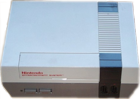
Nintendo Entertainment System
В 1983 году компания Nintendo выпустила в Японии свою первую 8-битную игровую приставку Family Computer (Famicom) и, как оказалось, самую успешную в то время — система в итоге заняла 90 % японского рынка. В 1985 году в США приставка вышла под названием Nintendo Entertainment System (NES). По прошествии нескольких лет после выхода NES в Америке, конкурентов у приставки в Новом Свете практически не осталось. NES была абсолютным лидером продаж.
За весь период существования 8-битной системы NES для неё было создано очень много первоклассных игр, включая Super Mario Bros.1,2, Kid Icarus, Metroid, The Legend of Zelda, Castlevania, Punch Out! и т. д. И многие из них получили своё продолжение на приставках последующих поколений. В 1990 году вышла игра Super Mario Bros. 3, и уже к концу года её продажи достигли семи миллионов копий.

Первая модель Game Boy
В 1989 году на свет появилось новое изобретение инженера Гумпэя Ёкои — портативная игровая система Game Boy. Система Game Boy состояла из центрального 8-битного процессора и экрана на жидких кристаллах без подсветки, способного выводить лишь четыре оттенка серого цвета. Несмотря на технические ограничения системы, очевидные даже для того времени, многие независимые разработчики стали создавать свои игры для Game Boy. В период существования на рынке системы Game Boy такие компании, как NEC, Atari и Sega, выпускали более мощные портативные игровые системы с лучшими графическими возможностями, однако никто из них не смог поколебать безоговорочного лидерства Game Boy. Game Boy оставался популярен и в эру 16-и битных приставок, но вскоре был вытеснен из этой конкуренции. Но с появлением игры Pokemon Red и Blue Game Boy вернул свою былую популярность.
Эра Super Nintendo Entertainment System

Super Nintendo Entertainment System
В 1990 году в Японии компания Nintendo предложила покупателю свою новую 16-битную приставку Super Famicom. Приставка поддерживала несколько режимов разрешения игрового экрана, была способна выводить наибольшее количество цветов и рисованных объектов на экраны телевизоров одновременно, а также обладала некоторыми математическими функциями для работы с трёхмерными объектами.
Получив огромные прибыли от продаж игры Super Mario Bros. 3 в Америке, в 1991 году Nintendo выпускает в США Super Famicom под названием Super Nintendo (SNES).
За весь период существования 16-битной приставки от компании Nintendo, для неё было выпущено большое количество качественных и удачных игр и прежде всего — игр от самого игрушечного гиганта: Super Mario World, F-Zero, The Legend of Zelda: A Link to the Past, Super Metroid и прочие шедевры дизайнерской мысли. А разработчик второго эшелона (second party), компания Rare, выпустила такие культовые игры для многих игроков всего мира, как Donkey Kong Country и Killer Instinct. Приставку охотно поддерживали и независимые разработчики, и прежде всего такие крупные компании, как Square, Enix, Capcom и Konami. Благодаря их труду для приставки Super Nintendo было создано множество игр: серии Final Fantasy и Dragon Quest, Castlevania, Ghouls’n Ghosts, Street Fighter 2, TMNT 4 и т. д.
Эра Virtual Boy
Ещё в 1994 году Nintendo выпустила Virtual Boy, 32-битную игровую систему, которая использовала для вывода трёхмерной графики несколько оттенков красного цвета.
В 1995 году Virtual Boy стала первой игровой системой, созданной в Nintendo, которая потерпела полный провал как у себя на родине в Японии, так и за океаном в США. Игроки, которые приобретали данный продукт от Nintendo, жаловались на неудобство игры. У них уставала шея от постоянного наклона головы к системе, с которой можно было играть, только предварительно поставив её на стол и надев специальные очки. Как оказалось, от такой игры болела ещё и голова.
И хотя несколько независимых разработчиков с самого начала согласились поддержать Virtual Boy, основная же их масса посчитала этот продукт рискованным и отказалась делать игры для него. Спустя недолгое время после выхода Virtual Boy склады Nintendo были просто завалены никому не нужной 32-битной системой. Продажи её были ничтожно малы. Ошибка с Virtual Boy привела к уходу из компании её разработчика (он же в своё время разработал систему Game Boy) Гумпэя Ёкои. По трагичному стечению обстоятельств Гумпэй Ёкои на следующий год после своего ухода погиб в автомобильной катастрофе.
Эра Nintendo 64

Nintendo 64
В 1996 году в Японии по цене $250 выходит приставка Nintendo 64. Для новой 64-битной игровой системы в компании Nintendo разработали инновационный контроллер. В него были заложены возможности управления игрой двумя способами: один представлял собой управление игрой с использованием обычной крестовины D-Pad, другой — с использованием аналогового джойстика. На контроллере размещались девять кнопок, а также был специальный порт на обратной стороне устройства для карт памяти и других дополнительных модулей.
Единственной проблемой в приставке Nintendo 64, послужившей поводом для размолвки компании Nintendo со многими важными независимыми разработчиками, были игровые модули (картриджи). Для издательств и разработчиков больше подходили обычные CD-ROM. Стоимость их производства была невелика, их можно было производить большими тиражами в отличие от дорогих и потому рискованных игровых модулей. Пока было не ясно, как новая приставка будет воспринята пользователями, а уже требовались весьма значительные затраты на предпродажное производство игровых модулей. Все конкурирующие приставки, а именно PlayStation от Sony и Saturn от Sega, использовали в качестве носителя информации CD-ROM.
В связи с этим многие крупные компании, включая таких давних партнеров Nintendo, как Square, Enix и Namco, отказались поддержать Nintendo 64 и объявили свои следующие проекты для нового фаворита, для приставки PlayStation.
Будучи обделена вниманием к своей 64-битной системе со стороны крупных японских издательств, компания Nintendo во многом благодаря своим маркетинговым усилиям, сотрудникам и в частности знаменитому Сигэру Миямото смогла добиться успеха для Nintendo 64, уступившей по продажам лишь PlayStation.
За все время активного существования на рынке приставки Nintendo 64 компания Nintendo продолжала следовать своей традиционной идее «лучше меньше, да лучше». Итогом стали игры Super Mario 64, Wave Race 64, Pokemon Stadium, Mario Kart 64, Star Fox 64, Golden Eye 007, Diddy Kong Racing, The Legend of Zelda: Ocarina of Time, Banjo-Kazooie, Super Smash Brothers.
Игра Super Mario 64, вышедшая в 1996 году для Nintendo 64, стала самой продаваемой игрой для своей платформы и одной из самых продаваемых в истории игр вообще. SM64 получила множество наград (как и её дизайнер, Сигэру Миямото) и восторженных отзывов, и неоднократно попадала на призовые места списков «Лучших игр всех времен» в различных игровых изданиях и при интернет-голосованиях.
Вышедшая в 1998 году игра The Legend of Zelda: Ocarina of Time, над которой на протяжении многих лет работал Сигэру Миямото, была названа многими авторитетными игровыми изданиями самой лучшей игрой за всю историю индустрии. Популярный японский еженедельник Famitsu дал игре высший балл — 40 из 40. На данный момент Ocarina of Time имеет высшую сводную оценку по рецензиям всех крупных игровых изданий среди всех игр в истории. Только в одних Соединённых Штатах два с половинной миллиона копий The Legend of Zelda: Ocarina of Time были проданы в период с 23 ноября (дата выхода игры) и до конца года.
В 1998 году система Game Boy вновь приобрела популярность. Nintendo выпустила камеру (Game Boy Camera) — небольшое устройство, которое позволяло снимать при низком разрешении черно-белое цифровое фото. Устройство вставлялось в слот, предназначенный для игровых модулей. А специальный принтер (Game Boy Printer) позволял печатать снимки на предназначенные для этого наклейки. Однако также появилась новая версия системы — Game Boy Color. Game Boy Color была снабжена более мощным процессором и экраном, способным выводить одновременно 56 цветов из палитры в 32 тысячи цветов, и была совместима со всеми играми, созданными для черно-белой системы Game Boy. К выходу Game Boy Color появляются цветные версии Tetris и The Legend of Zelda.
Эра покемонов
Сначала в Японии, а потом и в США компания Nintendo выпустила для Game Boy игры Pokemon Red и Pokemon Blue. С тех пор как был придуман Марио, игровая марка Pokemon стала вторым величайшим успехом компании Nintendo, наряду с играми серий Super Mario Bros. и The Legend of Zelda. В 1999 году популярность покемонов набирала обороты во всем мире. В этом году вышли сразу три новых игры под маркой Pokemon: Pokemon Snap, Pokemon Pinball и Pokemon Yellow.
Pokemon Snap стала первой игрой с покемонами для Nintendo 64. В ней игрок выступал в качестве фотографа, который должен был искать покемонов и снимать их на фотопленку. Pokemon Pinball — пинбол-игра для Game Boy Color. Следом вышла игра Pokemon Yellow — ремейк игр Pokemon Red и Blue, но на этот раз главным героем был самый популярный покемон Пикачу.
Начавшаяся покемономания подвигла Nintendo вернуться к выпуску игральных карт и игрушек. Новое направление бизнеса принесло компании огромную прибыль. Подкрепленные популярным мультфильмом, стали появляться различные продукты под лицензированной Nintendo маркой Pokemon: футболки, комиксы, мягкие игрушки, сумки, видеокассеты.
Карточная игра Pokemon стала не менее популярным развлечением, чем видеоигры. Концепция игры была схожа с другими «боевыми» карточными играми. Игроку необходимо было собирать и обмениваться картами для того, чтобы в итоге обладать самой полной колодой карт с покемонами.
Эра GameCube

GameCube
В 1999 году 12 мая, за день до открытия выставки Electronic Entertainment Expo (E3), компания Nintendo на пресс-конференции официально заявила, что ведутся работы над приставкой нового поколения под названием Dolphin (позже она была переименована в GameCube). Были объявлены партнеры компании по проекту, включая такие крупные корпорации, как Matsushita (Panasonic) и IBM. Была дана краткая спецификация системы, и Nintendo объявила, что Dolphin будет использовать в качестве носителя информации Mini-DVD, которые разработала Matsushita.
В 2000 году на выставке Space World были представлены портативная 32-битная игровая система Game Boy Advance и домашняя приставка нового поколения GameCube. Там же были обнародованы полные технические характеристики Game Boy Advance, представлены периферия и первые игры. Консоль вышла 21 марта 2001 года в Японии и 11 июня 2001 года в США. Game Boy Advance полностью совместима со всеми предыдущими версиями Game Boy и может взаимодействовать с GameCube..
Эра Nintendo DS

Nintendo DS Lite
Nintendo DS, также известна как NDS или DS, также iQue DS в Китае — портативная игровая система, выпущенная в 2004 году. Узнается по своему горизонтальному дизайну раскладушки, который является возвращением к Game & Watch, и наличию двух TFT LCD экранов, нижний из которых является сенсорным. У системы также есть встроенный микрофон и поддержка беспроводного стандарта IEEE 802.11b/g WiFi, который позволяет соединять консоли между собой на расстоянии в 10-30 метров, или с помощью службы Nintendo Wi-Fi Connection.
Буквы «DS» в названии расшифровываются как Dual Screen и как Developers’ System. Во время разработки система была известна как Project Nitro.
Эра Wii
Основная статья: Wii
В июне 2004 года, на внутрикорпоративном брифинге, Сатору Ивата объявил о том, что компания работает над абсолютно новой системой под кодовым названием «Revolution». В разработке системы самое активное участие принимали Сигеру Миямото и команда инженеров под руководством Гэнъё Такэды. Впервые на публике, на выставке E3 в 2005 году, был показан лишь контроллер новой консоли. В мае 2006 года, на E3, была показана вся консоль целиком, и было объявлено официальное название консоли — Wii. Изначально консоль вышла на американском рынке 19 ноября 2006 года по цене в 249 долларов. В 2007 году консоль стала лучшей по продажам на территории Японии и США. На июль 2012 года по всему миру консоль Wii была продана в количестве 96,56 миллионов консолей, став таким образом самой успешной консолью Nintendo[2].
Эра 3DS
Впервые консоль была анонсирована 23 марта 2010 года, и уже была показана на выставке E3 15 июня 2010 года. Главное отличие Nintendo 3DS от своей предшественницы Nintendo DS заключается в возможности отображения стереоскопических, трехмерных эффектов без использования сторонних средств. В продажу новая консоль вышла сначала в Японии (26 февраля 2011 года), затем в Европе (25 марта 2011 года), а затем в Северной Америке (27 марта 2011 года). Не слишком удачные продажи консоли из-за высокой цены и небольшого количества игр вынудили руководство компании снизить цену на устройство, что подстегнуло дальнейшие продажи, и снизило стоимость акций Nintendo. Это привело к убыткам компании, случившиеся впервые за последние 30 лет. К концу 2011 года, с выходом таких игр, как «Super Mario Land 3D» и «Mario Kart 7», система стала пользоваться все большей популярностью и к середине 2012 года, общее количество проданных в мире 3DS превысило 19 миллионов устройств[3]. 28 июля 2012 года, в Японии и Европе и 19 августа 2012 года в США в продажу поступила улучшенная версия Nintendo 3DS — Nintendo 3DS XL.[4][5]
Эра Wii U
Основная статья: Wii U
Впервые была анонсирована 7 июня 2011 года на пресс-конференции Nintendo на E3 2011.Игровая приставка будет преемником Wii.Выход игровой консоли в США намечен на 18 ноября 2012 года.В Евросоюзе консоль выйдет 30 ноября 2012 года,а в Японии 8 декабря.[6][7][8]Особенностью Wii U является новый контроллер, который может продолжать игру даже тогда, когда телевизор выключен.Уже известно,что несколько компании подтвердили то,что их игры выйдут на консоль.Подтверждённые игры — LEGO City Stories,Mass Effect 3 (портирование с других платформ), Darksiders 2, New Super Mario Bros. U, новые игры серий Super Smash Bros. ,Pikmin 3, Assassin’s Creed III, Sonic & All-Stars Racing Transformed, Aliens: Colonial Marines, Ghost Recon Online, ZombiU и Rayman Legends.[9][10][11][12]
Деятельность
Выручка компании в финансовом году, закончившемся 31 марта 2007 года, составила 966,5 млрд иен ($8,19 млрд), чистая прибыль — 174,3 млрд иен ($1,48 млрд)[13].
Влияние на субкультуру
Под воздействием торговой марки Nintendo сложилась субкультура фанатов этой компании, увлекающихся выпускаемыми ею игровыми консолями и играми. Таких фанатов в Рунете называют марио-боями (англ. Mario Boy), а в англоязычной среде распространено название «Nintendo fanboy». Как правило, эти лица проводят свободное время в интернет-форумах, обсуждая видеоигры и темы, касающиеся продукции Nintendo. Прозвище родилось в форумных противостояниях между фанатами Nintendo и теми, кто не признаёт продукцию компании, считая её детской и недостаточно серьёзной. Изначально придуманный как оскорбление, термин Mario Boy быстро прижился и через некоторое время был принят самими марио-боями.
См. также
Nintendo World Store
Примечания
- ↑ Рекламный буклет игрового автомата
- ↑ Nintendо планирует продать 5 миллионов Wii U до апреля 2013 года//
- ↑ Финансовые результаты Nintendo за первый квартал года. Продажи Wii и DS падают, 3DS — растут//
- ↑ Nintendo 3DS XL появится в магазинах 28 июля //ferra.ru
- ↑ Order Nintendo 3DS XL//game.co.uk
- ↑ Nintendo Will Sell Wii U at a Loss//ign.com
- ↑ Nintendo будет продавать Wii U дешевле себестоимости на момент запуска//3Dnews
- ↑ Wii U//Official Site Nintendo
- ↑ pikmin 3 Wii U//IGN
- ↑ The Return of an Army//NintendoLife
- ↑ Wii U’s Darksiders 2 features off-screen play, included DLC//Joystiq
- ↑ ‘Darksiders 2’ supports GamePad-only play, will sell DLC through eShop//Polygon
- ↑ Nintendo догнала Sony. //pressmon.com
Ссылки
- Официальный вебсайт Nintendo в России (рус.)
- Другие официальные сайты
- Официальный магазин Nintendo
 Игровые консоли Nintendo Игровые консоли Nintendo |
|
|---|---|
| Приставки | NES/Famicom (Disk System) • SNES/Super Famicom • Nintendo 64 (Nintendo 64 DD) • GameCube • Wii • Wii U |
| Портативные | Game & Watch • Game Boy (Pocket · Light) • Game Boy Color • Virtual Boy • Game Boy Advance (SP · Micro) • Nintendo DS (Lite · DSi · XL) • Nintendo 3DS |
|
Серии игр Nintendo |
|---|
|
Advance Wars/Wars • Animal Crossing • Art Style • Brain Age • Chibi-Robo! • Custom Robo • Donkey Kong • Excitebike • EarthBound/Mother • Fire Emblem • F-Zero • Game & Watch • Golden Sun • Ice Climber • Kirby • Kid Icarus • The Legendary Starfy • The Legend of Zelda • Mario • Metroid • Nintendogs (+ Cats) • Pikmin • Pilotwings • Pokémon • Punch-Out!! • Puzzle League • Sin and Punishment • Star Fox • Steel Diver • Super Smash Bros. • Wario • Wii • Yoshi |
| База расчёта индекса Topix 100 Токийской фондовой биржи |
|
|---|---|
| Основные 30 | 7&i · Astellas · Canon · Honda · JFE · JR East · JT · KDDI · KEPCO · Komatsu · Mitsubishi Corporation · Mitsubishi Estate · Mitsui & Co. · Mizuho · MUFG · Nintendo · Nippon Steel · Nissan · Nomura · NTT · NTT DoCoMo · Panasonic · Shin-Etsu Chemical · Sony · Sumitomo Mitsui Financial Group · Takeda · TEPCO · Tokio Marine · Toshiba · Toyota |
| Дополнительные 70 | Æon · AGC · Asahi Kasei · Bank of Yokohama · Bridgestone · Chubu Electric Power · Daiichi Sankyo · Daikin · Daiwa House · Daiwa Securities · Denso · DNP · Eisai · FANUC · Fujifilm · Fujitsu · Hitachi · Hoya · INPEX · Itochu · JR Central · JR West · Kao · Keyence · Kirin · Kobelco · Kubota · Kyocera · Kyushu Electric Power · Marubeni · Mitsubishi Chemical · Mitsubishi Electric · Mitsubishi Heavy Industries · Mitsui Fudosan · MOL · MSIG · Murata · NEC · Nidec · Nikon · Nippon Oil · Nitto Denko · ORIX · Resona · Ricoh · Rohm · Secom · Sekisui House · Sharp · Shiseido · SMC · SoftBank · Sompo Japan · Sumitomo Chemical · Sumitomo Corporation · Sumitomo Electric · Sumitomo Metal Mining · Sumitomo Metals · Sumitomo Realty · Sumitomo Trust · Suzuki · T&D Holdings · TDK · Tohoku Electric Power · Tokyo Electron · Tokyo Gas · Toppan · Toray · Yahoo! Japan · Yamada Denki |
1 августа 2022
1.08.22
3
1498
Видеоматериал:
Если вы еще не читали, мой предыдущий выпуск про «Феномен Atari» – то обязательно рекомендую ознакомится, чтобы глубже понимать историю развития игровой отрасли. В нем я, так или иначе, рассказал весь путь эволюции компании, в качестве производителя аппаратного обеспечения. В этом же выпуске, который коснется японской Nintendo – я расскажу вам об истории её происхождения, проделанного пути до реструктуризации в игровой бизнес, и окончательного закрепления успеха путём выпуска легендарной «Nintendo Entertainment System» и не менее значимой для всей индустрии портативки Nintendo «GameBoy» – потому как именно благодаря выпуску этих приставок -японская корпорация возвысила свою репутацию на рынке видеоигр и дала понять всему миру, что видеоигры – это настоящее искусство
ГЛАВА 1. ДОРОГА В ИГРОВУЮ ИНДУСТРИЮ.
Nintendo была основана 23 сентября 1889 года в городе Киото, 30-летним предпринимателем Фусадзиро Ямаути. В то время это был небольшой бизнес по производству японских игральных карт «Ханафуда», которые были выполнены в особом японском стиле, вдобавок еще и нарисованы вручную. Они быстро завоевали популярность, и компания прочно закрепилась на японском рынке. На протяжении последующих десятилетий, производство игральных карт было основным источником дохода для Nintendo, и причин для того, чтобы перенаправить бизнес в другое русло попросту не возникало.
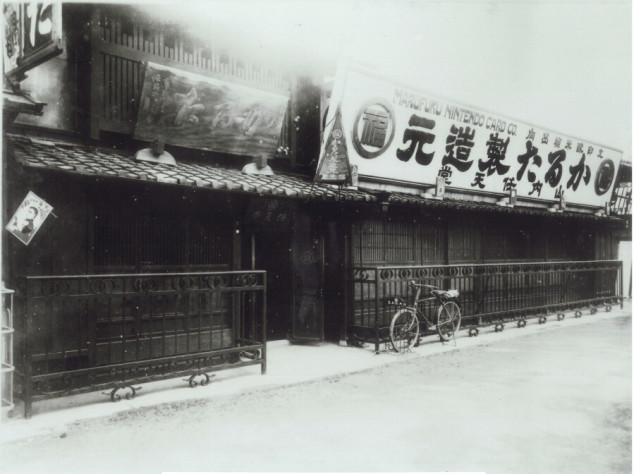
Здание Nintendo 1889 года. Япония г.Киото
В 1949 году должность президента компании занял 22-летний потомок основателя Nintendo – Хироси Ямаути. Пост руководителя он занял в довольно юном возрасте, приняв бразды правления от своего дедушки Секирё Ямаути, который был вынужден передать руководство компанией, ввиду серьёзной болезни. Когда Хироси возглавил Nintendo, в штате насчитывалось около 100 сотрудников. Коллектив воспринял крайне холодно назначение на пост президента 22-летнего юнца, посчитав его «папеньким сынком». Многие всерьёз беспокоились о том, что компания под руководством Ямаути долго не продержится. Однако Хироси не воспринимал всерьёз презренное отношение подчинённых и медленно, но верно стал предпринимать попытки с целью увеличения дохода компании.
Одним из важнейших его решений было начатое в 1953 году производство совершенно нового продукта — игральных карт, сделанных на 100 % из пластика. Эти и многие другие организационные инновации, осуществлённые Хироси Ямаути, привели к тому, что к 1959 году оборот компании составил 600 миллионов иен, когда до этого оборот достигал отметку лишь в 150 миллионов. Это позволило Ямаути заключить контракт с компанией «Walt Disney» и приобрести права на использование «диснеевских» персонажей в своей продукции. Этот шаг принёс компании ещё бОльшую прибыль. И так оно и продолжалось вплоть до середины 60-х гг. ХХ века. Послевоенный период охарактеризовался для Nintendo падением продаж ориентированных на взрослых карт «ханафуда». Связано это было с тяготением японского общества к другим увлечениям, таким как боулинг, аркадные залы, ночные дискотеки и т.п.. Необходимо было придумывать что то новое, дабы сохранить бизнес на плаву.
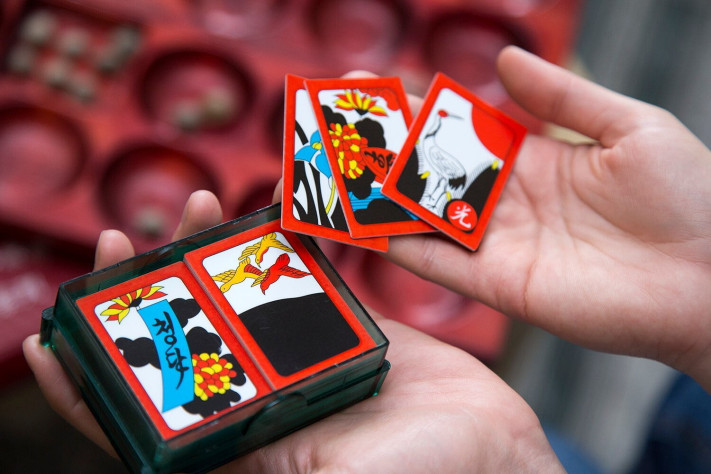
«Ханафуда» — игральные карты японского происхождения.
В период с 1963-1968 гг. Хироси Ямаути инвестировал финансы в самые различные направления, от производства упаковок для риса быстрого приготовления до службы такси – но все эти попытки по самым разным причинам не имели успеха. Большое количество неудач побудило Ямаути увеличить инвестиции в отдел исследований и разработок. В 1969 году к отделу присоединился 28-летний инженер Гумпей Ёкой – который отвечал за координацию различных проектов и начал разработку игрушек для детей, по личной просьбе Ямаути. Благодаря разработкам талантливого инженера-Nintendo удалось закрепить прочные позиции на рынке детских игрушек, благодаря таким товарам как например «The Ultra Hand». Гумпей Ёкой был человеком очень сообразительным и умел привносить в этот мир новые тренды и всяческие инновации — именно благодаря его разработкам Nintendo стали зарабатывать большие деньги, и даже построили собственную игрушечную фабрику – т.к. спрос на продукцию от Nintendo значительно превышал предложение. Таким образом в начале 1970-х Хироси Ямаути принял решение сфокусировать бизнес на производство товаров для детей.
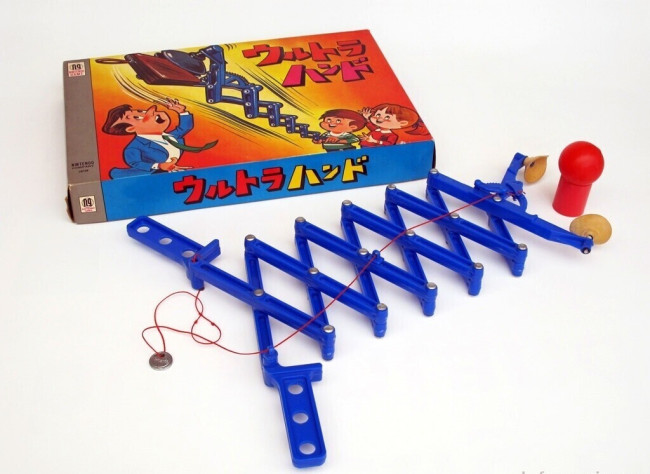
«The Ultra Hand» — механическая игрушка компании Nintendo.
Nintendo уже не была компанией, на грани банкротства, даже наоборот – они завоевали хорошую репутацию на рынке Японии, благодаря выбранному вектору производства игрушек. Вообще начало 70-х стало переломным моментом в истории компании. Дело в том, что в 1970 году -Nintendo выпустила первую в Японии электронную игрушку — «Nintendo Beam Gun», оптоэлектронный пистолет, продажи которого переваливали за миллион проданных единиц. Обратив внимание на волну популярности инновационной игрушки – американская компания Magnavox, в 1971 году заключила партнерское соглашение с Nintendo чтобы предоставить контроллер светового пистолета основанный на дизайне «Beam Gun», для своей домашней игровой консоли Magnavox Odyssey. Дела внутри компании, мягко говоря, «пошли в гору». Благодаря выпуску сверхпопулярных игрушек, которые расходились по рынку сотнями тысяч проданных единиц – Nintendo смогли расширить штат сотрудников и переехать в новую штаб-квартиру. Успех необходимо было закреплять новыми идеями и проектами. Растущий спрос на продукцию Nintendo побудил Ямаути к дальнейшему расширению офисов, для чего он приобрел прилегающую землю и поручил производство карт первоначальному зданию Nintendo. Тем временем основные сотрудники отдела исследований и разработок, такие как Ёкой, Такэда и другие, продолжали разрабатывать инновационные продукты для компании.
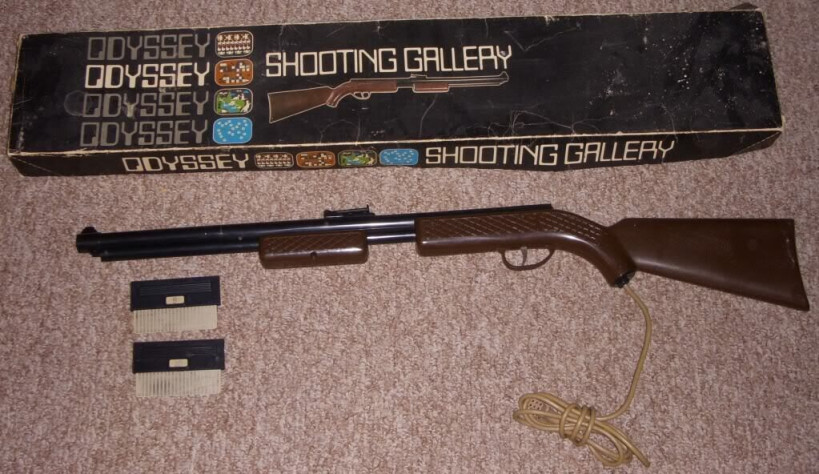
Контроллер светового пистолета игровой приставки «Magnavox Odyssey».
Следующим переломным моментом для Nintendo стал нефтяной кризис 1973 года, который вызвал как всплеск стоимости пластика, так и изменение потребительских приоритетов, которые поставили товары первой необходимости выше развлечений, и Nintendo снова начала терять прибыль. Так уж получилось, что как раз в те года, на западном рынке, а точнее в США набирали бешенную популярность аркадные автоматы компании «Atari», которые приносили огромный доход. Хироси Ямаути, вдохновленный успехом «Pong» от Atari увидел в этом отличную возможность занять никем не занятую нишу на японском рынке. В 1974 году Nintendo выпустила «Wild Gunman» — аркадный симулятор стрельбы по «тарелочкам», состоящий из 16-мм проектора изображения с датчиком, обнаруживающим луч от светового пистолета игрока. Игра оказалась успешной и была впоследствии экспортирована в Европу и Северную Америку. Затем, на волне успеха выпуска домашней версии «Pong» в США в 1975 году, Nintendo окончательно решает начать разработку и производство собственной, японской «ПОНГ-консоли». Но до её выпуска нужно было чем-то зарабатывать на хлеб и Nintendo заключает партнерское соглашение с Magnavox, распространяя их «Oddysey» на рынке Японии. В период с 1974-1978гг., Nintendo также выпускали несколько видов аркадных автоматов. В 1977 году к компании присоединился молодой художник Сигэру Миямото – который изначально помогал в проектировании корпуса для первой домашней игровой приставки от Nintendo. Но о том, что же такого революционного для всего мира сделал никому не известный, скромный юноша Миямото – мы поговорим чуть позже.
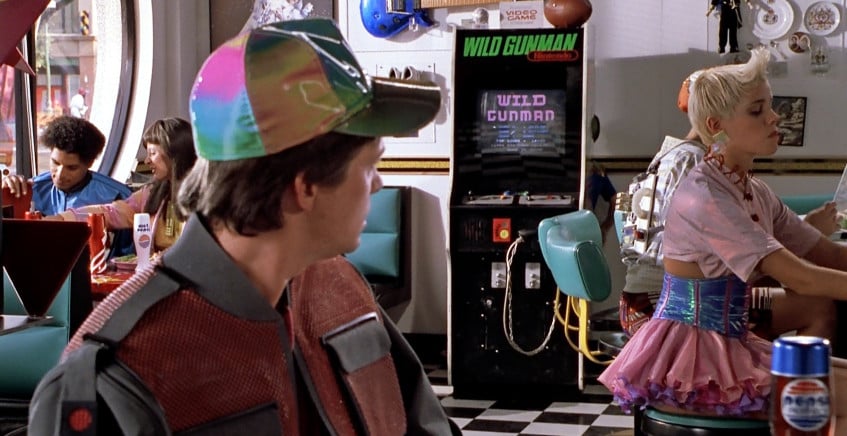
Аркадный автомат с игрой «Wild Gunman» (вставка из х/ф «Назад в будущее 2»)
В том же 1977 году, на территории Японии выходит первая домашняя приставка от Nintendo – «Color TV-Game», которая по сути являлась клоном «Pong» от Atari, только с цветным дисплеем (оно и понятно, из-за названия приставки). Да, в то время подобные «ПОНГ-консоли» делали практически все, кому не лень, но успеха достигли лишь единицы. Так вот, «Color TV-Game» само собой достиг высоких продаж на Японском рынке, по официальным данным разойдясь в количестве чуть более 3 млн экземпляров, и таким образом решение Ямаути сосредоточить силы в сторону электронных игровых развлечений — всё больше подкреплялось.
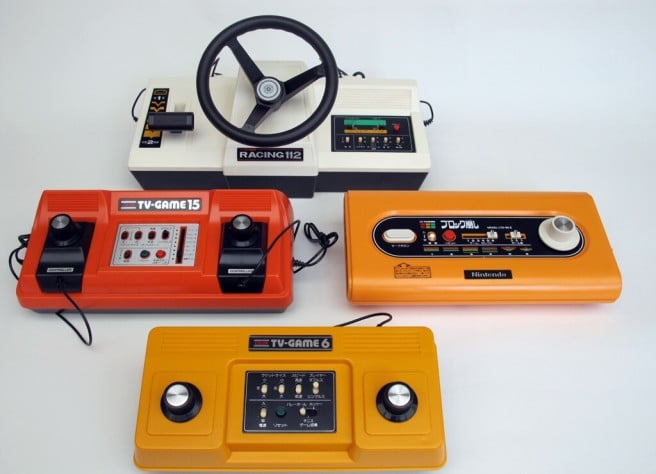
Nintendo Color TV Game — первая домашняя игровая приставка от Nintendo.
Растущий спрос на продукцию компании побудил к тому, что в 1978 году отдел исследований и разработок Nintendo был разделен на два объекта, Nintendo Research & Development 1 и Nintendo Research & Development 2. Первый отвечал за разработку самих игр, а второй за разработку программного и аппаратного обеспечения. Понимая, что компания движется в правильном направлении, Ямаути мечтал о расширении рынка сбыта и таким образом, годом позже (в 1979) Нинтендо открывает офис в США и создает отдел по разработке аркадных игровых автоматов.
Глава 2. Случайный пассажир в поезде.
Следующий успех Nintendo был на счету Гумпея Ёкоя — главы Nintendo Research & Development 1. Согласно известной истории – Ёкой ехал на скоростном поезде, в котором он обратил внимание на пассажира, убивающего время поездки хаотично и бессмысленно нажимая на кнопки своего калькулятора. И ему практически молниеносно пришла в голову идея создания портативного устройства – которое помогло бы не просто «убить время» этому пассажиру, но и красочно разбавить время поездки до пункта назначения играя в игру. Прибыв в офис, он немедленно распространил эту идею своим инженерам и соответственно Ямаути. Не сказать, чтобы глава Nintendo с искренним восторгом отреагировал на концепт Ёкоя, однако после деловых переговоров совета директоров Nintendo, Хироси Ямаути дал добро на разработку портативного устройства. Гумпей Ёкой придумал элементы управления, которые были максимально понятны как для взрослого игрока, так и для детей. После создания дизайна приставки, Ёкой также придумал и название к ней – «Game&Watch», которое и отображало изначальную задумку инженера – т.е. аналог карманных часов с игрой в комплекте. Вместе с командой они разработали первую игру для «Game&Watch» с банальным геймплеем, и не менее банальным названием – «Ball», ставшего впоследствии одним из первых крупных хитов Nintendo.
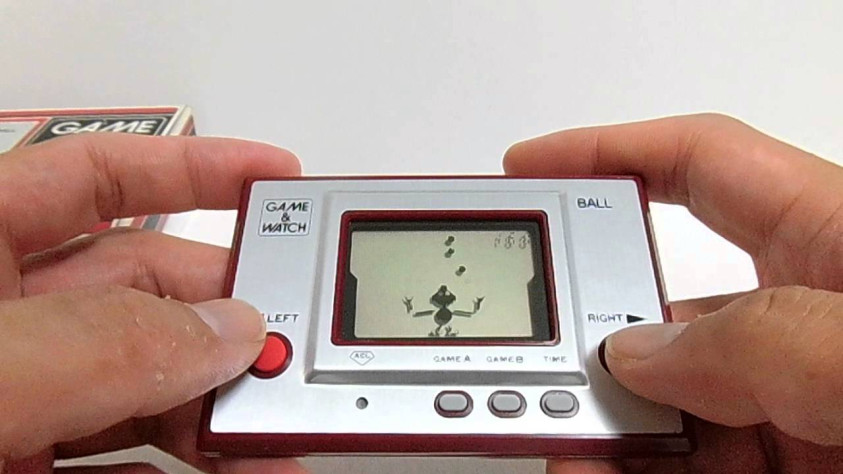
Ball — первая игра на Game&Watch
Таким образом в 1980 году выходит портативная приставка «Game&Watch». И вот здесь Nintendo уже ожидал настоящий коммерческий успех – более 40 млн проданных единиц за всё время существования портативки, компания наконец встретила всемирное признание. Исходя из того, что приставка ввиду технических ограничений того времени не имела возможности запускать различные игры, т.к. не было слота для вставки картриджей– было выпущено 59 вариаций игр. Также были выпущены различные модификации корпуса приставки. Некоторые из дизайнов модификации послужат в будущем вдохновением для Ёкоя, при разработке «Game Boy». А один из этих вариантов дизайна приставки 1982 года (фото ниже), станет основой концепта и главной идеей создания сверхпопулярной портативки — Nintendo DS. На этом же варианте приставки впервые была использована легендарная крестовина «d-pad». Крестовину, также придумал Гумпей Ёкой, в качестве удобства управления игрока в портативной версии Donkey Kong для «Game&Watch». Данный элемент управления используется в продуктах Nintendo и по сей день.
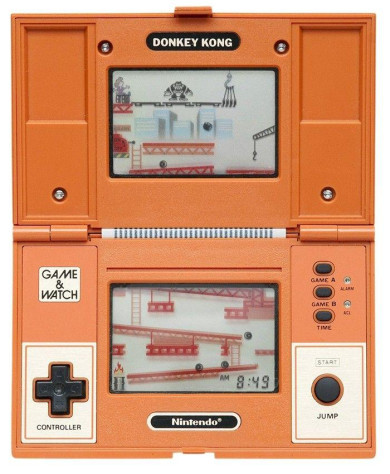
Game&Watch с портативной версией «Donkey Kong». На этом устройстве впервые в истории для управления игрока была использована крестовина
Коммерческий успех Game&Watch окончательно реструктуризировал направление компании на разработку и выпуск игр, а также аппаратного обеспечения.
Хироси Ямаути, после успешного запуска и всеобщего признания Game&Watch понимал, что Nintendo движется в правильном направлении. Сам по себе он был человеком преимущественно высокомерным и считал, что именно он задаёт этому миру правила, основываясь на нескольких своих удачных решениях в плане развития бизнеса. Огромный доход, который компания получала за счет разработанных электронных развлечений и игр к ним – подталкивала его на «расширение границ». Nintendo собирались стать настоящими монополистами рынка, а не просто занимать хорошие позиции на нём.
Глава 3. Первый шедевр Миямото и его последствия…
В конце 1970-х гг. в Японии, также как и в США бешенную популярность стали охватывать игровые залы с аркадными автоматами (они кстати до сих пор там очень востребованы). Геймеров «страны восходящего солнца» поразила, вышедшая в 1978 году «Space Invaders» — которая вызвала такой высокий спрос, что в стране наблюдался дефицит монеток по 100 иен – именно такую монетку требовал аркадный автомат с нашумевшей по всей стране игрой. Nintendo тоже хотели заполучить себе кусочек пирога, и соответственно взяться за создание игровых автоматов. Таким образом В 1980 году Nintendo выпустила на территории Японии аркадный автомат с игрой «Radar Scope». Не сказать, чтобы эта игра имела головокружительный успех – но провалом её назвать также нельзя. По сути она просто не несла ничего революционного и геймплейно напоминала сверхуспешную «Space Invaders». Филиал Nintendo в США – заказали 2 000 аркадных машин с «Radar Scope». В то время на американском рынке игровых автоматов господствовала Atari, и Nintendo жаждали потеснить их с лидирующих позиций. Однако в США игра провалилась и понесла за собой колоссальные финансовые потери, ввиду не окупившихся затрат на производство аркадных машин и оплаты аренды в аркадных залах. Немедленно поступил запрос о создании новой игры, но в компании не нашлось ни одного свободного разработчика для реализации срочной просьбы американских коллег. Ямаути, решил поручить создание нового проекта самому молодому из всего штата сотруднику – Сигэру Миямото, предоставив полную свободу творчества. Миямото никогда и не думал, что будет когда-то в своей жизни разрабатывать игры, он устроился на должность художника и никогда особо ни в чем не проявлял инициативы. Изначально такое поручение ошеломило его, но потом он погряз в работе целиком и полностью… Он днями напролет посещал различные залы с игровыми автоматами и наблюдал за игроками. Он хотел понять, в чём же кроется успех игр и в каком жанре создать игру. После долгого и тщательного обдумывания концепта он проникся идеей создать игру, которая походила бы на мультфильм. Создать персонажа, историю и мотивацию проходить один уровень за другим. Миямото сделал наброски посетивших его голову идей, в которых он показал главного героя, главного врага и поэтапно нарисовал на бумаге игровой процесс, в котором, на каждом уровне Горилла похищает принцессу, а человечек, избегая препятствий должен спасти принцессу из лап злостного похитителя.
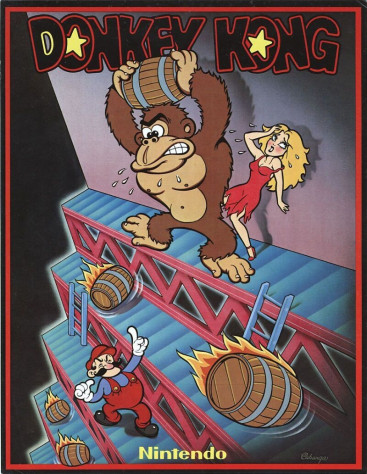
Обложка первого хита Сигэру Миямото
Проекту дали зеленый свет, началась разработка и впоследствии выпуск игры, получившей название «Donkey Kong». В качестве последнего штриха – Миямото сам написал музыку к игре. Разработка завершилась и автомат с игрой отправили в США. Американцы поиграв в игру — решили, что их японские коллеги сошли с ума. Опасаясь худшего, они не стали запускать массовое производство и решили опробовать автомат в одном из местных баров, как когда-то испытывали свой «Pong» – Нолан Бушнелл и Эл Элкорн. На следующий день они пришли в бар, открыли ящик для монет – и он оказался переполненным от «четвертаков». Это значило что в «Donkey Kong» играли без перерыва до тех пор, пока не закрылся бар. У сотрудников американского подразделения Nintendo не было слов, чтобы описать такой успех – стартовало массовое производство. Только за первый год выпуска аркадного автомата с «Donkey Kong» –Nintendo заработали более 100 млн долларов, сделав игру международным успехом и впоследствии породив целую серию игр с этим персонажем, а также заработать огромные деньги на продаже лицензии по выпуску «Donkey Kong» на различные игровые приставки того времени. Но что же было с главным героем, за которого игрокам приходилось проходить уровень за уровнем? Дело в том, что «Donkey Kong» стал одной из первых видеоигр-платформеров, которая позволяла персонажу игрока прыгать. Именно поэтому того самого человечка с усами и шляпой назвали банально – «Jumpman».
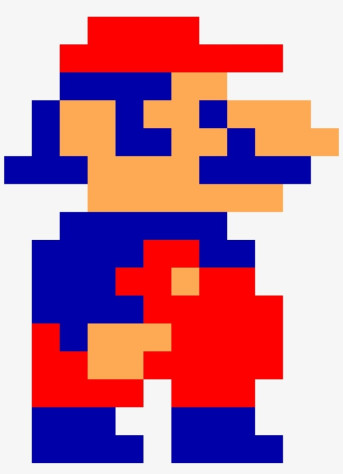
Jumpman (еще не Super Mario) — гг. Donkey Kong, управление которым игрок берет в свои руки
Но давайте разберемся с историей создания этого персонажа. После многочасовых посещений игровых залов– Сигэру Миямото вдруг стал всё чаще обращать внимание на то, что в видеоиграх, преимущественно игрок управляет каким-нибудь космическим кораблем, битой для отбивания мячика, просто бегающим болванчиком (pitfall) и тому подобное. Ему вдруг пришла в голову мысль – создать персонажа. Он подумал, что игроки будут намного глубже погружаться в игровой процесс, если смогут проникнуться личностью главного героя. Идея была очень хорошей, но не стоит забывать, что на дворе стоял 1980 год – и технологии того времени еще не могли позволить изобразить персонажа таким образом, чтобы было понятно, как он выглядит – и человек ли это вообще. Поэтому, исходя из технических ограничений, Миямото старался всяческим образом максимально подчеркнуть образ главного героя. Он добавил шляпу – чтобы было понятно, где у персонажа лицо, затем добавил усы – чтобы было понятно, где заканчивается лицо и начинается туловище – ну и так далее. Но игра всё же называлась «Donkey Kong» – и следовательно главным героем был вовсе не усатый человечек, даже несмотря на то, что именно он отдан игроку под управление. Поэтому, с именем этого персонажа – Миямото решил не заморачиваться. После успеха «Donkey Kong» – маэстро окончательно осознал, что игрокам очень понравилась визуальная и геймплейная составляющая его творения. Они восторженно оценили завязку игры, подобную мультфильму, а также интересным и ярким героям. Само собой, успех «Donkey Kong» позволил заработать высокую репутацию Миямото в Nintendo, НО высокий статус еще необходимо было доказать. После получения «зеленого света» от Хироси Ямаути на разработку продолжения «Donkey Kong», Миямото приступил к созданию полноценного платформера, который на сей раз должен был повествовать исключительно о приключениях «Джампмена». Donkey Kong был финансовым успехом для Nintendo как в Японии, так и за рубежом, и привел Coleco к борьбе с Atari за лицензионные права на перенос игры на домашние консоли и персональные компьютеры.
Головокружительный успех «Donkey Kong» побудил страстное желание президента Nintendo разработать собственную полноценную домашнюю игровую приставку, с функцией смены картриджей, чтобы выпускать на ней свои хиты. Он поручил создание приставки главе Nintendo Research & Development 2 – Масаюке Уэмуре, поставив главную задачу – сделать консоль дешевой в производстве и превосходящей конкурентов по техническим параметрам. Уэмура решил разработать приставку опираясь на успех «Atari 2600» И «COLECOVISION». Больше всего он вдохновлялся опытом «COLECOVISION» – так как именно на этой приставке, их суперхит «Donkey Kong» – являлся «системселлером».
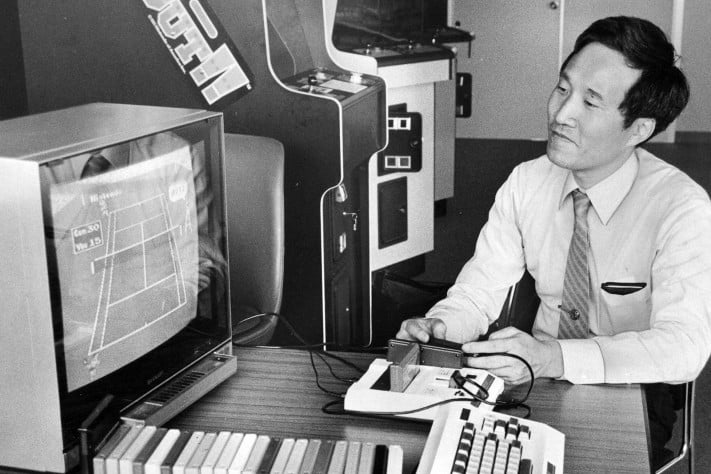
Масаюки Уэмура играет в своё детище
Масаюки Уэмура выполнил все задачи своего босса Хироси Ямаути и предоставил японским игрокам новую приставку третьего поколения под названием «Nintendo Family Computer», или в сокращении «Famicom».. Называлась она так из за того, что изначально она должна была быть этаким гибридом ПК и игровой приставки, т.е. в нее можно было подключить различную периферию, типа клавиатуры, модема и дисковода.
«Famicom» появилась на прилавках магазинов Японии 15 июля 1983 года и обладала следующими отличительными особенностями: эффективность в написании игр и низкая стоимость производства консоли заключалась в том, что получение информации и данных в приставку осуществлялось без проверки, запроса, и полной загрузки в оперативную память, что было у других приставок того времени. Из-за новой технологии и моментальной загрузки с картриджа можно было достичь хорошей графики, анимации и звука.
Запуск «Famicom» на японском рынке едва ли оказался успешным. Дело в том, что в первый год своего существования, приставка часто критиковалась как ненадёжная, подверженная сбоям и ошибкам программирования. После отзыва продукта и повторного выпуска с переработанной материнской платой, популярность приставки резко выросла — к концу 1984 года «Famicom» стала наиболее продаваемой игровой консолью в Японии — было продано более 2,5 миллионов единиц, оставив своего ближайшего конкурента, «Sega SG-1000» далеко позади. Спрос настолько превышал предложение, что Nintendo просто не успевали создавать игры в различных жанрах. Исходя из того, что компания изначально выбрала путь качества, а не количества – им не оставалось другого выбора, кроме как открыть лицензию на разработку и выпуск игр для «Famicom» сторонним разработчикам. Разработчикам было поставлено 3 условия. 1 – выпускать не более 5 игр в год. 2 -обязательное отчисление процентов с каждого проданного картриджа. 3 – каждая игра проходила проверку качества в Nintendo. Если игра подвергалась переработке в определенных аспектах – Nintendo возвращала игру обратно разработчику на выполнение поставленных условий качества до тех пор, пока игра не выполняла требований Nintendo. В итоге, когда игра проходила по всем параметрам – Nintendo разрешали выпуск, но производство картриджей было полностью под их контролем и обязательно с плашкой печати качества Nintendo. Это позволяло вызывать доверие игроков, которые видели картридж с игрой и понимали, что покупают игру несомненно высокого качества. На такие условия соглашался далеко не каждый издатель, но вопреки всему – растущая аудитория приставки была слишком огромной, чтобы отказываться от такой прибыли. Помимо всего этого Nintendo окончательно «перекрывала кислород» своим конкурентам подписав соглашение с каждым сторонним издателем, гарантирующие, что ни одна игра «Famicom» не будет адаптирована для других консолей в течение двух лет после её выпуска.
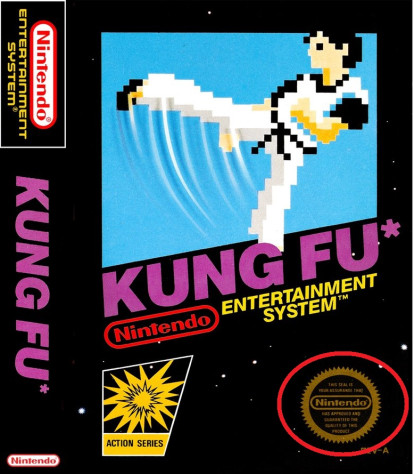
Типичная обложка игры на Famicom (красным обведен штамп «печати качества Nintendo)
Коммерческий успех новой приставки Nintendo в Японии означал для Ямаути только одно – теперь необходимо было любыми способами завоевать американских рынок игровых развлечений, потому что основной источник прибыли для компании он видел непосредственно в геймерах США. Но зайти в Северную Америку, в качестве производителя игровых приставок в то время – означало практически неизбежный финансовый крах. Но Ямаути всегда играл ва-банк и готов был рискнуть всем, ради мирового господства своей компании. Nintendo начали продумывать бизнес-план, изучать провал «Atari» и кризис игровой индустрии америки в целом. Права на ошибку попросту не было.
Понимая серьезность положения, Ямаути указал своему зятю, главе Nintendo of America Минору Аракаве решить вопрос с крупнейшими магазинами США, о возможности продажи приставки. Однако американские ритейлеры не хотели ничего даже слышать об игровых приставках, тем более как огня боялись выставлять что-то подобное на прилавки. И тогда Nintendo решили пойти другим путем.
Они вступили в переговоры с Atari для совместного продвижения консоли на североамериканский рынок под названием «Nintendo Advanced Video System», и задумка была именно в трансформации приставки в полноценный домашний ПК. Сделка сорвалась — Atari разорвала отношения с Nintendo в ответ на обнародованное заявление Coleco, в котором говорилось о нелицензированном порте игры «Donkey Kong» для их Coleco Adam. Хотя игра была выпущена без разрешения или поддержки Nintendo, Atari восприняла это как знак того, что Nintendo сотрудничает с одним из главных конкурентов Atari.
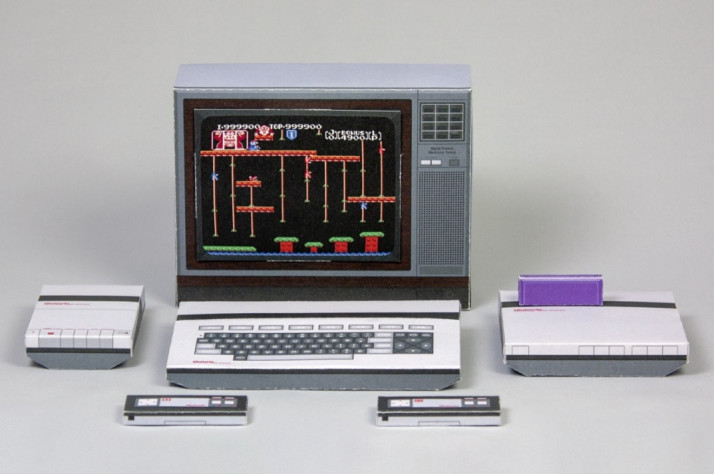
Концепт Nintendo Advanced Video System — гибридная приставка, которую Nintendo планировали выпускать в Северной Америке
Nintendo решила продавать свою систему самостоятельно. Впоследствии от идеи выпускать гибрид приставки с персональным компьютером отказался именно Ямаути, сфокусировав внимание исключительно на играх, потому как осознал, что крахом для Atari 2600 послужили не аппаратные особенности приставки, а плохие игры. Рынок США в то время был слишком опасен для экспериментов и поэтому от названия «Nintendo Advanced Video Gaming System» – тоже было решено отказаться, чтобы не допускать мыслей у игроков, что это очередная «АТАРИПОДОБНАЯ» приставка. И не прогадал.
На выставке Consumer Electronics Show (CES) в июне 1985 года Nintendo представила американскую версию своего «Famicom» с новым корпусом, и слотом для картриджа. Дизайн приставки походил на видеомагнитофон, популярность которого выросла к 1985 году. Чтобы отличить «Famicom» от конкурентов в Америке, Nintendo переименовала ее в развлекательную систему – Nintendo Entertainment System, в сокращении «Nes», дабы полностью исключить все ассоциации с крахом игровой индустрии США.
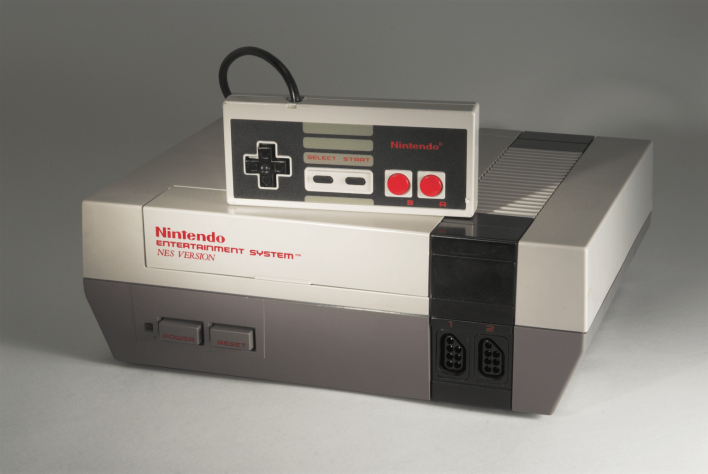
Итоговый вариант дизайна и названия игровой приставки от Nintendo — «Nintendo Entertainment System (NES)»
Также стоит взять во внимание, что физический носитель, на который была записана игра назывался не картридж, а «gamepack» – что опять же позволяло геймерам не связывать консоль от «Nintendo» с «Atari» и кризисом игровой отрасли. Короче говоря «Nintendo» всяческим образом продавала игровую приставку, которая должна была возродить игровую индустрию, и для этого нужно было избавиться от всяческого напоминания в голове игрока о крахе видеоигр. Чтобы предотвратить производство игр, не имеющих лицензии «Nintendo», и предотвратить копирование, японцы встраивали в картриджи чип, который действует на приставку как неразрывная связь каждого «gamepacka». Именно поэтому, впоследствии в России и был произведен клон «Nintendo»» компанией «Steepler» под всем известным брендом «Dendy». Так как Российский рынок тогда не представлял интереса для «Nintendo», а лицензионные картриджи было недостать — решение было только одно — разработать пиратскую приставку, поддерживающую чипы с пиратскими картриджами.
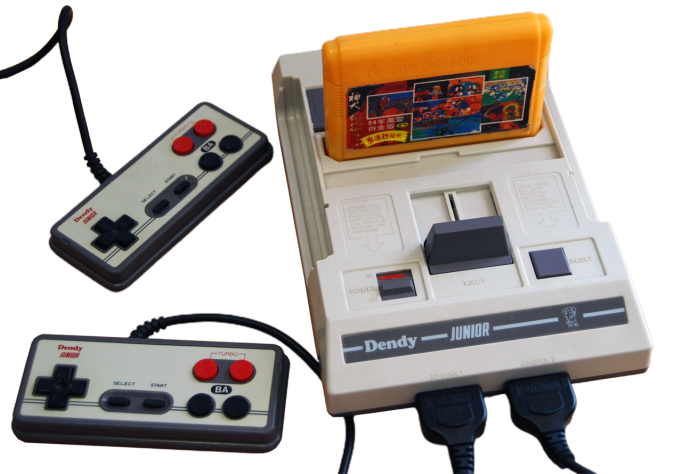
Dendy — отечественная (пиратская) игровая приставка, производимая компанией Steepler
Возвращаемся к теме запуска «Nintendo Entertainment System» в США. Nintendo удалось убедить ритейлеров на распространение «Nes» в крупных магазинах Америки. В аккурат старта продаж приставки в США,18 октября 1985 года – на прилавках магазинов также появляется новый хит от Nintendo – Super Mario Bros. Второй шедевр Сигэру Миямото, в котором он превратил «Джампмена» главного героя игры знакомого игрокам по «Donkey Kong» ,в итальянского водопроводчика — Марио, в честь Марио Сегале , главы офиса Nintendo в Туквиле, штат Вашингтон. Собственно сама игра и повествовала о приключениях Марио и его брата – Луиджи. На территории Японии это был «крышесносный» платформер, в который молниеносно влюбились и часами напролет проходили уровень за уровнем все дети, у которых дома стоял «Famicom».
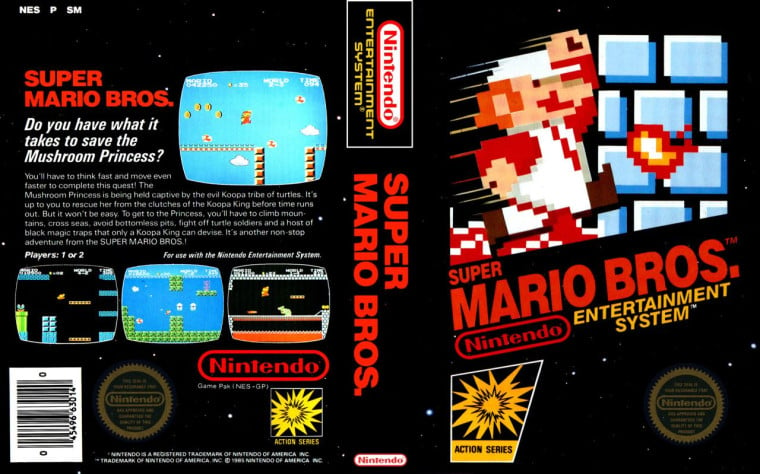
Обложка «геймпэка» с игрой «Super Mario Bros». Первое появление усатого водопроводчика
А вот старт продаж в США, также как и в Японии — успешным не назовешь. Несмотря даже на такие мегахиты как «Donkey Kong, Super Mario Bros.» – американские геймеры всё же относились к игровым приставкам со скепсисом. Минору Аракава готов был сдаться, но Ямаути не желал принимать поражение, как настоящий Японец, и предложил своему зятю взять фокус на один крупный город США. Этим городом был выбран Нью-Йорк, в нем проводилась масштабная рекламная компания, но ритейлеры всё же не хотели продавать игровые приставки, опасаясь оттолкнуть клиентов, которые не желали видеть ничего общего с видеоиграми в магазинах. Но долгим и упорным трудом путем ведения переговоров — Nintendo взяли на себя обязательство вернуть обратно все приставки на свои склады в случае поражения. И успех наконец пришел в предрождественский период, Nes поступила в продажу в комплекте с игрой «Super Mario Bros», и приставку и игры начали скупать пачками.
В отличие от «Famicom», «Nintendo of America» продавала консоль в первую очередь детям, введя строгую политику цензуры ненормативной лексики, сексуального, религиозного или политического контента. Самый известный пример — попытки «Lucasfilm» перенести комедийный хоррор «Maniac Mansion» на NES, который, по настоянию «Nintendo», должен быть значительно смягчен. «Nintendo of America» продолжала свою политику цензуры вплоть до 1994 года пока официально не появилась система присвоения рейтинга развлекательного контента.
Что касается самих игр – то ради чего и стоило покупать приставку, то на релизе в США игрокам предоставили следующие проекты: 10-Yard Fight, Baseball, Clu Clu Land, Duck Hunt, Excitebike, Golf, Gyromite, Hogan’s Alley, Ice Climber, Kung Fu, Pinball, Soccer, Stack-Up, Super Mario Bros., Tennis, Wild Gunman, and Wrecking Crew. Интересно, что которые обложки совершенно разных игр напоминают одного и того же персонажа (фото ниже). Дело в том, что тогда «Super Mario Bros.» еще только стартовал в качестве самостоятельной франшизы – и чтобы упростить понимание геймеров – дизайн персонажей в этих самых играх или же на обложках был максимально схож с «Джампменом» (гг Donkey Kong) – супермегахита от Nintendo, который знал каждый ребенок и подросток. А значит так было легче войти в доверие и повысить продажи как самих картриджей с играми, так и приставки. До «NES» упаковка многих видеоигр представляла собой напыщенные изображения, которые не отображали реальную графику игры. Кроме того, такая игра, как например «Pac-Man» появились на консолях с существенными различиями в графике, звуке и общем качестве. Маркетинговая стратегия Nintendo напротив, была направлена на восстановление доверия потребителей и розничных продавцов за счет предоставления единственной платформы, графика которой могла быть представлена правдиво. Что касается игр серии Super Mario Bros. посвященных приключениям водопроводчика Марио, то его значимость и узнаваемость в США была настолько велика, что бренд Super Mario и сам усатый водопроводчик стал для детей популярнее Микки Мауса, и с каждой новой вышедшей игрой этой франшизы – популярность лишь возрастала и возрастала.
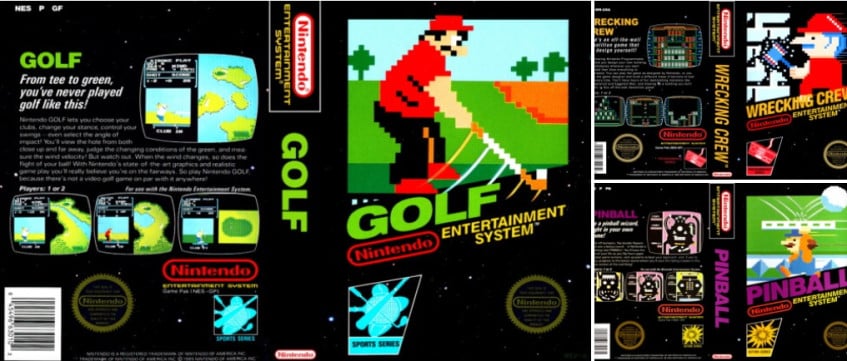
Обложки стартовых игр NES, в которых главный герой «подозрительно» напоминает очень известного персонажа.
Закреплением успеха приставки как на рынке США, так и на мировом уровне послужила игра – «The Legend of Zelda», еще одно детище Сигэру Миямото. Миямото придумал концепт игры, вспоминая своё детство. Он очень любил гулять в лесу и однажды наткнулся на пещеру, которую решил исследовать. Эти впечатление геймдизайнер решил передать всему миру отразив их в ролевой игре, где игроку предстояло самостоятельно изучить и исследовать локации, найти себе снаряжение, понимать куда идти и что делать в этом огромном, по меркам тех лет, открытом мире. Главная особенность игры заключалось в том, что Миямото намеренно не объяснял сюжет – он хотел, чтобы игроки самостоятельно находили себе снаряжение, изучали открытый мир, взаимодействовали с окружением и самое главное, обменивались друг с другом той или иной информацией касательно прохождения игры. Еще одной отличительной чертой «Зельды» заключалось в том, что это была по-настоящему большая игра на десятки часов геймплея и соответственно, чтобы не начинать каждый раз прохождение сначала – Nintendo выпустили картридж с дополнительным блоком памяти, который позволял сохранять процесс прохождения игры. Игроки в любое время могли перестать играть и на следующий день продолжить приключение с места сохранения. Задумка Сигэру Миямото сработала на ура и «The Legend of Zelda» стала колоссальным успехом. Миллионы проданных копий, восторженные отзывы игроков и критиков, первая часть приключений главного героя игры – Линка послужила началом к многолетней и одной из самых значимых и почитаемых в индустрии франшизе, опытом которой вдохновлялись и продолжают вдохновляться многие игровые студии. Серия занесена в Книгу рекордов Гиннесса как самая продолжительная серия игр жанра «action-adventure» за всю историю.
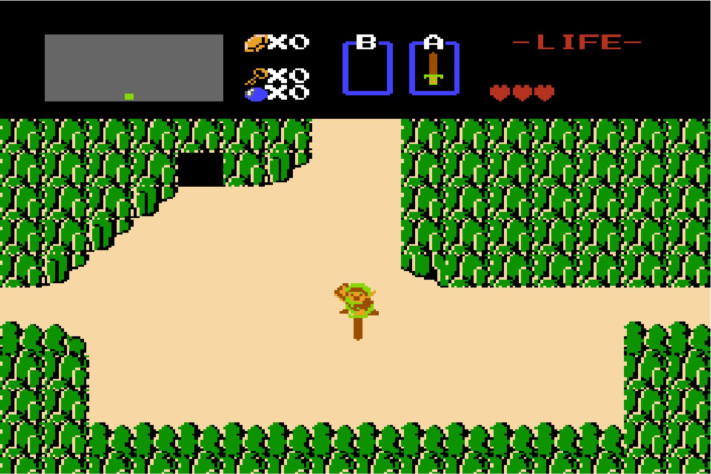
Кадр геймплея The Legend of Zelda (NES)
Глава 4. Влияние Nintendo на игровой бизнес
После того, как Nintendo возглавили игровую индустрию став эталоном качества, они активно старались монополизировать весь рынок под себя. Ямаути ставил жесткие условия для сторонних разработчиков, не давая им выпускать более 5 игр в год и то при условии, что игра издаваемая на NES в последующие 2 года после выпуска не будет портирована на другие платформы, что каждая игра будет проходить проверку качества сотрудниками «Nintendo» перед попаданием на прилавки ну и вдобавок выпуск картриджей «Большая Н» тоже брала в свои руки. Все крупные ритейлеры даже и слышать не хотели о том, чтобы продавать в своих магазинах приставки других производителей, опасаясь, что Nintendo расторгнет с ними соглашение о продаже NES в их розничных сетях. В общем они практически полностью контролировали рынок США и Японии, «перекрывая кислород» всем, кто встанет у них на пути, что впоследствии превратится в настоящую битву за потребителем между Sega и Nintendo.
К 1988 году отраслевые обозреватели заявили, что популярность «NES» росла так быстро, что рынок картриджей «Nintendo» был больше, чем рынок всего программного обеспечения для домашних компьютеров. В 1989 году сообщалось, что «Nintendo» продала семь миллионов систем «NES» только в 1988 году, это почти столько же, сколько «Commodore 64» было продано за первые пять лет. Популярность «Nintendo» привела многих конкурентов по бизнесу к серьезным финансовым проблемам…
В начале 90-х годов прошлого столетия, геймеры предсказывали, что конкуренция со стороны технологически более совершенных систем, таких как 16-битная «Sega Mega Drive», будет означать немедленный конец доминирования «NES». Вместо этого, в течение первого года существования консоли-преемницы 4 поколения «Super Nintendo Entertainment System» оставалась второй самой продаваемой игровой консолью в Японии, опережая по продажам более новый и мощный «NEC PC Engine» и «Sega Mega Drive» с большим отрывом. Запуск «Mega Drive» был омрачен выпуском «Super Mario Bros. 3» для «NES». Консоль оставалась популярной в Японии и Северной Америке до конца 1993 года, вплоть до того, пока спрос на новое программное обеспечение на «NES» резко снизился. «Nintendo of America» официально прекратила выпуск «NES» к 1995 году. Сами же «Nintendo» производили новые устройства «Famicom» в Японии до 25 сентября 2003 года, а официальное прекращение поддержки приставки произошло только 31 октября 2007 г., объясняя это недостатком необходимых для ремонта запчастей.
Итак, что же мы имеем основываясь на том, как именно Nintendo возродила игровую индустрию. «NES» была выпущена через два года после краха видеоигр, когда многие розничные продавцы и взрослые потребители считали видеоигры мимолетным увлечением. До появления NES и Famicom, Nintendo была известна как успешный японский производитель игрушек и игральных карт, но популярность консолей помогла компании стать всемирно признанным брендом, почти синонимом видеоигр, каким была Atari в начале своего пути. С NES Nintendo также изменила отношения между производителями консолей и сторонними разработчиками программного обеспечения, запрещая разработчикам публикацию и распространение программного обеспечения без лицензионного разрешения. Это привело к созданию игр более высокого качества, что помогло изменить отношение публики, уставшей от плохо сделанных игр для более ранних систем.
За весь период существования Nintendo смогли реализовать по всему миру более 60 млн экземпляров Nintendo Entertainment System. Именно благодаря этой приставке, многие разработчики и издатели по-настоящему разглядели потенциал игровой индустрии и наконец поняли, что игроки готовы выкладывать деньги за качественно сделанные игры. Nintendo показали всем и каждому, как именно нужно зарабатывать деньги в этом не простом бизнесе и в будущем это сыграет огромную роль, когда такие бренды как Sega, Sony и другие – в результате ожесточенной борьбы за потребителя попытаются присвоить и себе бОльшую часть видеоигрового бизнеса.
GAMEBOY
Так, ну со стационарной игровой приставкой разобрались. Настало время рассказать вам о том, как Nintendo целиком и полностью захватила рынок портативных приставок выпуском легендарной «GameBoy». После всемирного успеха «Game&Watch», не было никаких сомнений в том, что японцы, во главе с Сатору Окадой и Гумпей Ёкоем уже вовсю работают над новым устройством. Основная идея заключалась в том, чтобы перенести уже существующую библиотеку тайтлов Nintendo в карманный девайс, ну и конечно же выпустить эксклюзивные игры, которые существенно увеличили бы продажи «Геймбоя».
В связи с тем, что руководство компании поставили перед инженерами задачу сделать приставку, которая не должна была превышать ценник в 13 тысяч йен, Ёкой и Окада всяческим образом предпринимали попытки акцентировать внимание игроков не на инновационных технологиях, а на дизайне и, собственно, самих играх. GameBoy оснастили монохромным дисплеем поддерживающим всего 4 оттенка серого цвета и зеленым фоном с регулируемой шкалой контрастности, одним динамиком с регулируемым ползунком громкости, ну и конечно же слотом для вставки картриджей. «Начинка» представляла из себя процессор с частотой 4,19 мГц. Крестовина и кнопки «A» и «B» прямиком «перекочевала» с геймпадов NES, сам аппарат работал на 4 пальчиковых батарейках, заряда которых хватало всего часов на 10 активного времени работы приставки.
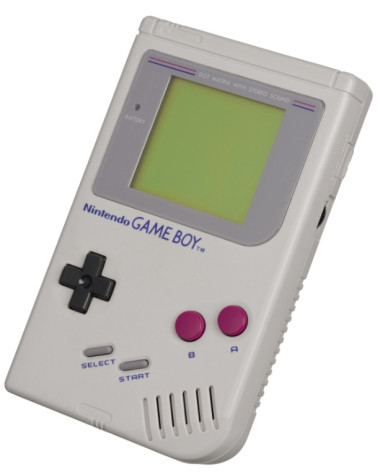
Nintendo GameBoy
21 апреля 1989 года, на территории Японии — Nintendo выпускают в продажу портативную игровую приставку 4 поколения – «GameBoy». На прилавках она появилась в трех вариациях: 1) Приставка без игры в комплекте, 2)в комплекте с игрой Super Mario Land, и 3)в комплекте с нашумевшей, к тому времени, по всему миру игрой из «железного занавеса» Советского Союза – Тетрисом. Кстати говоря, Тетрис подарил миру московский программист Алексей Пажитнов, а популяризировал его предприниматель Хэнк Роджерс, который заметил стенд с Тетрисом на выставке электроники в Лас-Вегасе в 1988 году. Его работа заключалась в том, чтобы покупать у начинающих разработчиков понравившиеся ему игры и привозить их в Японию с целью продажи крупным издателям. После того, как он наткнулся на стенд с Тетрисом, он понял что это настоящий хит. Необходимо было как можно скорее выкупить лицензию на выпуск игры, оставив в этой гонке за право продавать Тетрис далеко позади конкурентов по бизнесу. Первым же рейсом он вылетел в Москву на переговоры с Пажитновым о приобретении лицензии на Тетрис. Права на выпуск игры были выкуплены и Роджерс вернулся в Японию, к руководству Nintendo с игрой, которая идеально подошла к «Геймбою». По официальным данным GameBoy в комплекте с Тетрисом купили по всему миру более 30 млн игроков, что сделало Тетрис одной из наиболее продаваемых игр на приставке.
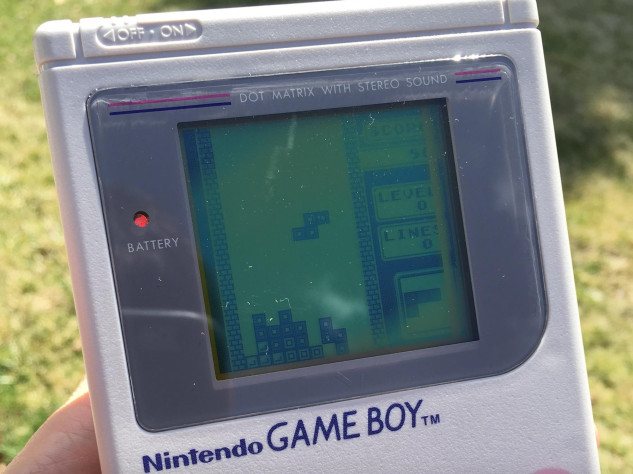
Тетрис на GameBoy в действии.
Что касается успеха второй портативной системы от Nintendo – то он был колоссальным. За первый месяц было продано около 300 тысяч приставок только в Японии, и спрос с каждым новым месяцем и годом только продолжал набирать обороты. Популярность приставки подхватили и другие регионы мира, такие как США и Европа. Прямым конкурентам, в лице выпущенной в том же 1989 году «Lynx» от Atari и вышедшей годом позже Sega «Game Gear», несмотря на значительно превосходящие по мощности «GameBoy» технические характеристики оставалось только собирать крошки со стола, в то время как Nintendo отхватила себе целый пирог и ни с кем не собиралась делиться. Дело в том, что Гумпей Ёкой осознал, что никакие мощности железа не смогут продавать приставку, если на ней не будет значимых игр и оригинальной задумки концепта игрового устройства. Поэтому еще в годы создания Game&Watch – он и начал придерживаться стратегии «нестандартное применение устаревших технологий» — что означало создать что-то новое, комбинируя обкатанную и знакомую технологию по-новому. Например, сделать экран Game&Watch из жидко-кристаллического дисплея, который в те годы использовался только на калькуляторах, что помогало удешевить производство, но это были мелочи, на которые рядовой пользователь не обращал внимания, самое главное был эффект от игры, а он был «сногсшибательным». Такой же подход использовался и в «GameBoy», когда ради увеличения срока службы заряда от батареек и низкой цены для потребителя – пришлось пойти на такие меры, как намеренное ухудшение «начинки» приставки. Да, там был маленький экран с весьма скудным качеством, но зато дизайн… — всё сделано очень аккуратно и удобно, ничего лишнего, ну и самое главное это конечно же библиотека игр, но об этом чуточку позже. В целом, можно сказать, что Nintendo придерживается такой стратегии и по сей день, вспомните ту же Nintendo DS – революционную портативку с сенсорным экраном. Да, для 2004 года это было революцией, т.к. технология тачскрина до выпуска приставки применялась только в банкоматах и первых электронных записных книжках. Причем в этой консоли она задействовалась задолго до начала ее использования в мобильных телефонах. Nintendo Wii – которая предлагала игроку инновационный контролер «Wii Remote», реагирующий на движения игрока. Сейчас это всё кажется обыденным, но в своё время это был по-настоящему новый, интересный и уникальный опыт игры на приставке. Так…что то меня понесло немного не по теме GameBoy.. но в целом вы поняли, что я хотел донести.
Благодаря выбранной стратегии нестандартного применения устаревших технологий – GameBoy, удалось разработать достаточно бюджетным для покупателей девайсом, он поступил в продажу по очень доступной цене всего в 12 500 тысяч йен в Японии, и 90 долларов в США. Игроки по всему миру были просто в восторге от этого стильного «игрового кирпичика». По всему миру было продано, вы только вдумайтесь, более 118 миллионов копий портативок.. Это третья, за всю историю игровой индустрии, самая продаваемая приставка в истории. Вперед она пропустила только «Nintendo DS» и «PlayStation 2» от Sony. Nintendo, как и подобает, не подвела игроков и с играми, поэтому таким высоким показателям продажи приставки послужили такие проекты как: Tetris, Super Mario Land, Dr. Mario, Kirby’s Dream Land, The Legend of Zelda: Link’s Awakening, спин-офф Super Mario — Wario Land: Super Mario Land 3, простите за тавтологию, ну и конечно же главный системселлер GameBoy – серия игр «Pokemon», одна из величайших франшиз в истории, старт которой произошел именно на «Геймбое». Игры этой серии получали высшие оценки у критиков, которые хвалили задумку, геймплей и концепцию обмена покемонами благодаря возможности играть на двух устройствах друг с другом, этакий мультиплеер 90-х. В 2009 году игра попала в Книгу рекордов Гиннесса в разделе «Самая продаваемая RPG на Game Boy» и «Самая продаваемая RPG всех времён». И вот подобных игр, с наивысшими оценками игроков и критиков на приставке было просто завались. Многие из них, те же «Покемоны» или The Legend of Zelda, Metroid, Kirby и многие другие подвергались различным ремейкам и ремастерам на самых разных приставках от Nintendo в будущем. Сам же «GameBoy» подвергался различным модификациям, например таким как вышедший в 1995 году «GameBoy Pocket» — обновленная версия, которая была меньше в размерах на 30%, чем свой предшественник, но с экраном большего размера и использовала только 2 пальчиковых батарейки, вместо четырех, и GameBoy Color – версия 1998 года с цветным дисплеем, из-за чего многие разработчики перевыпускали свои игры повторно, только теперь они уже были по настоящему цветные. Nintendo, благодаря GameBoy подарили игрокам потрясающие эмоции и великолепные игры, а сама приставка дала старт многим значимым для индустрии франшизам. Для многих игроков эта приставка и помогла влюбиться в видеоигры и популяризировала большое количество тайтлов, в том числе помогла и нашему отечественному Тетрису, выйти за пределы Советского Союза, благодаря чему эта уникальная головоломка Алексея Пажитнова «жива» и по сей день. В общем про GameBoy можно говорить много и очень очень много, но основную суть вы уяснили. Nintendo официально прекратила поддержку приставки только в 2003 году, спустя 14 лет пребывания на полках магазинов. И то, как мне кажется, это было сделано ради увеличения продаж наследницы GameBoy – GameBoy Advance.
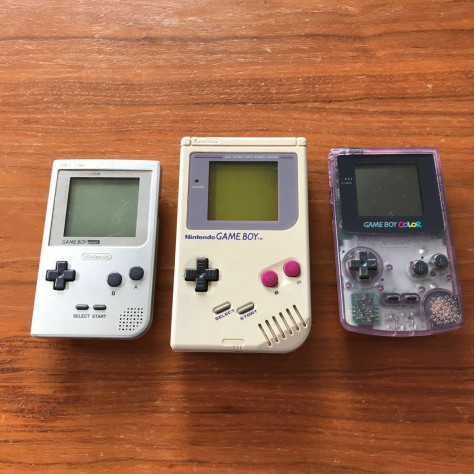
Основные ревизии GameBoy (слева — Pocket, посередине — GameBoy Classic, справа — Color)
Такой вот получился феномен Nintendo. Из этого выпуска вы узнали, что такие люди как Хироси Ямаути, Сигэру Миямото, Гумпей Ёкой, Масаюки Уэмура навсегда останутся в истории видеоигр как революционеры игровой отрасли. Благодаря их разработкам и инновациям, сейчас мы имеем возможность наслаждаться видеоиграми во всей красе, ведь если бы не они, возможно игровая индустрия так и закончила бы свой цикл в 80-90 х гг. прошлого столетия.. и была бы не более, чем «забавой для детей». На этом всё, надеюсь материал вам понравился, пишите в комментариях, имелась ли в вашем распоряжении приставка от Nintendo и какие впечатления она на вас произвела. Спасибо за внимание!