
This article is about the company. For the search engine provided by the company, see Google Search. For other uses, see Google (disambiguation).

The Google logo used since 2015 |
|
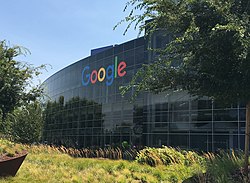
Google’s headquarters, the Googleplex |
|
| Formerly | Google Inc. (1998–2017) |
|---|---|
| Type | Subsidiary (LLC) |
| Industry |
|
| Founded | September 4, 1998; 24 years ago[a] in Menlo Park, California, United States |
| Founders |
|
| Headquarters | 1600 Amphitheatre Parkway,
Mountain View, California , U.S. |
|
Area served |
Worldwide |
|
Key people |
Sundar Pichai (CEO) Ruth Porat (CFO) Thomas Kurian (CEO of Google Cloud) |
| Products | Workspace Android YouTube Waze Pixel Nest Full list |
|
Number of employees |
139,995 (2021)  |
| Parent | Alphabet Inc. |
| Website | about.google google.com |
| Footnotes / references [5][6][7][8] |
Google LLC () is an American multinational technology company focusing on online advertising, search engine technology, cloud computing, computer software, quantum computing, e-commerce, artificial intelligence,[9] and consumer electronics. It has been referred to as «the most powerful company in the world»[10] and one of the world’s most valuable brands due to its market dominance, data collection, and technological advantages in the area of artificial intelligence.[11][12][13] Its parent company Alphabet is considered one of the Big Five American information technology companies, alongside Amazon, Apple, Meta, and Microsoft.
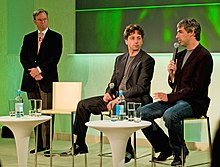
Google was founded on September 4, 1998, by computer scientists Larry Page and Sergey Brin while they were PhD students at Stanford University in California. Together they own about 14% of its publicly listed shares and control 56% of its stockholder voting power through super-voting stock. The company went public via an initial public offering (IPO) in 2004. In 2015, Google was reorganized as a wholly owned subsidiary of Alphabet Inc. Google is Alphabet’s largest subsidiary and is a holding company for Alphabet’s internet properties and interests. Sundar Pichai was appointed CEO of Google on October 24, 2015, replacing Larry Page, who became the CEO of Alphabet. On December 3, 2019, Pichai also became the CEO of Alphabet.[14]
The company has since rapidly grown to offer a multitude of products and services beyond Google Search, many of which hold dominant market positions. These products address a wide range of use cases, including email (Gmail), navigation (Waze & Maps), cloud computing (Cloud), web browsing (Chrome), video sharing (YouTube), productivity (Workspace), operating systems (Android), cloud storage (Drive), language translation (Translate), photo storage (Photos), video calling (Meet), smart home (Nest), smartphones (Pixel), wearable technology (Pixel Watch & Fitbit), music streaming (YouTube Music), video on demand (YouTube TV), artificial intelligence (Google Assistant), machine learning APIs (TensorFlow), AI chips (TPU), and more. Discontinued Google products include gaming (Stadia), Glass, Google+, Reader, Play Music, Nexus, Hangouts, and Inbox by Gmail.[15][16]
Google’s other ventures outside of Internet services and consumer electronics include quantum computing (Sycamore), self-driving cars (Waymo, formerly the Google Self-Driving Car Project), smart cities (Sidewalk Labs), and transformer models (Google Brain).[17]
Google and YouTube are the two most visited websites worldwide followed by Facebook and Twitter. Google is also the largest search engine, mapping and navigation application, email provider, office suite, video sharing platform, photo and cloud storage provider, mobile operating system, web browser, ML framework, and AI virtual assistant provider in the world as measured by market share. On the list of most valuable brands, Google is ranked second by Forbes[18] and fourth by Interbrand.[19] It has received significant criticism involving issues such as privacy concerns, tax avoidance, censorship, search neutrality, antitrust and abuse of its monopoly position.
History
Early years
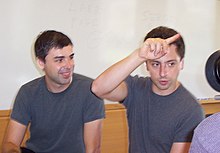
Google began in January 1996 as a research project by Larry Page and Sergey Brin when they were both PhD students at Stanford University in California.[20][21][22] The project initially involved an unofficial «third founder», Scott Hassan, the original lead programmer who wrote much of the code for the original Google Search engine, but he left before Google was officially founded as a company;[23][24] Hassan went on to pursue a career in robotics and founded the company Willow Garage in 2006.[25][26]
While conventional search engines ranked results by counting how many times the search terms appeared on the page, they theorized about a better system that analyzed the relationships among websites.[27] They called this algorithm PageRank; it determined a website’s relevance by the number of pages, and the importance of those pages that linked back to the original site.[28][29] Page told his ideas to Hassan, who began writing the code to implement Page’s ideas.[23]
Page and Brin originally nicknamed the new search engine «BackRub», because the system checked backlinks to estimate the importance of a site.[20][30][31] Hassan as well as Alan Steremberg were cited by Page and Brin as being critical to the development of Google. Rajeev Motwani and Terry Winograd later co-authored with Page and Brin the first paper about the project, describing PageRank and the initial prototype of the Google search engine, published in 1998. Héctor García-Molina and Jeff Ullman were also cited as contributors to the project.[32] PageRank was influenced by a similar page-ranking and site-scoring algorithm earlier used for RankDex, developed by Robin Li in 1996, with Larry Page’s PageRank patent including a citation to Li’s earlier RankDex patent; Li later went on to create the Chinese search engine Baidu.[33][34]
Eventually, they changed the name to Google; the name of the search engine was a misspelling of the word googol,[20][35][36] a very large number written 10100 (1 followed by 100 zeros), picked to signify that the search engine was intended to provide large quantities of information.[37]
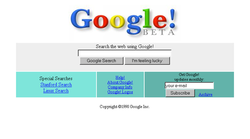
Google’s original homepage had a simple design because the company founders had little experience in HTML, the markup language used for designing web pages.[38]
Google was initially funded by an August 1998 investment of $100,000 from Andy Bechtolsheim,[20] co-founder of Sun Microsystems. This initial investment served as a motivation to incorporate the company to be able to use the funds.[39][40] Page and Brin initially approached David Cheriton for advice because he had a nearby office in Stanford, and they knew he had startup experience, having recently sold the company he co-founded, Granite Systems, to Cisco for $220 million. David arranged a meeting with Page and Brin and his Granite co-founder Andy Bechtolsheim. The meeting was set for 8 AM at the front porch of David’s home in Palo Alto and it had to be brief because Andy had another meeting at Cisco, where he now worked after the acquisition, at 9 AM. Andy briefly tested a demo of the website, liked what he saw, and then went back to his car to grab the check. David Cheriton later also joined in with a $250,000 investment.[41][42]
Google received money from two other angel investors in 1998: Amazon.com founder Jeff Bezos, and entrepreneur Ram Shriram.[43] Page and Brin had first approached Shriram, who was a venture capitalist, for funding and counsel, and Shriram invested $250,000 in Google in February 1998. Shriram knew Bezos because Amazon had acquired Junglee, at which Shriram was the president. It was Shriram who told Bezos about Google. Bezos asked Shriram to meet Google’s founders and they met 6 months after Shriram had made his investment when Bezos and his wife were in a vacation trip to the Bay Area. Google’s initial funding round had already formally closed but Bezos’ status as CEO of Amazon was enough to persuade Page and Brin to extend the round and accept his investment.[44][45]
Between these initial investors, friends, and family Google raised around $1,000,000, which is what allowed them to open up their original shop in Menlo Park, California.[46]
Craig Silverstein, a fellow PhD student at Stanford, was hired as the first employee.[22][47][48]
After some additional, small investments through the end of 1998 to early 1999,[43] a new $25 million round of funding was announced on June 7, 1999,[49] with major investors including the venture capital firms Kleiner Perkins and Sequoia Capital.[40] Both firms were initially reticent about investing jointly in Google, as each wanted to retain a larger percentage of control over the company to themselves. Larry and Sergey however insisted in taking investments from both. Both venture companies finally agreed to investing jointly $12.5 million each due to their belief in Google’s great potential and through mediation of earlier angel investors Ron Conway and Ram Shriram who had contacts in the venture companies.[50]
Growth
In March 1999, the company moved its offices to Palo Alto, California,[51] which is home to several prominent Silicon Valley technology start-ups.[52] The next year, Google began selling advertisements associated with search keywords against Page and Brin’s initial opposition toward an advertising-funded search engine.[53][22] To maintain an uncluttered page design, advertisements were solely text-based.[54] In June 2000, it was announced that Google would become the default search engine provider for Yahoo!, one of the most popular websites at the time, replacing Inktomi.[55][56]
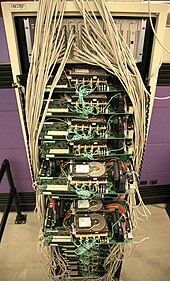
Google’s first production server[57]
In 2003, after outgrowing two other locations, the company leased an office complex from Silicon Graphics, at 1600 Amphitheatre Parkway in Mountain View, California.[58] The complex became known as the Googleplex, a play on the word googolplex, the number one followed by a googol zeroes. Three years later, Google bought the property from SGI for $319 million.[59] By that time, the name «Google» had found its way into everyday language, causing the verb «google» to be added to the Merriam-Webster Collegiate Dictionary and the Oxford English Dictionary, denoted as: «to use the Google search engine to obtain information on the Internet».[60][61] The first use of the verb on television appeared in an October 2002 episode of Buffy the Vampire Slayer.[62]
Additionally, in 2001 Google’s investors felt the need to have a strong internal management, and they agreed to hire Eric Schmidt as the chairman and CEO of Google.[46] Eric was proposed by John Doerr from Kleiner Perkins. He had been trying to find a CEO that Sergey and Larry would accept for several months, but they rejected several candidates because they wanted to retain control over the company. Michael Moritz from Sequoia Capital at one point even menaced requesting Google to immediately pay back Sequoia’s $12.5m investment if they did not fulfill their promise to hire a chief executive officer, which had been made verbally during investment negotiations. Eric wasn’t initially enthusiastic about joining Google either, as the company’s full potential hadn’t yet been widely recognized at the time, and as he was occupied with his responsibilities at Novell where he was CEO. As part of him joining, Eric agreed to buy $1 million of Google preferred stocks as a way to show his commitment and to provide funds Google needed.[63]
Initial public offering
On August 19, 2004, Google became a public company via an initial public offering. At that time Larry Page, Sergey Brin, and Eric Schmidt agreed to work together at Google for 20 years, until the year 2024.[64] The company offered 19,605,052 shares at a price of $85 per share.[65][66] Shares were sold in an online auction format using a system built by Morgan Stanley and Credit Suisse, underwriters for the deal.[67][68] The sale of $1.67 billion gave Google a market capitalization of more than $23 billion.[69]

On November 13, 2006, Google acquired YouTube for $1.65 billion in Google stock,[70][71][72][73] On March 11, 2008, Google acquired DoubleClick for $3.1 billion, transferring to Google valuable relationships that DoubleClick had with Web publishers and advertising agencies.[74][75]
By 2011, Google was handling approximately 3 billion searches per day. To handle this workload, Google built 11 data centers around the world with several thousand servers in each. These data centers allowed Google to handle the ever-changing workload more efficiently.[46]
In May 2011, the number of monthly unique visitors to Google surpassed one billion for the first time.[76][77]
In May 2012, Google acquired Motorola Mobility for $12.5 billion, in its largest acquisition to date.[78][79][80] This purchase was made in part to help Google gain Motorola’s considerable patent portfolio on mobile phones and wireless technologies, to help protect Google in its ongoing patent disputes with other companies,[81] mainly Apple and Microsoft,[82] and to allow it to continue to freely offer Android.[83]
2012 onward
In June 2013, Google acquired Waze, a $966 million deal.[84] While Waze would remain an independent entity, its social features, such as its crowdsourced location platform, were reportedly valuable integrations between Waze and Google Maps, Google’s own mapping service.[85]
Google announced the launch of a new company, called Calico, on September 19, 2013, to be led by Apple Inc. chairman Arthur Levinson. In the official public statement, Page explained that the «health and well-being» company would focus on «the challenge of ageing and associated diseases».[86]
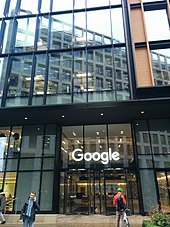
Entrance of building where Google and its subsidiary Deep Mind are located at 6 Pancras Square, London
On January 26, 2014, Google announced it had agreed to acquire DeepMind Technologies, a privately held artificial intelligence company from London.[87] Technology news website Recode reported that the company was purchased for $400 million, yet the source of the information was not disclosed. A Google spokesperson declined to comment on the price.[88][89] The purchase of DeepMind aids in Google’s recent growth in the artificial intelligence and robotics community.[90]
According to Interbrand’s annual Best Global Brands report, Google has been the second most valuable brand in the world (behind Apple Inc.) in 2013,[91] 2014,[92] 2015,[93] and 2016, with a valuation of $133 billion.[94]
On August 10, 2015, Google announced plans to reorganize its various interests as a conglomerate named Alphabet Inc. Google became Alphabet’s largest subsidiary and the umbrella company for Alphabet’s Internet interests. Upon completion of the restructuring, Sundar Pichai became CEO of Google, replacing Larry Page, who became CEO of Alphabet.[95][96][97]
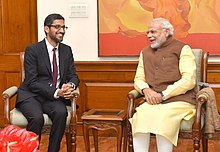
On August 8, 2017, Google fired employee James Damore after he distributed a memo throughout the company that argued bias and «Google’s Ideological Echo Chamber» clouded their thinking about diversity and inclusion, and that it is also biological factors, not discrimination alone, that cause the average woman to be less interested than men in technical positions.[98] Google CEO Sundar Pichai accused Damore of violating company policy by «advancing harmful gender stereotypes in our workplace», and he was fired on the same day.[99][100][101]
Between 2018 and 2019, tensions between the company’s leadership and its workers escalated as staff protested company decisions on internal sexual harassment, Dragonfly, a censored Chinese search engine, and Project Maven, a military drone artificial intelligence, which had been seen as areas of revenue growth for the company.[102][103] On October 25, 2018, The New York Times published the exposé, «How Google Protected Andy Rubin, the ‘Father of Android'». The company subsequently announced that «48 employees have been fired over the last two years» for sexual misconduct.[104] On November 1, 2018, more than 20,000 Google employees and contractors staged a global walk-out to protest the company’s handling of sexual harassment complaints.[105][106] CEO Sundar Pichai was reported to be in support of the protests.[107] Later in 2019, some workers accused the company of retaliating against internal activists.[103]
On March 19, 2019, Google announced that it would enter the video game market, launching a cloud gaming platform called Google Stadia.[108]
On June 3, 2019, the United States Department of Justice reported that it would investigate Google for antitrust violations.[109] This led to the filing of an antitrust lawsuit in October 2020, on the grounds the company had abused a monopoly position in the search and search advertising markets.[110]
In December 2019, former PayPal chief operating officer Bill Ready became Google’s new commerce chief. Ready’s role will not be directly involved with Google Pay.[111]
In April 2020, due to the COVID-19 pandemic, Google announced several cost-cutting measures. Such measures included slowing down hiring for the remainder of 2020, except for a small number of strategic areas, recalibrating the focus and pace of investments in areas like data centers and machines, and non-business essential marketing and travel.[112] Most employees were also working from home due to the COVID-19 pandemic and the success of it even led to Google announcing that they would be permanently converting some of their jobs to work from home [113]
The 2020 Google services outages disrupted Google services: one in August that affected Google Drive among others, another in November affecting YouTube, and a third in December affecting the entire suite of Google applications. All three outages were resolved within hours.[114][115][116]
In 2021, the Alphabet Workers Union was founded, composed mostly of Google employees.[117]
In January 2021, the Australian Government proposed legislation that would require Google and Facebook to pay media companies for the right to use their content. In response, Google threatened to close off access to its search engine in Australia.[118]
In March 2021, Google reportedly paid $20 million for Ubisoft ports on Google Stadia.[119] Google spent «tens of millions of dollars» on getting major publishers such as Ubisoft and Take-Two to bring some of their biggest games to Stadia.[120]
In April 2021, The Wall Street Journal reported that Google ran a years-long program called «Project Bernanke» that used data from past advertising bids to gain an advantage over competing for ad services. This was revealed in documents concerning the antitrust lawsuit filed by ten US states against Google in December.[121]
In September 2021, the Australian government announced plans to curb Google’s capability to sell targeted ads, claiming that the company has a monopoly on the market harming publishers, advertisers, and consumers.[122]
In 2022, Google began accepting requests for the removal of phone numbers, physical addresses and email addresses from its search results. It had previously accepted requests for removing confidential data only, such as Social Security numbers, bank account and credit card numbers, personal signatures, and medical records. Even with the new policy, Google may remove information from only certain but not all search queries. It would not remove content that is «broadly useful», such as news articles, or already part of the public record.[123]
In May 2022, Google announced that the company had acquired California based, MicroLED display technology development and manufacturing Start-up Raxium. Raxium is set to join Google’s Devices and Services team to aid in the development of micro-optics, monolithic integration, and system integration.[124][125]
In early 2023, following the success of ChatGPT and concerns that Google was falling behind in the AI race, Google’s senior management issued a «code red» and a «directive that all of its most important products—those with more than a billion users—must incorporate generative AI within months».[126]
In early May 2023, Google announced its plans to build two additional data centers in Ohio. These centers, which will be built in Columbus and Lancaster, will power up the company’s tools, including AI technology. The said data hub will add to the already operational center near Columbus, bringing Google’s total investment in Ohio to over $2 billion.[127]
Products and services
Search engine
Google indexes billions of web pages to allow users to search for the information they desire through the use of keywords and operators.[128] According to comScore market research from November 2009, Google Search is the dominant search engine in the United States market, with a market share of 65.6%.[129] In May 2017, Google enabled a new «Personal» tab in Google Search, letting users search for content in their Google accounts’ various services, including email messages from Gmail and photos from Google Photos.[130][131]
Google launched its Google News service in 2002, an automated service which summarizes news articles from various websites.[132] Google also hosts Google Books, a service which searches the text found in books in its database and shows limited previews or and the full book where allowed.[133]
Google has added several features in recent years.[timeframe?] Such options includes Flights, Shopping, and Finance.
Advertising
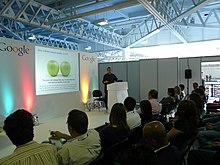
Google on ad-tech London, 2010
Google generates most of its revenues from advertising. This includes sales of apps, purchases made in-app, digital content products on Google and YouTube, Android and licensing and service fees, including fees received for Google Cloud offerings. Forty-six percent of this profit was from clicks (cost per clicks), amounting to US$109,652 million in 2017. This includes three principal methods, namely AdMob, AdSense (such as AdSense for Content, AdSense for Search, etc.) and DoubleClick AdExchange.[134]
In addition to its own algorithms for understanding search requests, Google uses technology its acquisition of DoubleClick, to project user interest and target advertising to the search context and the user history.[135][136]
In 2007, Google launched «AdSense for Mobile», taking advantage of the emerging mobile advertising market.[137]
Google Analytics allows website owners to track where and how people use their website, for example by examining click rates for all the links on a page.[138] Google advertisements can be placed on third-party websites in a two-part program. Google Ads allows advertisers to display their advertisements in the Google content network, through a cost-per-click scheme.[139] The sister service, Google AdSense, allows website owners to display these advertisements on their website and earn money every time ads are clicked.[140] One of the criticisms of this program is the possibility of click fraud, which occurs when a person or automated script clicks on advertisements without being interested in the product, causing the advertiser to pay money to Google unduly. Industry reports in 2006 claimed that approximately 14 to 20 percent of clicks were fraudulent or invalid.[141] Google Search Console (rebranded from Google Webmaster Tools in May 2015) allows webmasters to check the sitemap, crawl rate, and for security issues of their websites, as well as optimize their website’s visibility.
Consumer services
Web-based services
Google offers Gmail for email,[142] Google Calendar for time-management and scheduling,[143] Google Maps for mapping, navigation and satellite imagery,[144] Google Drive for cloud storage of files,[145] Google Docs, Sheets and Slides for productivity,[145] Google Photos for photo storage and sharing,[146] Google Keep for note-taking,[147] Google Translate for language translation,[148] YouTube for video viewing and sharing,[149] Google My Business for managing public business information,[150] and Duo for social interaction.[151] In March 2019, Google unveiled a cloud gaming service named Stadia.[108] A job search product has also existed since before 2017,[152][153][154] Google for Jobs is an enhanced search feature that aggregates listings from job boards and career sites.[155]
Some Google services are not web-based. Google Earth, launched in 2005, allowed users to see high-definition satellite pictures from all over the world for free through a client software downloaded to their computers.[156]
Software
Google develops the Android mobile operating system,[157] as well as its smartwatch,[158] television,[159] car,[160] and Internet of things-enabled smart devices variations.[161]
It also develops the Google Chrome web browser,[162] and ChromeOS, an operating system based on Chrome.[163]
Hardware

Google Pixel smartphones on display in a store
In January 2010, Google released Nexus One, the first Android phone under its own brand.[164] It spawned a number of phones and tablets under the «Nexus» branding[165] until its eventual discontinuation in 2016, replaced by a new brand called Pixel.[166]
In 2011, the Chromebook was introduced, which runs on ChromeOS.[167]
In July 2013, Google introduced the Chromecast dongle, which allows users to stream content from their smartphones to televisions.[168][169]
In June 2014, Google announced Google Cardboard, a simple cardboard viewer that lets the user place their smartphone in a special front compartment to view virtual reality (VR) media.[170]
Other hardware products include:
- Nest, a series of voice assistant smart speakers that can answer voice queries, play music, find information from apps (calendar, weather etc.), and control third-party smart home appliances (users can tell it to turn on the lights, for example). The Google Nest line includes the original Google Home[171] (later succeeded by the Nest Audio), the Google Home Mini (later succeeded by the Nest Mini), the Google Home Max, the Google Home Hub (later rebranded as the Nest Hub), and the Nest Hub Max.
- Nest Wifi (originally Google Wifi), a connected set of Wi-Fi routers to simplify and extend coverage of home Wi-Fi.[172]
Enterprise services
Google Workspace (formerly G Suite until October 2020[173]) is a monthly subscription offering for organizations and businesses to get access to a collection of Google’s services, including Gmail, Google Drive and Google Docs, Google Sheets and Google Slides, with additional administrative tools, unique domain names, and 24/7 support.[174]
On September 24, 2012,[175] Google launched Google for Entrepreneurs, a largely not-for-profit business incubator providing startups with co-working spaces known as Campuses, with assistance to startup founders that may include workshops, conferences, and mentorships.[176] Presently, there are seven Campus locations: Berlin, London, Madrid, Seoul, São Paulo, Tel Aviv, and Warsaw.
On March 15, 2016, Google announced the introduction of Google Analytics 360 Suite, «a set of integrated data and marketing analytics products, designed specifically for the needs of enterprise-class marketers» which can be integrated with BigQuery on the Google Cloud Platform. Among other things, the suite is designed to help «enterprise class marketers» «see the complete customer journey», generate «useful insights», and «deliver engaging experiences to the right people».[177] Jack Marshall of The Wall Street Journal wrote that the suite competes with existing marketing cloud offerings by companies including Adobe, Oracle, Salesforce, and IBM.[178]
Internet services
In February 2010, Google announced the Google Fiber project, with experimental plans to build an ultra-high-speed broadband network for 50,000 to 500,000 customers in one or more American cities.[179][180] Following Google’s corporate restructure to make Alphabet Inc. its parent company, Google Fiber was moved to Alphabet’s Access division.[181][182]
In April 2015, Google announced Project Fi, a mobile virtual network operator, that combines Wi-Fi and cellular networks from different telecommunication providers in an effort to enable seamless connectivity and fast Internet signal.[183][184]
Corporate affairs
Stock price performance and quarterly earnings
Google’s initial public offering (IPO) took place on August 19, 2004. At IPO, the company offered 19,605,052 shares at a price of $85 per share.[65][66] The sale of $1.67 billion gave Google a market capitalization of more than $23 billion.[69] The stock performed well after the IPO, with shares hitting $350 for the first time on October 31, 2007,[185] primarily because of strong sales and earnings in the online advertising market.[186] The surge in stock price was fueled mainly by individual investors, as opposed to large institutional investors and mutual funds.[186] GOOG shares split into GOOG class C shares and GOOGL class A shares.[187] The company is listed on the NASDAQ stock exchange under the ticker symbols GOOGL and GOOG, and on the Frankfurt Stock Exchange under the ticker symbol GGQ1. These ticker symbols now refer to Alphabet Inc., Google’s holding company, since the fourth quarter of 2015.[188]
In the third quarter of 2005, Google reported a 700% increase in profit, largely due to large companies shifting their advertising strategies from newspapers, magazines, and television to the Internet.[189][190][191]
For the 2006 fiscal year, the company reported $10.492 billion in total advertising revenues and only $112 million in licensing and other revenues.[192] In 2011, 96% of Google’s revenue was derived from its advertising programs.[193]
Google generated $50 billion in annual revenue for the first time in 2012, generating $38 billion the previous year. In January 2013, then-CEO Larry Page commented, «We ended 2012 with a strong quarter … Revenues were up 36% year-on-year, and 8% quarter-on-quarter. And we hit $50 billion in revenues for the first time last year – not a bad achievement in just a decade and a half.»[194]
Google’s consolidated revenue for the third quarter of 2013 was reported in mid-October 2013 as $14.89 billion, a 12 percent increase compared to the previous quarter.[195] Google’s Internet business was responsible for $10.8 billion of this total, with an increase in the number of users’ clicks on advertisements.[196] By January 2014, Google’s market capitalization had grown to $397 billion.[197]
Tax avoidance strategies
Google uses various tax avoidance strategies. On the list of largest technology companies by revenue, it pays the lowest taxes to the countries of origin of its revenues. Google between 2007 and 2010 saved $3.1 billion in taxes by shuttling non-U.S. profits through Ireland and the Netherlands and then to Bermuda. Such techniques lower its non-U.S. tax rate to 2.3 per cent, while normally the corporate tax rate in, for instance, the UK is 28 per cent.[198] This has reportedly sparked a French investigation into Google’s transfer pricing practices.[199]
In 2020, Google said it had overhauled its controversial global tax structure and consolidated all of its intellectual property holdings back to the US.[200]
Google Vice-president Matt Brittin testified to the Public Accounts Committee of the UK House of Commons that his UK sales team made no sales and hence owed no sales taxes to the UK.[201] In January 2016, Google reached a settlement with the UK to pay £130m in back taxes plus higher taxes in future.[202] In 2017, Google channeled $22.7 billion from the Netherlands to Bermuda to reduce its tax bill.[203]
In 2013, Google ranked 5th in lobbying spending, up from 213th in 2003. In 2012, the company ranked 2nd in campaign donations of technology and Internet sections.[204]
Corporate identity

Google’s logo from 2013 to 2015
The name «Google» originated from a misspelling of «googol»,[205][206] which refers to the number represented by a 1 followed by one-hundred zeros. Page and Brin write in their original paper on PageRank:[32] «We chose our systems name, Google, because it is a common spelling of googol, or 10100 and fits well with our goal of building very large-scale search engines.» Having found its way increasingly into everyday language, the verb «google» was added to the Merriam Webster Collegiate Dictionary and the Oxford English Dictionary in 2006, meaning «to use the Google search engine to obtain information on the Internet.»[207][208] Google’s mission statement, from the outset, was «to organize the world’s information and make it universally accessible and useful»,[209] and its unofficial slogan is «Don’t be evil».[210] In October 2015, a related motto was adopted in the Alphabet corporate code of conduct by the phrase: «Do the right thing».[211] The original motto was retained in the code of conduct of Google, now a subsidiary of Alphabet.
The original Google logo was designed by Sergey Brin.[212] Since 1998, Google has been designing special, temporary alternate logos to place on their homepage intended to celebrate holidays, events, achievements and people. The first Google Doodle was in honor of the Burning Man Festival of 1998.[213][214] The doodle was designed by Larry Page and Sergey Brin to notify users of their absence in case the servers crashed. Subsequent Google Doodles were designed by an outside contractor, until Larry and Sergey asked then-intern Dennis Hwang to design a logo for Bastille Day in 2000. From that point onward, Doodles have been organized and created by a team of employees termed «Doodlers».[215]
Google has a tradition of creating April Fools’ Day jokes. Its first on April 1, 2000, was Google MentalPlex which allegedly featured the use of mental power to search the web.[216] In 2007, Google announced a free Internet service called TiSP, or Toilet Internet Service Provider, where one obtained a connection by flushing one end of a fiber-optic cable down their toilet.[217]
Google’s services contain easter eggs, such as the Swedish Chef’s «Bork bork bork,» Pig Latin, «Hacker» or leetspeak, Elmer Fudd, Pirate, and Klingon as language selections for its search engine.[218] When searching for the word «anagram,» meaning a rearrangement of letters from one word to form other valid words, Google’s suggestion feature displays «Did you mean: nag a ram?»[219] Since 2019, Google runs free online courses to help engineers learn how to plan and author technical documentation better.[220]
Workplace culture

On Fortune magazine’s list of the best companies to work for, Google ranked first in 2007, 2008 and 2012,[221][222][223] and fourth in 2009 and 2010.[224][225] Google was also nominated in 2010 to be the world’s most attractive employer to graduating students in the Universum Communications talent attraction index.[226] Google’s corporate philosophy includes principles such as «you can make money without doing evil,» «you can be serious without a suit,» and «work should be challenging and the challenge should be fun.»[227]
As of September 30, 2020, Alphabet Inc. had 132,121 employees,[228] of which more than 100,000 worked for Google.[8] Google’s 2020 diversity report states that 32 percent of its workforce are women and 68 percent are men, with the ethnicity of its workforce being predominantly white (51.7%) and Asian (41.9%).[229] Within tech roles, 23.6 percent were women; and 26.7 percent of leadership roles were held by women.[230] In addition to its 100,000+ full-time employees, Google used about 121,000 temporary workers and contractors, as of March 2019.[8]
Google’s employees are hired based on a hierarchical system. Employees are split into six hierarchies based on experience and can range «from entry-level data center workers at level one to managers and experienced engineers at level six.»[231] As a motivation technique, Google uses a policy known as Innovation Time Off, where Google engineers are encouraged to spend 20% of their work time on projects that interest them. Some of Google’s services, such as Gmail, Google News, Orkut, and AdSense originated from these independent endeavors.[232] In a talk at Stanford University, Marissa Mayer, Google’s vice-president of Search Products and User Experience until July 2012, showed that half of all new product launches in the second half of 2005 had originated from the Innovation Time Off.[233]
In 2005, articles in The New York Times[234] and other sources began suggesting that Google had lost its anti-corporate, no evil philosophy.[235][236][237] In an effort to maintain the company’s unique culture, Google designated a Chief Culture Officer whose purpose was to develop and maintain the culture and work on ways to keep true to the core values that the company was founded on.[238] Google has also faced allegations of sexism and ageism from former employees.[239][240] In 2013, a class action against several Silicon Valley companies, including Google, was filed for alleged «no cold call» agreements which restrained the recruitment of high-tech employees.[241] In a lawsuit filed January 8, 2018, multiple employees and job applicants alleged Google discriminated against a class defined by their «conservative political views[,] male gender[,] and/or […] Caucasian or Asian race».[242]
On January 25, 2020, the formation of an international workers union of Google employees, Alpha Global, was announced.[243] The coalition is made up of «13 different unions representing workers in 10 countries, including the United States, United Kingdom, and Switzerland.»[244] The group is affiliated with UNI Global Union, which represents nearly 20 million international workers from various unions and federations. The formation of the union is in response to persistent allegations of mistreatment of Google employees and a toxic workplace culture.[244][245][242] Google had previously been accused of surveilling and firing employees who were suspected of organizing a workers union.[246] In 2021 court documents revealed that between 2018 and 2020 Google ran an anti-union campaign called Project Vivian to «convince them (employees) that unions suck».[247]
Office locations
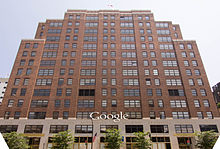
Google’s New York City office building houses its largest advertising sales team.

Google’s headquarters in Mountain View, California is referred to as «the Googleplex», a play on words on the number googolplex and the headquarters itself being a complex of buildings. Internationally, Google has over 78 offices in more than 50 countries.[248]
In 2006, Google moved into about 300,000 square feet (27,900 m2) of office space at 111 Eighth Avenue in Manhattan, New York City. The office was designed and built specially for Google, and houses its largest advertising sales team.[249] In 2010, Google bought the building housing the headquarter, in a deal that valued the property at around $1.9 billion.[250][251] In March 2018, Google’s parent company Alphabet bought the nearby Chelsea Market building for $2.4 billion. The sale is touted as one of the most expensive real estate transactions for a single building in the history of New York.[252][253][254][255] In November 2018, Google announced its plan to expand its New York City office to a capacity of 12,000 employees.[256] The same December, it was announced that a $1 billion, 1,700,000-square-foot (160,000 m2) headquarters for Google would be built in Manhattan’s Hudson Square neighborhood.[257][258] Called Google Hudson Square, the new campus is projected to more than double the number of Google employees working in New York City.[259]
By late 2006, Google established a new headquarters for its AdWords division in Ann Arbor, Michigan.[260] In November 2006, Google opened offices on Carnegie Mellon’s campus in Pittsburgh, focusing on shopping-related advertisement coding and smartphone applications and programs.[261][262] Other office locations in the U.S. include Atlanta, Georgia; Austin, Texas; Boulder, Colorado; Cambridge, Massachusetts; San Francisco, California; Seattle, Washington; Kirkland, Washington; Birmingham, Michigan; Reston, Virginia, Washington, D.C.,[263] and Madison, Wisconsin.[264]
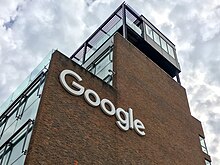
Google’s Dublin Ireland office, headquarters of Google Ads for Europe
It also has product research and development operations in cities around the world, namely Sydney (birthplace location of Google Maps)[265] and London (part of Android development).[266] In November 2013, Google announced plans for a new London headquarter, a 1 million square foot office able to accommodate 4,500 employees. Recognized as one of the biggest ever commercial property acquisitions at the time of the deal’s announcement in January,[267] Google submitted plans for the new headquarter to the Camden Council in June 2017.[268][269] In May 2015, Google announced its intention to create its own campus in Hyderabad, India. The new campus, reported to be the company’s largest outside the United States, will accommodate 13,000 employees.[270][271]
Google’s Global Offices sum a total of 85 Locations worldwide,[272] with 32 offices in North America, 3 of them in Canada and 29 in United States Territory, California being the state with the most Google’s offices with 9 in total including the Googleplex. In the Latin America Region Google counts with 6 offices, in Europe 24 (3 of them in UK), the Asia Pacific region counts with 18 offices principally 4 in India and 3 in China, and the Africa Middle East region counts 5 offices.
North America
| SN | City | US State/Country |
|---|---|---|
| 1. | Ann Arbor |  Michigan Michigan
|
| 2. | Atlanta |  Georgia Georgia
|
| 3. | Austin |  Texas Texas
|
| 4. | Boulder |  Colorado Colorado
|
| 5. | Boulder – Pearl Place | Colorado
|
| 6. | Boulder – Walnut | Colorado
|
| 7. | Cambridge |  Massachusetts Massachusetts
|
| 8. | Chapel Hill |  North Carolina North Carolina
|
| 9. | Chicago – Carpenter |  Illinois Illinois
|
| 10. | Chicago – Fulton Market | Illinois
|
| 11. | Detroit | Michigan
|
| 12. | Irvine |  California California
|
| 13. | Kirkland |  Washington Washington
|
| 14. | Kitchener |  Canada Canada
|
| 15. | Los Angeles | California
|
| 16. | Madison |  Wisconsin Wisconsin
|
| 17. | Miami |  Florida Florida
|
| 18. | Montreal | Canada
|
| 19. | Mountain View | California
|
| 20. | New York |  New York New York
|
| 21. | Pittsburgh |  Pennsylvania Pennsylvania
|
| 22. | Playa Vista | California
|
| 23. | Portland |  Oregon Oregon
|
| 24. | Redwood City | California
|
| 25. | Reston |  Virginia Virginia
|
| 26. | San Bruno | California
|
| 27. | San Diego | California
|
| 28. | San Francisco | California (H)
|
| 29. | Seattle | Washington
|
| 30. | Sunnyvale | California
|
| 31. | Toronto | Canada
|
| 32. | Washington DC |  District of Columbia District of Columbia
|
Latin America
| SN | City | Country |
|---|---|---|
| 1. | Belo Horizonte |  Brazil Brazil
|
| 2. | São Paulo | |
| 3. | Bogotá |  Colombia Colombia
|
| 4. | Buenos Aires |  Argentina Argentina
|
| 5. | Mexico City |  Mexico Mexico
|
| 6. | Santiago de Chile |  Chile Chile
|
Europe
| SN | City | Country |
|---|---|---|
| 1. | Aarhus |  Denmark Denmark
|
| 2. | Copenhagen | |
| 3. | Amsterdam |  Netherlands Netherlands
|
| 4. | Athens |  Greece Greece
|
| 5. | Berlin |  Germany Germany
|
| 6. | Hamburg | |
| 7. | Munich | |
| 8. | Brussels |  Belgium Belgium
|
| 9. | Dublin |  Ireland Ireland
|
| 10. | Lisbon |  Portugal Portugal
|
| 11. | London – 6PS |  United Kingdom United Kingdom
|
| 12. | London – BEL | |
| 13. | London – CSG | |
| 14. | Madrid |  Spain Spain
|
| 15. | Milan |  Italy Italy
|
| 16. | Moscow |  Russia Russia
|
| 17. | Oslo |  Norway Norway
|
| 18. | Paris |  France France
|
| 19. | Prague |  Czech Republic Czech Republic
|
| 20. | Stockholm |  Sweden Sweden
|
| 21. | Vienna |  Austria Austria
|
| 22. | Warsaw |  Poland Poland
|
| 23. | Wroclaw | |
| 24. | Zurich |  Switzerland Switzerland
|
Asia-Pacific
| SN | City | Country |
|---|---|---|
| 1. | Bangalore |  India India
|
| 2. | Gurgaon | |
| 3. | Hyderabad | |
| 4. | Mumbai | |
| 5. | Bangkok |  Thailand Thailand
|
| 6. | Beijing |  China China
|
| 7. | Guangzhou | |
| 8. | Shanghai | |
| 9. | Hong Kong |  Hong Kong Hong Kong
|
| 10. | Jakarta |  Indonesia Indonesia
|
| 11. | Kuala Lumpur |  Malaysia Malaysia
|
| 12. | Melbourne |  Australia Australia
|
| 13. | Sydney | |
| 14. | Seoul |  South Korea South Korea
|
| 15. | Singapore |  Singapore Singapore
|
| 16. | Taipei |  Taiwan Taiwan
|
| 17. | Tokyo – RPG |  Japan Japan
|
| 18. | Tokyo – STRM |
Africa and the Middle East
| SN | City | Country |
|---|---|---|
| 1. | Dubai |  United Arab Emirates United Arab Emirates
|
| 2. | Haifa |  Israel Israel
|
| 3. | Tel Aviv | |
| 4. | Istanbul |  Turkey Turkey
|
| 5. | Johannesburg |  South Africa South Africa
|
Infrastructure
Google data centers are located in North and South America, Asia, and Europe.[273] There is no official data on the number of servers in Google data centers; however, research and advisory firm Gartner estimated in a July 2016 report that Google at the time had 2.5 million servers.[274] Traditionally, Google relied on parallel computing on commodity hardware like mainstream x86 computers (similar to home PCs) to keep costs per query low.[275][276][277] In 2005, it started developing its own designs, which were only revealed in 2009.[277]
Google built its own private submarine communications cables; the first, named Curie, connects California with Chile and was completed on November 15, 2019.[278][279] The second fully Google-owned undersea cable, named Dunant, connects the United States with France and is planned to begin operation in 2020.[280] Google’s third subsea cable, Equiano, will connect Lisbon, Portugal with Lagos, Nigeria and Cape Town, South Africa.[281] The company’s fourth cable, named Grace Hopper, connects landing points in New York, US, Bude, UK and Bilbao, Spain, and is expected to become operational in 2022.[282]
Environment
In October 2006, the company announced plans to install thousands of solar panels to provide up to 1.6 Megawatt of electricity, enough to satisfy approximately 30% of the campus’ energy needs.[283][284] The system is the largest rooftop photovoltaic power station constructed on a U.S. corporate campus and one of the largest on any corporate site in the world.[283] Since 2007, Google has aimed for carbon neutrality in regard to its operations.[285]
Google disclosed in September 2011 that it «continuously uses enough electricity to power 200,000 homes», almost 260 million watts or about a quarter of the output of a nuclear power plant. Total carbon emissions for 2010 were just under 1.5 million metric tons, mostly due to fossil fuels that provide electricity for the data centers. Google said that 25 percent of its energy was supplied by renewable fuels in 2010. An average search uses only 0.3 watt-hours of electricity, so all global searches are only 12.5 million watts or 5% of the total electricity consumption by Google.[286]
In 2010, Google Energy made its first investment in a renewable energy project, putting $38.8 million into two wind farms in North Dakota. The company announced the two locations will generate 169.5 megawatts of power, enough to supply 55,000 homes.[287] In February 2010, the Federal Energy Regulatory Commission granted Google an authorization to buy and sell energy at market rates.[288] The corporation exercised this authorization in September 2013 when it announced it would purchase all the electricity produced by the not-yet-built 240-megawatt Happy Hereford wind farm.[289]
In July 2010, Google signed an agreement with an Iowa wind farm to buy 114 megawatts of power for 20 years.[290]
In December 2016, Google announced that—starting in 2017—it would purchase enough renewable energy to match 100% of the energy usage of its data centers and offices. The commitment will make Google «the world’s largest corporate buyer of renewable power, with commitments reaching 2.6 gigawatts (2,600 megawatts) of wind and solar energy».[291][292][293]
In November 2017, Google bought 536 megawatts of wind power. The purchase made the firm reach 100% renewable energy. The wind energy comes from two power plants in South Dakota, one in Iowa and one in Oklahoma.[294] In September 2019, Google’s chief executive announced plans for a $2 billion wind and solar investment, the biggest renewable energy deal in corporate history. This will grow their green energy profile by 40%, giving them an extra 1.6 gigawatt of clean energy, the company said.[295]
In September 2020, Google announced it had retroactively offset all of its carbon emissions since the company’s foundation in 1998.[296] It also committed to operating its data centers and offices using only carbon-free energy by 2030.[297] In October 2020, the company pledged to make the packaging for its hardware products 100% plastic-free and 100% recyclable by 2025. It also said that all its final assembly manufacturing sites will achieve a UL 2799 Zero Waste to Landfill certification by 2022 by ensuring that the vast majority of waste from the manufacturing process is recycled instead of ending up in a landfill.[298]
Climate change denial and misinformation
Google donates to climate change denial political groups including the State Policy Network and the Competitive Enterprise Institute.[299][300] The company also actively funds and profits from climate disinformation by monetizing ad spaces on most of the largest climate disinformation sites.[301] Google continued to monetize and profit from sites propagating climate disinformation even after the company updated their policy to prohibit placing their ads on similar sites.[302]
Philanthropy
In 2004, Google formed the not-for-profit philanthropic Google.org, with a start-up fund of $1 billion.[303] The mission of the organization is to create awareness about climate change, global public health, and global poverty. One of its first projects was to develop a viable plug-in hybrid electric vehicle that can attain 100 miles per gallon. Google hired Larry Brilliant as the program’s executive director in 2004[304] and Megan Smith has since replaced him as director.[305]
In March 2007, in partnership with the Mathematical Sciences Research Institute (MSRI), Google hosted the first Julia Robinson Mathematics Festival at its headquarters in Mountain View.[306] In 2011, Google donated 1 million euros to International Mathematical Olympiad to support the next five annual International Mathematical Olympiads (2011–2015).[307][308] In July 2012, Google launched a «Legalize Love» campaign in support of gay rights.[309]
In 2008, Google announced its «project 10100» which accepted ideas for how to help the community and then allowed Google users to vote on their favorites.[310] After two years of silence, during which many wondered what had happened to the program,[311] Google revealed the winners of the project, giving a total of ten million dollars to various ideas ranging from non-profit organizations that promote education to a website that intends to make all legal documents public and online.[312]
Responding to the humanitarian crisis after the Russian invasion of Ukraine, Google announced a $15 million donation to support Ukrainian citizens.[313] The company also decided to transform its office in Warsaw into a help center for refugees.[314]
Criticism and controversies

San Francisco activists protest privately owned shuttle buses that transport workers for tech companies such as Google from their homes in San Francisco and Oakland to corporate campuses in Silicon Valley.
Google has had criticism over issues such as aggressive tax avoidance,[315] search neutrality, copyright, censorship of search results and content,[316] and privacy.[317][318]
Other criticisms are alleged misuse and manipulation of search results, its use of other people’s intellectual property, concerns that its compilation of data may violate people’s privacy, and the energy consumption of its servers, as well as concerns over traditional business issues such as monopoly, restraint of trade, anti-competitive practices, and patent infringement.
Google formerly complied with Internet censorship policies of the People’s Republic of China,[319] enforced by means of filters colloquially known as «The Great Firewall of China», but no longer does so. As a result, all Google services except for Chinese Google Maps are blocked from access within mainland China without the aid of virtual private networks, proxy servers, or other similar technologies.
2018
In July 2018, Mozilla program manager Chris Peterson accused Google of intentionally slowing down YouTube performance on Firefox.[320][321] In April 2019, former Mozilla executive Jonathan Nightingale accused Google of intentionally and systematically sabotaging the Firefox browser over the past decade in order to boost adoption of Google Chrome.[322]
In August 2018, The Intercept reported that Google is developing for the People’s Republic of China a censored version of its search engine (known as Dragonfly) «that will blacklist websites and search terms about human rights, democracy, religion, and peaceful protest».[323][324] However, the project had been withheld due to privacy concerns.[325][326]
2019
In 2019, a hub for critics of Google dedicated to abstaining from using Google products coalesced in the Reddit online community /r/degoogle.[327] The DeGoogle grassroots campaign continues to grow as privacy activists highlight information about Google products, and the associated incursion on personal privacy rights by the company.
In November 2019, the Office for Civil Rights of the United States Department of Health and Human Services began investigation into Project Nightingale, to assess whether the «mass collection of individuals’ medical records» complied with HIPAA.[328] According to The Wall Street Journal, Google secretively began the project in 2018, with St. Louis-based healthcare company Ascension.[329]
2022
In a 2022 National Labor Relations Board ruling, court documents suggested that Google sponsored a secretive project — Project Vivian to counsel its employees and to discourage them from forming unions.[330]
2023
On May 1, 2023, Google placed an ad against anti-disinformation Brazilian Congressional Bill No. 2630, which was about to be approved, on its search homepage in Brazil, calling on its users to ask congressional representatives to oppose the legislation. The country’s government and judiciary accused the company of undue interference in the congressional debate, saying it could amount to abuse of economic power and ordering the company to change the ad within two hours of notification or face fines of R$1 million (2023) (US$) per non-compliance hour. The company then promptly removed the ad.[331][332]
Racially-targeted surveillance
Google has aided controversial governments in mass surveillance projects, sharing with police and military the identities of those protesting racial injustice. In 2020, they shared with the FBI information collected from all Android users at a Black Lives Matter protest in Seattle,[333] including those who had opted out of location data collection.[334][335]
Google is also part of Project Nimbus, a $1.2 billion deal in which the technology companies Google and Amazon will provide Israel and its military with artificial intelligence, machine learning, and other cloud computing services, including building local cloud sites that will «keep information within Israel’s borders under strict security guidelines.»[336][337][338] The contract has been criticized by shareholders as well as their employees over concerns that the project will lead to further abuses of Palestinians’ human rights in the context of the ongoing illegal occupation and the Israeli–Palestinian conflict.[339][340] Ariel Koren, a former marketing manager for Google’s educational products and an outspoken critic of the project, wrote that Google «systematically silences Palestinian, Jewish, Arab and Muslim voices concerned about Google’s complicity in violations of Palestinian human rights—to the point of formally retaliating against workers and creating an environment of fear,» reflecting her view that the ultimatum came in retaliation for her opposition to and organization against the project.[336][341]
Anti-trust, privacy, and other litigation
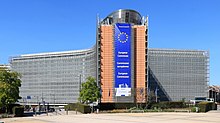
The European Commission, which imposed three fines on Google in 2017, 2018, and 2019
Fines and lawsuits
European Union
On June 27, 2017, the company received a record fine of €2.42 billion from the European Union for «promoting its own shopping comparison service at the top of search results.»[342]
On July 18, 2018,[343] the European Commission fined Google €4.34 billion for breaching EU antitrust rules. The abuse of dominant position has been referred to Google’s constraint applied to Android device manufacturers and network operators to ensure that traffic on Android devices goes to the Google search engine. On October 9, 2018, Google confirmed[344] that it had appealed the fine to the General Court of the European Union.[345]
On October 8, 2018, a class action lawsuit was filed against Google and Alphabet due to «non-public» Google+ account data being exposed as a result of a bug that allowed app developers to gain access to the private information of users. The litigation was settled in July 2020 for $7.5 million with a payout to claimants of at least $5 each, with a maximum of $12 each.[346][347][348]
On March 20, 2019, the European Commission imposed a €1.49 billion ($1.69 billion) fine on Google for preventing rivals from being able to «compete and innovate fairly» in the online advertising market. European Union competition commissioner Margrethe Vestager said Google had violated EU antitrust rules by «imposing anti-competitive contractual restrictions on third-party websites» that required them to exclude search results from Google’s rivals.[349][350]
On September 14, 2022, Google lost the appeal over €4.125bn (£3.5bn) fine, which was ruled to be paid after it was proved by the European Commission that Google forced Android phone-makers to carry Google’s search and web browser apps. Since the initial accusations, Google changed its policy.[351]
France
On January 21, 2019, French data regulator CNIL imposed a record €50 million fine on Google for breaching the European Union’s General Data Protection Regulation. The judgment claimed Google had failed to sufficiently inform users of its methods for collecting data to personalize advertising. Google issued a statement saying it was «deeply committed» to transparency and was «studying the decision» before determining its response.[352]
On January 6, 2022, France’s data privacy regulatory body CNIL fined Alphabet’s Google 150 million euros (US$169 million) for not allowing its Internet users an easy refusal of Cookies along with Facebook.[353]
United States
After U.S. Congressional hearings in July 2020,[354] and a report from the U.S. House of Representatives’ Antitrust Subcommittee released in early October[355] the United States Department of Justice filed an antitrust lawsuit against Google on October 20, 2020, asserting that it has illegally maintained its monopoly position in web search and search advertising.[356][357] The lawsuit alleged that Google engaged in anticompetitive behavior by paying Apple between $8 billion-$12 billion to be the default search engine on iPhones.[358] Later that month, both Facebook and Alphabet agreed to «cooperate and assist one another» in the face of investigation into their online advertising practices.[359][360]
Private browsing lawsuit
In early June 2020, a $5 billion class-action lawsuit was filed against Google by a group of consumers, alleging that Chrome’s Incognito browsing mode still collects their user history.[361][362] The lawsuit became known in March 2021 when a federal judge denied Google’s request to dismiss the case, ruling that they must face the group’s charges.[363][364] Reuters reported that the lawsuit alleged that Google’s CEO Sundar Pichai sought to keep the users unaware of this issue.[365]
Gender discrimination lawsuit
In 2017, three women sued Google, accusing the company of violating California’s Equal Pay Act by underpaying its female employees. The lawsuit cited the wage gap was around $17,000 and that Google locked women into lower career tracks, leading to smaller salaries and bonuses. In June 2022, Google agreed to pay a $118 million settlement to 15,550 female employees working in California since 2013. As a part of the settlement, Google also agreed to hire a third party to analyze its hiring and compensation practices.[366][367][368]
U.S. government contracts
Following media reports about PRISM, the NSA’s massive electronic surveillance program, in June 2013, several technology companies were identified as participants, including Google.[369] According to unnamed sources, Google joined the PRISM program in 2009, as YouTube in 2010.[370]
Google has worked with the United States Department of Defense on drone software through the 2017 Project Maven that could be used to improve the accuracy of drone strikes.[371] In April 2018, thousands of Google employees, including senior engineers, signed a letter urging Google CEO Sundar Pichai to end this controversial contract with the Pentagon.[372] Google ultimately decided not to renew this DoD contract, which was set to expire in 2019.[373]
See also
- Outline of Google
- History of Google
- List of Google products
- Google China
- Google logo
- Googlization
- Google.org
- Google ATAP
- List of mergers and acquisitions by Alphabet
Notes
- ^ Google was incorporated on September 4, 1998, however, since 2002, the company has celebrated its anniversaries on various days in September, most frequently on September 27.[1][2][3] The shift in dates reportedly happened to celebrate index-size milestones in tandem with the birthday.[4]
References
- ^ Fitzpatrick, Alex (September 4, 2014). «Google Used to Be the Company That Did ‘Nothing But Search’«. Time.
- ^ «When is Google’s birthday – and why are people confused?». The Telegraph. September 27, 2019. Archived from the original on January 10, 2022.
- ^ Griffin, Andrew (September 27, 2019). «Google birthday: The one big problem with the company’s celebratory doodle». The Independent.
- ^ Wray, Richard (September 5, 2008). «Happy birthday Google». The Guardian.
- ^ «Company – Google». January 16, 2015. Archived from the original on January 16, 2015. Retrieved September 13, 2018.
- ^ Claburn, Thomas (September 24, 2008). «Google Founded By Sergey Brin, Larry Page… And Hubert Chang?!?». InformationWeek. UBM plc. Archived from the original on June 28, 2011. Retrieved January 22, 2017.
- ^ «Locations— Google Jobs». Archived from the original on September 30, 2013. Retrieved September 27, 2013.
- ^ a b c Wakabayashi, Daisuke (May 28, 2019). «Google’s Shadow Work Force: Temps Who Outnumber Full-Time Employees (Published 2019)». The New York Times. ISSN 0362-4331. Archived from the original on December 18, 2020. Retrieved December 30, 2020.
- ^ Condon, Stephanie (May 7, 2019). «Google I/O: From ‘AI first’ to AI working for everyone». ZDNet. Retrieved April 2, 2022.
{{cite web}}: CS1 maint: url-status (link) - ^ Jack, Simon (November 21, 2017). «Google — powerful and responsible?». BBC News. Retrieved March 29, 2022.
{{cite news}}: CS1 maint: url-status (link) - ^ McCormick, Rich (June 2, 2016). «Elon Musk: There’s only one AI company that worries me». The Verge. Retrieved March 29, 2022.
{{cite web}}: CS1 maint: url-status (link) - ^ «Justice Department Sues Monopolist Google For Violating Antitrust Laws». www.justice.gov. October 20, 2020. Retrieved March 29, 2022.
{{cite web}}: CS1 maint: url-status (link) - ^ «Land of the Giants: The Titans of Tech | CNN+». plus.cnn.com. Retrieved April 18, 2022.
- ^ Feiner, Lauren (December 3, 2019). «Larry Page steps down as CEO of Alphabet, Sundar Pichai to take over». CNBC. Retrieved June 16, 2021.
{{cite web}}: CS1 maint: url-status (link) - ^ Brady, Heather; Kirk, Chris (March 15, 2013). «The Google Graveyard». Slate. Archived from the original on March 16, 2013. Retrieved March 16, 2013.
- ^ Booker, Logan (March 17, 2013). «Google Graveyard Does Exist». gizmodo. Gizmodo. Archived from the original on May 18, 2018. Retrieved May 17, 2018.
- ^ «Inside X, Google’s top-secret moonshot factory». Wired UK. ISSN 1357-0978. Retrieved May 17, 2022.
- ^ Swant, Marty. «THE WORLD’S VALUABLE BRANDS». Forbes. Retrieved January 19, 2022.
{{cite web}}: CS1 maint: url-status (link) - ^ «BEST GLOBAL BRANDS». Interbrand. Retrieved March 7, 2011.
{{cite web}}: CS1 maint: url-status (link) - ^ a b c d «How we started and where we are today – Google». about.google. Archived from the original on April 22, 2020. Retrieved April 24, 2021.
- ^ Brezina, Corona (2013). Sergey Brin, Larry Page, Eric Schmidt, and Google (1st ed.). New York: Rosen Publishing Group. p. 18. ISBN 978-1-4488-6911-4. LCCN 2011039480.
- ^ a b c «Our history in depth». Google Company. Archived from the original on April 1, 2012. Retrieved July 15, 2017.
- ^ a b Fisher, Adam (July 10, 2018). «Brin, Page, and Mayer on the Accidental Birth of the Company that Changed Everything». Vanity Fair. Archived from the original on July 4, 2019. Retrieved August 23, 2019.
- ^ McHugh, Josh (January 1, 2003). «Google vs. Evil». Wired. Archived from the original on June 2, 2019. Retrieved August 24, 2019.
- ^ «Willow Garage Founder Scott Hassan Aims To Build A Startup Village». IEEE Spectrum. September 5, 2014. Archived from the original on August 24, 2019. Retrieved September 1, 2019.
- ^ D’Onfro, Jillian (February 13, 2016). «How a billionaire who wrote Google’s original code created a robot revolution». Business Insider. Archived from the original on August 24, 2019. Retrieved August 24, 2019.
- ^ Page, Lawrence; Brin, Sergey; Motwani, Rajeev; Winograd, Terry (November 11, 1999). «The PageRank Citation Ranking: Bringing Order to the Web». Stanford University. Archived from the original on November 18, 2009.
- ^ «Helpful products. For everyone». Google, Inc. Archived from the original on February 10, 2010.
- ^ Page, Larry (August 18, 1997). «PageRank: Bringing Order to the Web». Stanford Digital Library Project. Archived from the original on May 6, 2002. Retrieved November 27, 2010.
- ^ Battelle, John (August 2005). «The Birth of Google». Wired. Archived from the original on November 7, 2012. Retrieved October 12, 2010.
- ^ «Backrub search engine at Stanford University». Archived from the original on December 24, 1996. Retrieved March 12, 2011.
- ^ a b Brin, Sergey; Page, Lawrence (1998). «The anatomy of a large-scale hypertextual Web search engine» (PDF). Computer Networks and ISDN Systems. 30 (1–7): 107–117. CiteSeerX 10.1.1.115.5930. doi:10.1016/S0169-7552(98)00110-X. ISSN 0169-7552. Archived (PDF) from the original on September 27, 2015. Retrieved April 7, 2019.
- ^ ««About: RankDex»«. Archived from the original on January 20, 2012. Retrieved September 29, 2010., RankDex
- ^ «Method for node ranking in a linked database». Google Patents. Archived from the original on October 15, 2015. Retrieved October 19, 2015.
- ^ Koller, David (January 2004). «Origin of the name «Google»«. Stanford University. Archived from the original on June 27, 2012.
- ^ Hanley, Rachael (February 12, 2003). «From Googol to Google». The Stanford Daily. Stanford University. Archived from the original on March 27, 2010. Retrieved February 15, 2010.
- ^ «Google! Beta website». Google, Inc. Archived from the original on February 21, 1999. Retrieved October 12, 2010.
- ^ Williamson, Alan (January 12, 2005). «An evening with Google’s Marissa Mayer». Alan Williamson. Archived from the original on September 30, 2011. Retrieved July 5, 2010.
- ^ Long, Tony (September 7, 2007). «Sept. 7, 1998: If the Check Says ‘Google Inc.,’ We’re ‘Google Inc.’«. Wired.
- ^ a b Kopytoff, Verne (April 29, 2004). «For early Googlers, key word is $». San Francisco Chronicle. Archived from the original on September 19, 2009.
- ^ Jolis, Jacob (April 16, 2010). «Frugal after Google». The Stanford Daily. Retrieved June 3, 2022.
- ^ «The Invention And History Of Google | Silicon Valley: The Untold Story». YouTube. Discovery UK. Retrieved June 3, 2022.
- ^ a b Auletta, Ken (2010). Googled: The End of the World as We Know it (Reprint ed.). New York, N.Y.: Penguin Books. ISBN 978-0-14-311804-6. OCLC 515456623.
On September 7, 1998, the day Google officially incorporated, he [Shriram] wrote out a check for just over $250,000, one of four of this size the founders received.
- ^ Canales, Katie. «The unlikely way Jeff Bezos became one of the first investors in Google, which probably made him a billionaire outside of Amazon». Business Insider. Retrieved June 3, 2022.
- ^ Bhagat, Rasheeda (January 12, 2012). «The sherpa who funded Google’s ascent». The Hindu Business Line.
- ^ a b c Hosch, William L.; Hall, Mark. «Google Inc». Britannica. Britannica. Archived from the original on February 20, 2019. Retrieved March 17, 2019.
- ^ «Craig Silverstein’s website». Stanford University. Archived from the original on October 2, 1999. Retrieved October 12, 2010.
- ^ Kopytoff, Verne (September 7, 2008). «Craig Silverstein grew a decade with Google». San Francisco Chronicle. Hearst Communications, Inc. Archived from the original on November 7, 2012.
- ^ «Google Receives $25 Million in Equity Funding» (Press release). Palo Alto, Calif. June 7, 1999. Archived from the original on February 12, 2001. Retrieved February 16, 2009.
- ^ Vise, David; Malseed, Mark (2005). «Chapter 5. Divide and Conquer». The Google Story.
- ^ Weinberger, Matt (October 12, 2015). «Google’s cofounders are stepping down from their company. Here are 43 photos showing Google’s rise from a Stanford dorm room to global internet superpower». Business Insider. Axel Springer SE. Archived from the original on August 19, 2017.
- ^ «A building blessed with tech success». CNET. CBS Interactive. Archived from the original on May 23, 2017. Retrieved July 15, 2017.
- ^ Stross, Randall (September 2008). «Introduction». Planet Google: One Company’s Audacious Plan to Organize Everything We Know. New York: Free Press. pp. 3–4. ISBN 978-1-4165-4691-7. Retrieved February 14, 2010.
- ^ «Google Launches Self-Service Advertising Program». News from Google. October 23, 2000. Archived from the original on April 1, 2012. Retrieved July 15, 2017.
- ^ Naughton, John (July 2, 2000). «Why’s Yahoo gone to Google? Search me». The Guardian. Archived from the original on January 31, 2019. Retrieved January 30, 2019 – via www.theguardian.com.
- ^ «Yahoo! Selects Google as its Default Search Engine Provider – News announcements – News from Google – Google». googlepress.blogspot.com. Archived from the original on January 31, 2019. Retrieved January 30, 2019.
- ^ Google Server Assembly. Computer History Museum. 1999. Archived from the original on July 22, 2010. Retrieved July 4, 2010.
- ^ Olsen, Stephanie (July 11, 2003). «Google’s movin’ on up». CNET. CBS Interactive. Archived from the original on November 2, 2012. Retrieved February 15, 2010.
- ^ «Google to buy headquarters building from Silicon Graphics». American City Business Journals. June 16, 2006. Archived from the original on April 18, 2010.
- ^ Krantz, Michael (October 25, 2006). «Do You «Google»?». Google, Inc. Archived from the original on May 30, 2012. Retrieved February 17, 2010.
- ^ Bylund, Anders (July 5, 2006). «To Google or Not to Google». msnbc.com. Archived from the original on July 7, 2006. Retrieved February 17, 2010.
- ^ Meyer, Robinson (June 27, 2014). «The First Use of ‘to Google’ on Television? Buffy the Vampire Slayer». The Atlantic. Retrieved June 30, 2021.
- ^ Vise, David; Malseed, Mark (2005). «Chapter 9. Hiring a Pilot». The Google Story.
- ^ Lashinsky, Adam (January 29, 2008). «Google wins again». Fortune. Time Warner. Archived from the original on October 22, 2012. Retrieved January 22, 2011.
- ^ a b «GOOG Stock». Business Insider.
- ^ a b «2004 Annual Report» (PDF). Google, Inc. Mountain View, California. 2004. p. 29. Archived (PDF) from the original on January 14, 2012. Retrieved February 19, 2010.
- ^ La Monica, Paul R. (April 30, 2004). «Google sets $2.7 billion IPO». CNN Money. Archived from the original on October 22, 2012. Retrieved February 19, 2010.
- ^ Kawamoto, Dawn (April 29, 2004). «Want In on Google’s IPO?». ZDNet. Archived from the original on December 28, 2011. Retrieved February 19, 2010.
- ^ a b Webb, Cynthia L. (August 19, 2004). «Google’s IPO: Grate Expectations». The Washington Post. Washington, D.C. Archived from the original on November 12, 2012. Retrieved February 19, 2010.
- ^ Arrington, Michael (October 9, 2006). «Google Has Acquired YouTube». TechCrunch. AOL. Archived from the original on March 16, 2017. Retrieved March 15, 2017.
- ^ Sorkin, Andrew Ross; Peters, Jeremy W. (October 9, 2006). «Google to Acquire YouTube for $1.65 Billion». The New York Times. Archived from the original on June 9, 2017. Retrieved March 15, 2017.
- ^ Arrington, Michael (November 13, 2006). «Google Closes YouTube Acquisition». TechCrunch. AOL. Archived from the original on March 16, 2017. Retrieved March 15, 2017.
- ^ Auchard, Eric (November 14, 2006). «Google closes YouTube deal». Reuters. Thomson Reuters. Archived from the original on March 16, 2017. Retrieved March 15, 2017.
- ^ Lawsky, David (March 11, 2008). «Google closes DoubleClick merger after EU approval». Reuters.
- ^ Story, Louise; Helft, Miguel (April 14, 2007). «Google Buys DoubleClick for $3.1 Billion». The New York Times. Archived from the original on April 4, 2017. Retrieved March 9, 2017.
- ^ Worstall, Tim (June 22, 2011). «Google Hits One Billion Visitors in Only One Month». Forbes.
- ^ Efrati, Amir (June 21, 2011). «Google Notches One Billion Unique Visitors Per Month». The Wall Street Journal.
- ^ «Google Completes Takeover of Motorola Mobility». IndustryWeek. Agence France-Presse. May 22, 2012.
- ^ Tsukayama, Hayley (August 15, 2011). «Google agrees to acquire Motorola Mobility». The Washington Post. Archived from the original on November 13, 2012.
- ^ «Google to Acquire Motorola Mobility — Google Investor Relations». Google. Archived from the original on August 17, 2011. Retrieved August 17, 2011.
- ^ Page, Larry (August 15, 2011). «Official Google Blog: Supercharging Android: Google to Acquire Motorola Mobility». Official Google Blog. Archived from the original on July 28, 2012.
- ^ Hughes, Neil (August 15, 2011). «Google CEO: ‘Anticompetitive’ Apple, Microsoft forced Motorola deal». AppleInsider. Archived from the original on December 10, 2011.
- ^ Cheng, Roger (August 15, 2011). «Google to buy Motorola Mobility for $12.5B». CNet News. Archived from the original on October 6, 2011. Retrieved August 15, 2011.
- ^ Kerr, Dara (July 25, 2013). «Google reveals it spent $966 million in Waze acquisition». CNET. CBS Interactive. Archived from the original on February 16, 2017. Retrieved June 12, 2017.
- ^ Lunden, Ingrid (June 11, 2013). «Google Bought Waze For $1.1B, Giving A Social Data Boost To Its Mapping Business». TechCrunch. AOL. Archived from the original on July 6, 2017. Retrieved June 12, 2017.
- ^ Wakefield, Jane (September 19, 2013). «Google spin-off Calico to search for answers to ageing». BBC News. Archived from the original on September 19, 2013. Retrieved September 20, 2013.
- ^ Chowdhry, Amit (January 27, 2014). «Google To Acquire Artificial Intelligence Company DeepMind». Forbes. Archived from the original on January 29, 2014. Retrieved January 27, 2014.
- ^ Helgren, Chris (January 27, 2014). «Google to buy artificial intelligence company DeepMind». Reuters. Archived from the original on January 27, 2014. Retrieved January 27, 2014.
- ^ Ribeiro, Jon (January 27, 2014). «Google buys artificial intelligence company DeepMind». PC World. Archived from the original on January 30, 2014. Retrieved January 27, 2014.
- ^ Opam, Kwame (January 26, 2014). «Google buying AI startup DeepMind for a reported $400 million». The Verge. Vox Media. Archived from the original on July 8, 2017. Retrieved March 9, 2017.
- ^ «Rankings – 2013 – Best Global Brands – Interbrand». Interbrand. Archived from the original on October 22, 2016. Retrieved October 23, 2016.
- ^ «Rankings – 2014 – Best Global Brands – Interbrand». Interbrand. Archived from the original on November 3, 2016. Retrieved October 23, 2016.
- ^ «Rankings – 2015 – Best Global Brands – Interbrand». Interbrand. Archived from the original on October 21, 2016. Retrieved October 23, 2016.
- ^ «Rankings – 2016 – Best Global Brands». Interbrand. Archived from the original on December 20, 2016. Retrieved October 23, 2016.
- ^ Womack, Brian (August 10, 2015). «Google Rises After Creating Holding Company Called Alphabet». Bloomberg L.P. Archived from the original on November 23, 2016. Retrieved November 22, 2016.
- ^ Barr, Alistair; Winkler, Rolf (August 10, 2015). «Google Creates Parent Company Called Alphabet in Restructuring». The Wall Street Journal. Archived from the original on November 28, 2016. Retrieved November 22, 2016.
- ^ Dougherty, Conor (August 10, 2015). «Google to Reorganize as Alphabet to Keep Its Lead as an Innovator». The New York Times. Archived from the original on October 19, 2016. Retrieved November 22, 2016.
- ^ Wakabayashi, Daisuke (August 8, 2017). ««Google Fires Engineer Who Wrote Memo Questioning Women in Tech»«. The New York Times. Archived from the original on August 10, 2017. Retrieved August 10, 2017.. The New York Times, August 7, 2017
- ^ Wakabayashi, Daisuke (August 8, 2017). «Contentious Memo Strikes Nerve Inside Google and Out». The New York Times. Archived from the original on August 9, 2017. Retrieved August 10, 2017.. The New York Times, August 8, 2017
- ^ diversitymemo.com
- ^ Friedersdorf, Conor (August 8, 2017). «The Most Common Error in Media Coverage of the Google Memo». The Atlantic. Archived from the original on August 8, 2017. Retrieved August 9, 2017.
- ^ Bergen, Mark (November 22, 2019). «Google Workers Protest Company’s ‘Brute Force Intimidation’«. Bloomberg.com.
- ^ a b Hollister, Sean (November 25, 2019). «Google is accused of union busting after firing four employees». The Verge. Retrieved November 26, 2019.
- ^ Welch, Chris (October 25, 2018). «Google says 48 people have been fired for sexual harassment in the last two years». The Verge. Archived from the original on October 31, 2018. Retrieved October 31, 2018.
- ^ Hamilton, Isobel Asher; et al. (November 1, 2018). «PHOTOS: Google employees all over the world left their desk and walked out in protest over sexual misconduct». Business Insider. Archived from the original on November 2, 2018. Retrieved November 6, 2018.
- ^ Segarra, Lisa Marie (November 3, 2018). «More Than 20,000 Google Employees Participated in Walkout Over Sexual Harassment Policy». Fortune. Archived from the original on November 7, 2018. Retrieved November 6, 2018.
- ^ Liedtke, Michael (November 1, 2018). «Google workers walk out to protest sexual misconduct». San Francisco, Calf.: Akron Beacon/Journal. The Associated Press. Retrieved November 6, 2018.
- ^ a b Warren, Tom (March 19, 2019). «Google unveils Stadia cloud gaming service, launches in 2019». The Verge. Archived from the original on March 19, 2019. Retrieved April 8, 2019.
- ^ «Google shares take a dive with reports of US DoJ ‘competition’ probe». www.theregister.com.
- ^ «U.S. Files Antitrust Suit Against Google». NPR.org.
- ^ Perez, Sarah (December 11, 2019). «PayPal’s exiting COO Bill Ready to join Google as its new president of Commerce». TechCrunch.
- ^ «Bloomberg – Google to Slow Hiring for Rest of 2020, CEO Tells Staff». www.bloomberg.com. April 15, 2020. Retrieved April 16, 2020.
- ^ Bonacini, Luca; Gallo, Giovanni; Scicchitano, Sergio (2021). «Working from home and income inequality: risks of a ‘new normal’ with COVID-19». Journal of Population Economics. 34 (1): 303–360. doi:10.1007/s00148-020-00800-7. ISSN 0933-1433. PMC 7486597. PMID 32952308.
- ^ «Google services including Gmail hit by serious disruption». Sky News.
- ^ Li, Abner (November 12, 2020). «YouTube is currently down amid widespread outage».
- ^ «YouTube back online, all services restored as Google apologizes for ‘system outage’ | TechRadar». www.techradar.com. December 14, 2020. Archived from the original on December 14, 2020. Retrieved February 23, 2022.
- ^ «Google employees are forming a union». Android Police. January 4, 2021. Retrieved March 26, 2022.
- ^ Jose, Renju (January 22, 2021). «Google says to block search engine in Australia if forced to pay for news». Reuters. Retrieved January 22, 2021.
- ^ «Google reportedly paid $20m for Ubisoft ports on Stadia». GamesIndustry.biz. March 2021. Retrieved March 1, 2021.
- ^ Schreier, Jason (February 28, 2021). «Google had big video game ambitions. Then reality hit». Fortune. Retrieved February 3, 2022.
- ^ «Google’s Secret ‘Project Bernanke’ Revealed in Texas Antitrust Case». The Wall Street Journal. April 11, 2021. Retrieved April 13, 2021.
- ^ «Australian Government Plans to Curb Google’s Capability to Sell Targeted Ads – September 28, 2021». Daily News Brief. September 28, 2021. Retrieved October 4, 2021.
- ^ Picchi, Aimee (April 28, 2022). «Google will now remove your phone number and other info from search results. Here’s how to do it». CBS News.
- ^ «Google announces acquisition of MicroLED startup Raxium». Devdiscourse. May 5, 2022. Archived from the original on May 6, 2022. Retrieved May 6, 2022.
- ^ Charlotte Trueman (July 6, 2022). «Noteworthy tech acquisitions 2022». Computer World. Retrieved July 24, 2022.
- ^ Love, Julia; Alba, Davey (March 8, 2023). «Google’s Plan to Catch ChatGPT Is to Stuff AI Into Everything». Bloomberg Businessweek. Retrieved March 14, 2023.
- ^ «Google to open two more data centers in Ohio». ABC News.
- ^ Arrington, Michael (July 25, 2008). «Google’s Misleading Blog Post: The Size Of The Web And The Size Of Their Index Are Very Different». TechCrunch. AOL. Archived from the original on March 12, 2017. Retrieved March 9, 2017.
- ^ «comScore Releases November 2009 U.S. Search Engine Rankings». December 16, 2006. Archived from the original on February 25, 2010. Retrieved July 5, 2010.
- ^ Schwartz, Barry (May 26, 2017). «Google Adds Personal Tab To Search Filters». Search Engine Roundtable. RustyBrick. Archived from the original on May 27, 2017. Retrieved May 27, 2017.
- ^ Gartenberg, Chaim (May 26, 2017). «Google adds new Personal tab to search results to show Gmail and Photos content». The Verge. Vox Media. Archived from the original on May 26, 2017. Retrieved May 27, 2017.
- ^ Macht, Joshua (September 30, 2002). «Automatic for the People». Time. Archived from the original on October 22, 2010. Retrieved June 7, 2010.
- ^ Martin, China (November 26, 2007). «Google hit with second lawsuit over Library project». InfoWorld. Archived from the original on May 10, 2011. Retrieved July 5, 2010.
- ^ Annualg report (Alphabet Inc.) – 2017. Alphabet Inc. Investor relations. March 1, 2018. Archived from the original on February 3, 2016. Retrieved December 3, 2018.
- ^ Nakashima, Ellen (August 12, 2008). «Some Web Firms Say They Track Behavior Without Explicit Consent». The Washington Post. Archived from the original on November 12, 2012.
- ^ Helft, Miguel (March 11, 2009). «Google to Offer Ads Based on Interests». The New York Times. Archived from the original on March 28, 2017. Retrieved March 9, 2017.
- ^ «Google AdSense for Mobile unlocks the potential of the mobile advertising market». Google, Inc. September 17, 2007. Archived from the original on June 20, 2012. Retrieved February 26, 2010.
- ^ Bright, Peter (August 27, 2008). «Surfing on the sly with IE8’s new «InPrivate» Internet». Ars Technica. Condé Nast. Archived from the original on March 12, 2017. Retrieved March 9, 2017.
- ^ Beal, Vangie (December 21, 2010). «AdWords – Google AdWords». Webopedia. QuinStreet Inc. Archived from the original on June 29, 2017. Retrieved May 27, 2017.
- ^ Beal, Vangie (December 20, 2010). «AdSense – Google AdSense». Webopedia. QuinStreet Inc. Archived from the original on May 2, 2017. Retrieved May 27, 2017.
- ^ Mills, Elinor (July 25, 2006). «Google to offer advertisers click fraud stats». news.cnet.com. CNET. Archived from the original on May 10, 2011. Retrieved July 29, 2006.
- ^ Gayomali, Chris (April 1, 2014). «When Gmail Launched On April 1, 2004, People Thought It Was A Joke». Fast Company. Mansueto Ventures. Archived from the original on October 18, 2017. Retrieved June 12, 2017.
- ^ Vincent, James (January 5, 2017). «Google Calendar update makes it easier to track your New Year’s fitness goals». The Verge. Vox Media. Archived from the original on January 13, 2017. Retrieved June 12, 2017.
- ^ Broussard, Mitchel (March 22, 2017). «Google Maps Introduces New Location Sharing Feature With Real-Time Friend Tracking». MacRumors. Archived from the original on March 27, 2017. Retrieved June 12, 2017.
- ^ a b Sottek, T.C. (April 24, 2012). «Google Drive officially launches with 5 GB free storage, Google Docs integration». The Verge. Vox Media. Archived from the original on December 26, 2016. Retrieved June 12, 2017.
- ^ Perez, Sarah (May 28, 2015). «Google Photos Breaks Free Of Google+, Now Offers Free, Unlimited Storage». TechCrunch. AOL. Archived from the original on July 6, 2017. Retrieved June 12, 2017.
- ^ Graziano, Dan (March 20, 2013). «Google launches Google Keep note-taking service «. BGR. Penske Media Corporation. Archived from the original on October 8, 2016. Retrieved June 12, 2017.
- ^ Eadicicco, Lisa (November 16, 2016). «Google’s Translation App Is About To Get Much Better». Time. Archived from the original on April 1, 2017. Retrieved June 12, 2017.
- ^ Hamedy, Saba (February 28, 2017). «People now spend 1 billion hours watching YouTube every day». Mashable. Archived from the original on May 17, 2017. Retrieved June 12, 2017.
- ^ «Google My Business – Stand Out on Google for Free». www.google.com. Archived from the original on February 7, 2019. Retrieved February 6, 2019.
- ^ Levy, Steven (June 28, 2011). «Inside Google+ — How the search giant plans to go social». Wired. Condé Nast. Archived from the original on April 5, 2017. Retrieved June 12, 2017.
- ^ Zakrasek, Nick (2017). «Connecting more Americans with jobs». blog.google.
- ^ «Job Search on Google – Get Your Job Postings on Google Today». jobs.google.com.
- ^ «Search Job Opportunities & Expand Career Skills». Grow With Google.
- ^ Ryan, Robin (2019). «How To Use Google’s Job Search Feature To Land A Job». forbes.com. Archived from the original on August 6, 2019.
- ^ Clarke, Philippa; Ailshire, Jennifer; Melendez, Robert; Bader, Michael; Morenoff, Jeffrey (2010). «Using Google Earth to conduct a neighborhood audit: reliability of a virtual audit instrument». Health & Place. 16 (6): 1224–1229. doi:10.1016/j.healthplace.2010.08.007. PMC 2952684. PMID 20797897.
- ^ Schonfeld, Erick (November 5, 2007). «Breaking: Google Announces Android and Open Handset Alliance». TechCrunch. AOL. Archived from the original on June 22, 2017. Retrieved June 12, 2017.
- ^ D’Orazio, Dante (March 18, 2014). «Google reveals Android Wear, an operating system for smartwatches». The Verge. Vox Media. Archived from the original on February 10, 2017. Retrieved April 4, 2017.
- ^ Ong, Josh (June 25, 2014). «Google announces Android TV to bring ‘voice input, user experience and content’ to the living room». The Next Web. Archived from the original on March 13, 2017. Retrieved April 4, 2017.
- ^ Wilhelm, Alex (June 25, 2014). «Google Announces Android Auto, Promises Enabled Cars By The End Of 2014». TechCrunch. AOL. Archived from the original on June 22, 2017. Retrieved April 4, 2017.
- ^ Kastrenakes, Jacob (December 13, 2016). «Android Things is Google’s new OS for smart devices». The Verge. Vox Media. Archived from the original on February 17, 2017. Retrieved April 4, 2017.
- ^ Pichai, Sundar; Upson, Linus (September 1, 2008). «A fresh take on the browser». Official Google Blog. Archived from the original on March 15, 2016. Retrieved November 22, 2016.
- ^ Pichai, Sundar; Upson, Linus (July 7, 2009). «Introducing the Google Chrome OS». Official Google Blog. Archived from the original on November 22, 2016. Retrieved November 22, 2016.
- ^ Siegler, MG (January 5, 2010). «The Droid You’re Looking For: Live From The Nexus One Event». TechCrunch. AOL. Archived from the original on November 23, 2016. Retrieved November 22, 2016.
- ^ Ion, Florence (May 15, 2013). «From Nexus One to Nexus 10: a brief history of Google’s flagship devices». Ars Technica. Condé Nast. Archived from the original on June 24, 2017. Retrieved June 12, 2017.
- ^ Bohn, Dieter (October 4, 2016). «The Google Phone: The inside story of Google’s bold bet on hardware». The Verge. Vox Media. Archived from the original on January 6, 2017. Retrieved June 12, 2017.
- ^ Pichai, Sundar; Upson, Linus (May 11, 2011). «A new kind of computer: Chromebook». Official Google Blog. Archived from the original on November 22, 2016. Retrieved November 22, 2016.
- ^ Robertson, Adi (July 24, 2013). «Google reveals Chromecast: video streaming to your TV from any device for $35». The Verge. Vox Media. Archived from the original on December 26, 2016. Retrieved November 29, 2016.
- ^ «Google Chromecast takes on streaming content to TV». BBC News. BBC. July 31, 2013. Archived from the original on November 29, 2016. Retrieved November 29, 2016.
- ^ O’Toole, James (June 26, 2014). «Google’s cardboard virtual-reality goggles». CNN. Archived from the original on November 29, 2016. Retrieved November 29, 2016.
- ^ Bohn, Dieter (October 4, 2016). «Google Home is smart, loud, and kind of cute». The Verge. Vox Media. Archived from the original on October 7, 2016. Retrieved October 8, 2016.
- ^ Bohn, Dieter (October 4, 2016). «The Google Wifi routers are little white pucks you can scatter throughout your house». The Verge. Vox Media. Archived from the original on October 7, 2016. Retrieved October 8, 2016.
- ^ «Announcing Google Workspace, everything you need to get it done, in one location». Google Cloud Blog. Retrieved October 24, 2020.
- ^ «Choose a Plan». G Suite by Google Cloud. Archived from the original on December 12, 2016. Retrieved December 2, 2016.
- ^ «Celebrating the spirit of entrepreneurship with the new Google for Entrepreneurs». Official Google Blog. September 24, 2012. Archived from the original on March 20, 2018. Retrieved March 20, 2018.
- ^ Fell, Jason (September 27, 2012). «How Google Wants to Make Starting Up Easier for Entrepreneurs». Entrepreneur. Archived from the original on March 20, 2018. Retrieved March 20, 2018.
- ^ Muret, Paul (March 15, 2016). «Introducing the Google Analytics 360 Suite». Archived from the original on January 12, 2017. Retrieved January 22, 2017.
- ^ Marshall, Jack (March 15, 2016). «Google Launches New Data Tools for Marketers». The Wall Street Journal. Archived from the original on November 13, 2016. Retrieved January 22, 2017.
- ^ Ingersoll, Minnie; Kelly, James (February 10, 2010). «Think big with a gig: Our experimental fiber network». Official Google Blog. Archived from the original on November 29, 2016. Retrieved November 29, 2016.
- ^ Schonfeld, Erick (February 10, 2010). «Google Plans To Deliver 1Gb/sec Fiber-Optic Broadband Network To More Than 50,000 Homes». TechCrunch. AOL. Archived from the original on November 29, 2016. Retrieved November 29, 2016.
- ^ McLaughlin, Kevin (August 25, 2016). «Inside the Battle Over Google Fiber». The Information. Archived from the original on November 29, 2016. Retrieved November 29, 2016.
- ^ Statt, Nick (August 25, 2016). «Alphabet is putting serious pressure on Google Fiber to cut costs». The Verge. Vox Media. Archived from the original on November 29, 2016. Retrieved November 29, 2016.
- ^ Fox, Nick (April 22, 2015). «Say hi to Fi: A new way to say hello». Official Google Blog. Archived from the original on November 29, 2016. Retrieved November 29, 2016.
- ^ Goldman, David (April 22, 2015). «Google launches ‘Project Fi’ wireless service». CNN. Archived from the original on November 29, 2016. Retrieved November 29, 2016.
- ^ Hancock, Jay (October 31, 2007). «Google shares hit $700». The Baltimore Sun. Archived from the original on February 2, 2012. Retrieved November 27, 2010.
- ^ a b La Monica, Paul R. (May 25, 2005). «Bowling for Google». CNN. Archived from the original on March 4, 2012. Retrieved February 28, 2007.
- ^ «This could cost Google more than $500 million». CNBC. April 2, 2015. Archived from the original on December 26, 2015. Retrieved December 30, 2015.
- ^ Pramuk, Jacob (August 10, 2015). «Google to become part of new company, Alphabet». CNBC. Archived from the original on August 11, 2015. Retrieved August 11, 2015.
- ^ Vise, David (October 21, 2005). «Online Ads Give Google Huge Gain in Profit». The Washington Post. Archived from the original on October 20, 2016. Retrieved November 27, 2016.
- ^ La Monica, Paul R. (October 21, 2005). «All signals go for Google». CNN.
- ^ «Google shares jump on big profit increase». CBC News. October 21, 2005.
- ^ «Form 10-K – Annual Report». SEC. Archived from the original on November 6, 2010. Retrieved July 5, 2010.
- ^ «Google Inc, Form 10-K, Annual Report, Filing Date January 26, 2012» (PDF). secdatabase.com. Archived (PDF) from the original on May 2, 2013. Retrieved March 8, 2013.
- ^ Fiegerman, Seth (January 22, 2013). «Google Has Its First $50 Billion Year». Mashable. Archived from the original on December 1, 2016. Retrieved November 30, 2016.
- ^ Whitwam, Ryan (October 18, 2013). «Google Beats Analyst Estimates For Third Quarter Results, Stock Passes $1000 Per Share». Android Police. Archived from the original on March 16, 2017. Retrieved March 15, 2017.
- ^ «Google earnings up 12% in third quarter even as Motorola losses deepen». The Guardian. Reuters. October 17, 2013. Archived from the original on October 17, 2013. Retrieved October 18, 2013.
- ^ «Google Overview». Marketwatch. Archived from the original on February 2, 2014. Retrieved February 2, 2014.
- ^ Metz, Cade (October 22, 2010). «Google slips $3.1bn through ‘Double Irish’ tax loophole». The Register. Archived from the original on July 6, 2017. Retrieved August 10, 2017.
- ^ Leach, Anna (October 31, 2012). «French gov ‘plans to hand Google €1bn tax bill’ – report». Theregister.co.uk. Archived from the original on January 4, 2013. Retrieved January 2, 2013.
- ^ Waters, Richard (January 2, 2020). «Google to end use of ‘double Irish’ as tax loophole set to close». Financial Times.
- ^ Brid-Aine Parnell (May 17, 2013). «I think you DO do evil, using smoke and mirrors to avoid tax». Theregister.co.uk. Archived from the original on December 26, 2013. Retrieved March 13, 2014.
- ^ Gapper, John (January 23, 2016). «Google strikes £130m back tax deal». FT.com. Archived from the original on January 24, 2016. Retrieved January 24, 2016.
- ^ Meijer, Bart (January 3, 2019). «Google shifted $23 billion to tax haven Bermuda in 2017: filing». Reuters. Archived from the original on January 3, 2019. Retrieved January 3, 2019.
Google moved 19.9 billion euros ($22.7 billion) through a Dutch shell company to Bermuda in 2017, as part of an arrangement that allows it to reduce its foreign tax bill
- ^ Hamburger, Tom; Gold, Matea (April 13, 2014). «Google, once disdainful of lobbying, now a master of Washington influence». The Washington Post. Archived from the original on October 27, 2017. Retrieved August 22, 2017.
- ^ «Origin of the name «Google»«. graphics.stanford.edu. Retrieved February 23, 2023.
- ^ Hanley, Rachael. ««From Googol to Google: Co-founder returns». Archived from the original on May 11, 2011. Retrieved February 15, 2010..» The Stanford Daily. February 12, 2003. Retrieved on August 26, 2010.
- ^ Harris, Scott D. (July 7, 2006). «Dictionary adds verb: to google». San Jose Mercury News. Archived from the original on February 6, 2007. Retrieved July 7, 2006.
- ^ Bylund, Anders (July 5, 2006). «To Google or Not to Google». The Motley Fool. Archived from the original on July 7, 2006. Retrieved July 7, 2006 – via MSNBC.
- ^ Gibbs, Samuel (November 3, 2014). «Google has ‘outgrown’ its 14-year old mission statement, says Larry Page». The Guardian. Archived from the original on March 26, 2017. Retrieved March 25, 2017.
- ^ «Google Code of Conduct». Alphabet Investor Relations. Alphabet Inc. April 11, 2012. Archived from the original on February 11, 2017. Retrieved March 25, 2017.
- ^ Lawler, Richard (October 2, 2015). «Alphabet replaces Google’s ‘Don’t be evil’ with ‘Do the right thing’«. Engadget. AOL. Archived from the original on July 1, 2017. Retrieved March 25, 2017.
- ^ «Happy Birthday Google!». ndtv.com. NDTV Convergence Limited. Archived from the original on April 7, 2019. Retrieved April 28, 2016.
- ^ «Doodle 4 Google». Archived from the original on April 27, 2014. Retrieved April 23, 2014.
- ^ «Burning Man Festival». August 30, 1998. Archived from the original on April 25, 2014. Retrieved April 23, 2014.
- ^ «Meet the people behind the Google Doodles». The Guardian. April 12, 2014. Archived from the original on October 6, 2014. Retrieved September 27, 2014.
- ^ «Google MentalPlex». Google, Inc. April 1, 2000. Archived from the original on September 21, 2010. Retrieved July 5, 2010.
- ^ «Welcome to Google TiSP». Google, Inc. April 1, 2007. Archived from the original on July 9, 2010. Retrieved July 5, 2010.
- ^ «Language Tools». Google, Inc. Archived from the original on May 22, 2009. Retrieved July 4, 2010.
- ^ «anagram search». Google, Inc. Archived from the original on June 24, 2013. Retrieved September 22, 2010.
- ^ «Technical Writing Courses». developers.google.com.
- ^ Levering, Robert; Moskowitz, Milton (January 22, 2007). Serwer, Andrew (ed.). «In good company». Fortune Magazine. 155 (1): 94–6, 100, 102 passim. PMID 17256628. Archived from the original on March 1, 2010. Retrieved June 19, 2010.
- ^ Levering, Robert; Moskowitz, Milton (February 4, 2008). Serwer, Andrew (ed.). «The 2008 list». Fortune Magazine. 157 (2). Archived from the original on July 23, 2010. Retrieved June 19, 2010.
- ^ «The 2012 list». Fortune Magazine. Archived from the original on October 31, 2012. Retrieved February 26, 2012.
- ^ Levering, Robert; Moskowitz, Milton (February 2, 2009). Serwer, Andrew (ed.). «The 2009 list». Fortune Magazine. 159 (2). Archived from the original on July 26, 2010. Retrieved June 19, 2010.
- ^ Levering, Robert; Moskowitz, Milton (February 8, 2010). Serwer, Andrew (ed.). «The 2010 list». Fortune Magazine. 161 (2). Archived from the original on June 18, 2010. Retrieved June 19, 2010.
- ^ «The World’s Most Attractive Employers 2010». Universum Global. September 28, 2010. Archived from the original on November 12, 2010. Retrieved October 28, 2010.
- ^ «Our Philosophy». Google, Inc. Archived from the original on July 9, 2010. Retrieved June 20, 2010.
- ^ «Alphabet Q3 2020 10-Q Report» (PDF). Alphabet Inc. Archived (PDF) from the original on December 30, 2020. Retrieved December 30, 2020.
- ^ Nieva, Richard; Carson, Erin (May 5, 2020). «Google’s diversity numbers show incremental progress». CNET. Retrieved January 1, 2021.
- ^ «Google Diversity Annual Report 2020». Google. 2020. Archived from the original on December 16, 2020. Retrieved January 1, 2021.
- ^ Wakabayashi, Daisuke (September 8, 2017). «Google workers collected data showing their male colleagues make more than women». CNBC. Archived from the original on September 26, 2017. Retrieved September 25, 2017.
- ^ Mediratta, Bharat; Bick, Julie (October 21, 2007). «The Google Way: Give Engineers Room». The New York Times. Archived from the original on April 2, 2017. Retrieved March 9, 2017.
- ^ Mayer, Marissa (speaker) (June 30, 2006). Marissa Mayer at Stanford University (Seminar). Martin Lafrance. Event occurs at 11:33. Archived from the original on August 16, 2010. Retrieved June 20, 2010.
Fifty percent of what Google launched in the second half of 2005 actually got built out of 20% time.
- ^ Rivlin, Gary (August 24, 2005). «Relax, Bill Gates; It’s Google’s Turn as the Villain». The New York Times. Archived from the original on April 3, 2017. Retrieved March 9, 2017.
- ^ Utz, Richard (2013). «The Good Corporation? Google’s Medievalism and Why It Matters». Studies in Medievalism. 23: 21–28.
- ^ Gibson, Owen; Wray, Richard (August 25, 2005). «Search giant may outgrow its fans». The Sydney Morning Herald. Archived from the original on May 17, 2010. Retrieved November 27, 2010.
- ^ Ranka, Mohit (May 17, 2007). «Google – Don’t Be Evil». OSNews. Archived from the original on July 6, 2010. Retrieved November 27, 2010.
- ^ Mills, Elinor (April 30, 2007). «Google’s culture czar». ZDNet. Archived from the original on October 31, 2010. Retrieved November 27, 2010.
- ^ Kawamoto, Dawn (July 27, 2005). «Google hit with job discrimination lawsuit». CNET. CBS Interactive. Retrieved November 27, 2010.
- ^ «Google accused of ageism in reinstated lawsuit». ctv.ca. October 6, 2007. Archived from the original on October 11, 2007. Retrieved January 22, 2017.
- ^ Rosenblatt, Seth (May 16, 2014). «Judge approves first payout in antitrust wage-fixing lawsuit». CNET. CBS Interactive. Archived from the original on February 2, 2017. Retrieved January 22, 2017.
- ^ a b «Damore, et al. v. Google – FAC» (PDF). www.dhillonlaw.com. Retrieved December 12, 2020.
- ^ «Google Unions Announce Global Alliance: «Together, we will change Alphabet»«. UNI Global Union. Archived from the original on January 25, 2021. Retrieved January 25, 2021.
- ^ a b Schiffer, Zoe (January 25, 2021). «Exclusive: Google workers across the globe announce international union alliance to hold Alphabet accountable». The Verge. Retrieved January 25, 2021.
- ^ Ghaffary, Shirin (September 9, 2019). «Dozens of Google employees say they were retaliated against for reporting harassment». Vox. Retrieved January 25, 2021.
- ^ Rahman, Rema (December 2, 2020). «Google illegally surveilled and fired organizers, NLRB complaint alleges». TheHill. Retrieved January 25, 2021.
- ^ «Google Had Secret Project to ‘Convince’ Employees ‘That Unions Suck’«. www.vice.com. Retrieved January 10, 2022.
- ^ «Google: Our Offices». Archived from the original on July 26, 2018. Retrieved April 19, 2018.
- ^ Reardon, Marguerite (October 11, 2006). «Google takes a bigger bite of Big Apple». CNET. CBS Interactive. Archived from the original on October 12, 2016. Retrieved June 13, 2017.
- ^ Grant, Peter (December 3, 2010). «Google to Buy New York Office Building». The Wall Street Journal. Dow Jones & Company. Archived from the original on October 10, 2016.
- ^ Gustin, Sam (December 22, 2010). «Google buys giant New York building for $1.9 billion». Wired. Condé Nast. Archived from the original on January 2, 2017. Retrieved June 13, 2017.
- ^ «Google buys NYC’s Chelsea Market building for $2.4 bn». Archived from the original on June 13, 2018. Retrieved June 1, 2018.
- ^ «Google bought Manhattan’s Chelsea Market building for $2.4 billion – TechCrunch». techcrunch.com. March 20, 2018. Archived from the original on June 8, 2018. Retrieved June 1, 2018.
- ^ «Google closes $2.4 billion Chelsea Market deal to expand New York…» U.S. Reuters. Archived from the original on May 27, 2018. Retrieved June 1, 2018.
- ^ «Report: Alphabet Is Buying Chelsea Market for Over $2B». PCMag UK. February 9, 2018. Archived from the original on June 13, 2018. Retrieved June 1, 2018.
- ^ MacMillan, Douglas; Brown, Eliot; Grant, Peter. «Google Plans Large New York City Expansion». WSJ. Archived from the original on November 8, 2018. Retrieved November 8, 2018.
- ^ «Google To Build New $1 Billion Campus In NYC». CBS New York. December 17, 2018. Archived from the original on December 17, 2018. Retrieved December 17, 2018.
- ^ Gartenberg, Chaim (December 17, 2018). «Google announces a new $1 billion NYC campus in Hudson Square». The Verge. Archived from the original on December 17, 2018. Retrieved December 17, 2018.
- ^ Chappell, Bill (December 17, 2018). «Google Will Spend $1 Billion For New York City Campus On Hudson River». NPR. Archived from the original on December 17, 2018. Retrieved December 17, 2018.
- ^ Weier, Mary Hayes (October 24, 2007). «Inside Google’s Michigan Office». InformationWeek. UBM plc. Archived from the original on May 3, 2008. Retrieved January 22, 2017.
- ^ «Google Completes Pittsburgh Office, Holds Open House». WTAE. November 17, 2006. Archived from the original on May 15, 2009. Retrieved January 13, 2008.
- ^ Olson, Thomas (December 8, 2010). «Google search: Tech-minded workers». Trib Total Media. Archived from the original on June 3, 2013. Retrieved December 8, 2010.
- ^ «Google locations». Archived from the original on August 15, 2013. Retrieved March 16, 2016.
- ^ «Xconomy: Google’s Madison Expansion to Triple Size of Local Offices». Xconomy. January 31, 2019. Retrieved August 5, 2021.
- ^ «Sydney». Google Careers. Archived from the original on May 5, 2017. Retrieved June 4, 2017.
- ^ «London». Google Careers. Archived from the original on February 14, 2017. Retrieved June 4, 2017.
- ^ Mirani, Leo (November 1, 2013). «Inside Google’s new 1-million-square-foot London office—three years before it’s ready». Quartz. Atlantic Media. Archived from the original on March 16, 2017. Retrieved March 15, 2017.
- ^ Vincent, James (June 1, 2017). «Google’s new London HQ is a ‘landscraper’ with a rooftop garden». The Verge. Vox Media. Archived from the original on June 3, 2017. Retrieved June 4, 2017.
- ^ Brian, Matt (June 1, 2017). «Google’s ‘innovative’ new London HQ features giant moving blinds». Engadget. AOL. Archived from the original on June 4, 2017. Retrieved June 4, 2017.
- ^ «Google to build biggest campus outside US in Hyderabad». The Indian Express. May 12, 2015. Archived from the original on November 18, 2015. Retrieved June 13, 2017.
- ^ «Google’s upcoming campus in Hyderabad to be its biggest outside the US». Firstpost. Network 18. May 13, 2015. Archived from the original on November 18, 2016. Retrieved June 13, 2017.
- ^ «Google world office locations». Google. Retrieved May 29, 2021.
- ^ «Data center locations». Archived from the original on May 17, 2018. Retrieved May 17, 2018.
- ^ «How Many Servers Does Google Have?». Data Center Knowledge. March 16, 2017. Archived from the original on February 17, 2019. Retrieved September 20, 2018.
- ^ «Google’s Secret: ‘Cheap and Fast’ Hardware» (PDF). PCWorld. October 10, 2003. Archived (PDF) from the original on December 14, 2009. Retrieved May 26, 2018.
- ^ Barroso, L.A.; Dean, J.; Holzle, U. (April 29, 2003). «Web search for a planet: the google cluster architecture». IEEE Micro. 23 (2): 22–28. doi:10.1109/mm.2003.1196112. ISSN 0272-1732. S2CID 15886858.
We believe that the best price/performance tradeoff for our applications comes from fashioning a reliable computing infrastructure from clusters of unreliable commodity PCs.
- ^ a b «Google uncloaks once-secret server». CNET. April 1, 2009. Archived from the original on June 6, 2018. Retrieved May 26, 2018.
Mainstream servers with x86 processors were the only option, he added. «Ten years ago…it was clear the only way to make (search) work as free product was to run on relatively cheap hardware. You can’t run it on a mainframe. The margins just don’t work out,» he said.
- ^ «Home – Submarine Networks». Submarine Networks. Retrieved July 14, 2020.
- ^ «Google and other tech giants are quietly buying up the most important part of the internet». VentureBeat. April 6, 2019. Archived from the original on April 25, 2019. Retrieved April 25, 2019.
- ^ Sawers, Paul (April 24, 2019). «How Google is building its huge subsea cable infrastructure». VentureBeat. Archived from the original on April 25, 2019. Retrieved April 26, 2019.
- ^ Sawers, Paul (June 28, 2019). «Google announces Equiano, a privately funded subsea cable that connects Europe with Africa». VentureBeat. Archived from the original on November 25, 2020. Retrieved December 31, 2020.
- ^ Lardinois, Frederic (July 28, 2020). «Google is building a new private subsea cable between Europe and the US». TechCrunch. Archived from the original on December 31, 2020. Retrieved December 31, 2020.
- ^ a b Marshall, Matt (October 16, 2006). «Google builds largest solar installation in U.S. — oh, and bigger than Microsoft’s». VentureBeat.
- ^ Thangham, Chris V. (June 19, 2007). «Google Solar Panels Produced 9,810 Kilowatt-hours of Electricity in 24 Hours». Digitaljournal.com.
- ^ McGrath, Jack (May 18, 2011). «Google’s Green Initiative: Environmentally Conscious Technology». TechnoBuffalo. Archived from the original on October 12, 2016. Retrieved January 22, 2017.
- ^ Glanz, James (September 8, 2011). «Google Details, and Defends, Its Use of Electricity». The New York Times. Archived from the original on March 12, 2017. Retrieved March 9, 2017.
- ^ Morrison, Scott; Sweet, Cassandra (May 4, 2010). «Google Invests in Two Wind Farms». The Wall Street Journal. Archived from the original on February 13, 2015. Retrieved November 27, 2010.
- ^ «Google Energy can now buy and sell energy». Cnet.com. Archived from the original on September 19, 2013. Retrieved September 23, 2013.
- ^ Woody, Todd (September 18, 2013). «Google is on the way to quietly becoming an electric utility». Quartz. Archived from the original on September 21, 2013. Retrieved September 23, 2013.
- ^ «Google buys power from Iowa wind farm». News.techworld.com. July 21, 2010. Archived from the original on January 5, 2012. Retrieved October 26, 2010.
- ^ Hölzle, Urs (December 6, 2016). «We’re set to reach 100% renewable energy — and it’s just the beginning». The Keyword Google Blog. Archived from the original on December 8, 2016. Retrieved December 28, 2020.
- ^ Statt, Nick (December 6, 2016). «Google just notched a big victory in the fight against climate change». The Verge. Vox Media. Archived from the original on December 8, 2016. Retrieved December 28, 2020.
- ^ Etherington, Darrell (December 7, 2016). «Google says it will hit 100% renewable energy by 2017». TechCrunch. AOL. Archived from the original on December 7, 2016. Retrieved December 28, 2020.
- ^ Donnelly, Grace (November 30, 2017). «Google Just Bought Enough Wind Power to Run 100% On Renewable Energy». Fortune. Archived from the original on December 1, 2017. Retrieved December 1, 2017.
- ^ Ambrose, Jillian (September 20, 2019). «Google signs up to $2bn wind and solar investment». The Guardian. ISSN 0261-3077. Retrieved September 25, 2019.
- ^ Hern, Alex (September 15, 2020). «Facebook and Google announce plans to become carbon neutral». the Guardian. Archived from the original on December 9, 2020. Retrieved December 28, 2020.
- ^ «Google aims to run on carbon-free energy by 2030». CNBC. September 14, 2020. Archived from the original on December 10, 2020. Retrieved December 28, 2020.
- ^ Schoon, Ben (October 26, 2020). «Google will ditch plastic packaging by 2025». 9to5Google. Archived from the original on November 4, 2020. Retrieved December 28, 2020.
- ^ Kirchgaessner, Stephanie (October 11, 2019). «Revealed: Google made large contributions to climate change deniers». The Guardian. ISSN 0261-3077. Retrieved February 7, 2020.
- ^ Kirchgaessner, Stephanie (October 11, 2019). «The obscure law that explains why Google backs climate deniers». The Guardian. ISSN 0261-3077. Retrieved February 7, 2020.
- ^ «Major Ad Platforms Profit Off Climate Disinformation (And Fund It, Too)». Friends of the Earth. Retrieved November 2, 2022.
- ^ «Briefing Note: Programmatic Digital Advertisements and Climate Disinformation» (PDF). Climate Action Against Disinformation (CAAD). October 20, 2022.
- ^ «About the Foundation». Google, Inc. Archived from the original on July 14, 2010. Retrieved July 16, 2010.
- ^ Hafner, Katie (September 14, 2006). «Philanthropy Google’s Way: Not the Usual». The New York Times. Archived from the original on July 23, 2016. Retrieved March 9, 2017.
- ^ Helft, Miguel (February 23, 2009). «Google Chief for Charity Steps Down on Revamp». The New York Times. Archived from the original on April 22, 2017. Retrieved March 9, 2017.
- ^ «The 2007». YouTube. Archived from the original on November 20, 2018. Retrieved April 28, 2018. Julia Robinson Mathematics Festival at Google was the founding of this event for middle school and high school students. video
- ^ Duffy, Jill (January 21, 2011). «Mathletes Receive €1M Donation from Google». PC Magazine. Ziff Davis. Archived from the original on March 23, 2017. Retrieved March 23, 2017.
- ^ «Google donating 1 million euros to IMO». January 20, 2011. Archived from the original on July 24, 2011. Retrieved February 4, 2011.
- ^ «Google launches ‘Legalise Love’ gay rights campaign». PinkNews.co.uk. July 8, 2012. Archived from the original on August 19, 2014. Retrieved September 9, 2014.
- ^ «Project 10 to the 100th». Google, Inc. Archived from the original on July 28, 2009. Retrieved July 16, 2010.
- ^ Van Burskirk, Elliot (June 28, 2010). «Google Struggles to Give Away $10 million». Wired. Archived from the original on August 31, 2010. Retrieved September 26, 2010.
- ^ Twohill, Lorraine (September 24, 2010). «$10 million for Project 10^100 winners». Google, Inc. Archived from the original on September 26, 2010. Retrieved September 26, 2010.
- ^ «Google donates $15 mn in relief to Ukraine, blocks RT, Sputnik on YouTube». Business Standard India. Business Standard. March 2, 2022. Retrieved March 8, 2022.
- ^ Amiah Taylor (March 7, 2022). «Google transforms Poland office into help center for Ukrainian refugees». Fortune. Retrieved March 8, 2022.
- ^ Drucker, Jesse (October 21, 2010). «Google 2.4% Rate Shows How $60 Billion Is Lost to Tax Loopholes». Bloomberg News. Bloomberg L.P. Archived from the original on September 22, 2016.
- ^ «The Case Against Google». The New York Times. February 20, 2018. Archived from the original on March 19, 2018. Retrieved March 21, 2018.
- ^ «Google ranked ‘worst’ on privacy». BBC News. June 11, 2007. Archived from the original on October 27, 2012. Retrieved April 30, 2010.
- ^ Rosen, Jeffrey (November 28, 2008). «Google’s Gatekeepers». The New York Times. Archived from the original on February 28, 2017. Retrieved March 9, 2017.
- ^ «Google censors itself for China». BBC News. January 25, 2006. Archived from the original on November 19, 2018. Retrieved August 4, 2018.
- ^ Kan, Michael (July 25, 2018). «Mozilla Developer Claims Google Is Slowing YouTube on Firefox». PCMag. Archived from the original on August 13, 2019.
- ^ Cimpanu, Catalin (April 15, 2019). «Former Mozilla exec: Google has sabotaged Firefox for years». ZDNet.
- ^ Cimpanu, Catalin. «Former Mozilla exec: Google has sabotaged Firefox for years». ZDNet. Archived from the original on August 19, 2019. Retrieved August 13, 2019.
- ^ Gallagher, Ryan (August 1, 2018). «Google Plans to Launch Censored Search Engine in China, Leaked Documents Reveal». The Intercept. Archived from the original on August 1, 2018. Retrieved August 4, 2018.
- ^ Disis, Jill (September 26, 2018). «Google grilled over ‘Project Dragonfly’ at Senate hearing on data privacy». CNN. Archived from the original on September 26, 2018.
- ^ Gallagher, Ryan (December 17, 2018). «Google’s Secret China Project «Effectively Ended» After Internal Confrontation». The Intercept. Archived from the original on March 21, 2019. Retrieved December 17, 2018.
- ^ «Google’s Project Dragonfly ‘terminated’ in China». BBC News. July 17, 2019. Retrieved June 18, 2022.
- ^ «Thousands of Reddit users are trying to delete Google from their lives, but they’re finding it impossible because Google is everywhere». Business Insider. March 23, 2019. Archived from the original on March 25, 2019. Retrieved April 24, 2019.
- ^ Copeland, Rob (November 12, 2019). «Google’s ‘Project Nightingale’ Triggers Federal Inquiry». Retrieved November 18, 2019.
- ^ Copeland, Rob (November 11, 2019). «Google’s ‘Project Nightingale’ Gathers Personal Health Data on Millions of Americans». Retrieved November 17, 2019.
- ^ «Google Had Secret Project to ‘Convince’ Employees ‘That Unions Suck’«. www.vice.com. Retrieved January 11, 2022.
- ^ «Brazil receives pushback from tech companies on ‘fake news’ bill». The Guardian. May 3, 2023. Retrieved May 10, 2023.
- ^ «Brazil’s ‘fake news’ bill sparks outcry from tech giants». Al Jazeera. May 2, 2023. Retrieved May 11, 2023.
- ^ Faife, Corin (February 5, 2022). «FBI used geofence warrant in Seattle after BLM protest attack, new documents show». The Verge. Retrieved November 17, 2022.
- ^ Sonnemaker, Tyler. «‘Apple is eating our lunch’: Google employees admit in lawsuit that the company made it nearly impossible for users to keep their location private». Business Insider. Retrieved November 17, 2022.
- ^ Doctorow, Cory (November 11, 2022). «Apple’s business model made Chinese oppression inevitable». Pluralistic: Daily links from Cory Doctorow. Retrieved November 16, 2022.
- ^ a b Grant, Nico (August 30, 2022). «Google Employee Who Played Key Role in Protest of Contract With Israel Quits». The New York Times. ISSN 0362-4331. Retrieved August 30, 2022.
- ^ Biddle, Sam (July 24, 2022). «Documents Reveal Advanced AI Tools Google Is Selling to Israel». The Intercept. Retrieved August 30, 2022.
- ^ «Israel picks Amazon’s AWS, Google for flagship cloud project». Reuters. Reuters. April 21, 2021. Retrieved August 31, 2022.
- ^ Biddle, Sam (May 18, 2022). «Google and Amazon Face Shareholder Revolt Over Israeli Defense Work». The Intercept. Retrieved August 30, 2022.
- ^ «We are Google and Amazon workers. We condemn Project Nimbus». the Guardian. October 12, 2021. Retrieved August 30, 2022.
- ^ Koren, Ariel (August 30, 2022). «Google’s Complicity in Israeli Apartheid: How Google Weaponizes «Diversity» to Silence Palestinians…». Medium. Retrieved August 30, 2022.
- ^ Kelion, Leo (June 27, 2017). «Google hit with record EU fine over Shopping service». bbc.co.uk. Archived from the original on June 27, 2017. Retrieved June 29, 2017.
- ^ «Antitrust: Commission fines Google €4.34 billion for illegal practices regarding Android mobile devices to strengthen dominance of Google’s search engine». European Commission. Bruxelles. July 18, 2018. Archived from the original on July 18, 2018.
- ^ «Google appeals $5 billion EU fine in Android antitrust case». APNews.com. Bruxelles. October 10, 2018. Archived from the original on October 10, 2018.
- ^ Foo Yun Chee (May 13, 2014). «Google challenges record $5 billion EU antitrust fine». Reuters. Archived from the original on December 22, 2018.
- ^ Murdock, Jason (August 5, 2020). «Google+ Settlement: How to Submit a Claim over Privacy Bug and Get a Payout». Newsweek. Archived from the original on August 6, 2020. Retrieved August 5, 2020.
- ^ Graham, Jefferson (August 4, 2020). «Did you use Google+? You may be owed some money from class-action privacy settlement». USA Today. Archived from the original on August 6, 2020. Retrieved August 5, 2020.
- ^ «In re Google Plus Profile Litigation District Court ND of California». courtlistener.com. Free Law Project. July 22, 2020. Archived from the original on August 6, 2020. Retrieved August 5, 2020.
- ^ Reid, David (March 20, 2019). «EU regulators hit Google with $1.7 billion fine for blocking ad rivals». CNBC.com. Archived from the original on March 20, 2019. Retrieved March 20, 2019.
- ^ «Europe hits Google with a third, $1.7 billion antitrust fine». CNN. March 20, 2019. Archived from the original on March 20, 2019. Retrieved March 21, 2019.
- ^ «Google loses appeal over record EU anti-trust Android fine». BBC News. September 14, 2022. Retrieved September 14, 2022.
- ^ Fox, Chris (January 21, 2019). «Google hit with £44m GDPR fine». BBC. Archived from the original on January 21, 2019. Retrieved January 22, 2019.
- ^ Rosemain, Mathieu (January 6, 2022). «Google hit with 150 mln euro French fine for cookie breaches». Reuters. Retrieved January 6, 2022.
- ^ «Tech bosses grilled over claims of ‘harmful’ power». BBC News. July 30, 2020. Archived from the original on July 30, 2020. Retrieved July 30, 2020.
- ^ Bond, Shannon; Selyukh, Alina; Allyn, Bobby (October 6, 2020). «How Are Apple, Amazon, Facebook, Google Monopolies? House Report Counts The Ways». NPR.
- ^ McCabe, David; Kang, Cecilia (October 20, 2020). «U.S. Accuses Google of Illegally Protecting Monopoly». The New York Times. Archived from the original on October 20, 2020. Retrieved October 20, 2020.
- ^ Allyn, Bobby. «DOC». www.documentcloud.org.
- ^ Ngo, Keach Hagey and Vivien (November 7, 2019). «How Google Edged Out Rivals and Built the World’s Dominant Ad Machine: A Visual Guide». The Wall Street Journal. ISSN 0099-9660. Retrieved December 25, 2020.
- ^ McKinnon, Ryan Tracy and John D. (December 22, 2020). «WSJ News Exclusive | Google, Facebook Agreed to Team Up Against Possible Antitrust Action, Draft Lawsuit Says». The Wall Street Journal. ISSN 0099-9660. Retrieved December 25, 2020.
- ^ Tracy, John D. McKinnon and Ryan (December 16, 2020). «Ten States Sue Google, Alleging Deal With Facebook to Rig Online Ad Market». The Wall Street Journal. ISSN 0099-9660. Retrieved December 25, 2020.
- ^ «$5 billion class-action lawsuit against Google». The Verge. March 13, 2021. Retrieved October 4, 2021.
- ^ «$5 billion class-action lawsuit against Google». SearchEngineJournal. March 15, 2021. Retrieved October 4, 2021.
- ^ «$5 billion class-action lawsuit». Bloomberg. March 13, 2021. Retrieved October 4, 2021.
- ^ «Google gets sued». Ars Technica. March 15, 2021. Retrieved October 4, 2021.
- ^ «$5 billion class-action lawsuit against Google». Reuters. September 24, 2021. Retrieved October 4, 2021.
- ^ Roth, Emma (June 12, 2022). «Google to pay $118 million to settle gender discrimination lawsuit». The Verge. Retrieved June 14, 2022.
- ^ Complex, Valerie (June 12, 2022). «Google Agrees to Pay Out $118 Million To Former Employees In Gender Discrimination And Pay Equity Suit». Deadline. Retrieved June 14, 2022.
- ^ Grant, Nico (June 13, 2022). «Google Agrees to Pay $118 Million to Settle Pay Discrimination Case». The New York Times. ISSN 0362-4331. Retrieved June 14, 2022.
- ^ «Edward Snowden: Leaks that exposed US spy programme». BBC News. January 17, 2014. Archived from the original on March 20, 2017. Retrieved March 25, 2017.
- ^ Greenwald, Glenn; MacAskill, Ewen (June 7, 2013). «NSA Prism program taps in to user data of Apple, Google and others». The Guardian. Archived from the original on August 18, 2006. Retrieved April 17, 2021.
- ^ Amadeo, Ron (April 4, 2018). «Google employees revolt, say company should shut down military drone project». Ars Technica. Archived from the original on February 2, 2021. Retrieved April 21, 2021.
- ^ Chapman, Ben (April 3, 2018). «Google staff protest company’s involvement with Pentagon drones programme». The Independent. Archived from the original on February 14, 2021. Retrieved April 21, 2021.
- ^ Wakabayashi, Daisuke; Shane, Scott (June 1, 2018). «Google Will Not Renew Pentagon Contract That Upset Employees». The New York Times. Archived from the original on October 16, 2018. Retrieved October 16, 2018.
Further reading
- Saylor, Michael (2012). The Mobile Wave: How Mobile Intelligence Will Change Everything. Perseus Books/Vanguard Press. ISBN 978-1-59315-720-3.
- Vaidhyanathan, Siya. 2011. The Googlization of Everything: (And Why We Should Worry). University of California Press.
External links
- Official website

- Official Blog
- Business data for Google, Inc.:
- Bloomberg
- Reuters
- SEC filings
Компания ОБЩЕСТВО С ОГРАНИЧЕННОЙ ОТВЕТСТВЕННОСТЬЮ «ГУГЛ» зарегистрирована 14.12.2005 г.
Краткое наименование: ГУГЛ.
При регистрации организации присвоен ОГРН 1057749528100, ИНН 7704582421 и КПП 770501001.
Юридический адрес: Г.Москва МУНИЦИПАЛЬНЫЙ ОКРУГ ЗАМОСКВОРЕЧЬЕ УЛ ЛЕТНИКОВСКАЯ 2 СТРОЕНИЕ 1.
Снэддон Дэвид Мунро является генеральным директором организации.
Учредители компании — «ГУГЛ ИНТЕРНЭШНЛ ЭЛ-ЭЛ-СИ».
В соответствии с данными ЕГРЮЛ, основной вид деятельности компании ОБЩЕСТВО С ОГРАНИЧЕННОЙ ОТВЕТСТВЕННОСТЬЮ «ГУГЛ» по ОКВЭД: 73.11 Деятельность рекламных агентств.
Общее количество направлений деятельности — 3.
За 2021 год прибыль компании составляет — -26 422 237 000 ₽, выручка за 2021 год — 134 268 489 000 ₽.
Размер уставного капитала ОБЩЕСТВО С ОГРАНИЧЕННОЙ ОТВЕТСТВЕННОСТЬЮ «ГУГЛ» — 24 500 000,00 ₽.
Выручка на начало 2021 года составила 85 462 654 000 ₽, на конец — 134 268 489 000 ₽.
Себестоимость продаж за 2021 год — 128 484 646 000 ₽.
Валовая прибыль на конец 2021 года — 5 783 843 000 ₽.
Общая сумма поступлений от текущих операций на 2021 год — 127 661 369 000 ₽.
На 12 мая 2023 организация действует.
Юридический адрес ГУГЛ, выписка ЕГРЮЛ, аналитические данные и бухгалтерская отчетность организации доступны в системе.
Американская корпорация Google накануне объявила о смене названия и структуры. Теперь головная компания, куда войдут Google и еще ряд структур, будет называться Alphabet Inc. Возглавит Alphabet Ларри Пейдж, президентом новой структуры станет Сергей Брин, а управлять Google будет Сундар Пичай.
Американская корпорация Google потрясла мир новостью о реструктуризации компании. Google войдет в новую структуру Alphabet Inc. Как сообщает TechCrunch, руководить Alphabet будут сооснователи Google Ларри Пейдж и Сергей Брин. Пейдж займет должность гендиректора, Брин станет президентом компании. Новым руководителем Google станет Сундар Пичай, ранее занимавший должность директора по продуктам.
Новый домен компании – abc.xyz. По этому адресу можно прочитать обращение, подписанное Ларри Пейджем. Alphabet будет включать в себя, помимо Google, лабораторию экспериментальных проектов Google X, венчурный фонд Google Ventures, исследовательские компании WIng и Calico, а также еще целый ряд компаний и стартапов, ранее принадлежавших Google.
«Наша компания работает хорошо сегодня, но мы думаем, что можем сделать ее чище и более подотчетной. Таким образом, мы создаем новую компанию под названием Alphabet», – пишет Пейдж.
Он также пояснил, что означает название новой компании. По его словам, коллекция букв, из которых складывается язык, одно из величайших достижений человечества; при этом обработка языка и письменности лежит в основе поисковой машины Google. Кроме того, термин Alpha-bet на сленге стартаперов означает желание получить более высокую прибыль с венчурной инвестиции.
Отметим, что акции Google будут включены в акции холдинга Alphabet. На фоне этой новости стоимость акций Google за несколько часов поднялась более чем на 6%.
Нашли опечатку? Выделите фрагмент и нажмите Ctrl + Enter.
Подписывайтесь на нас в Telegram, Яндекс.Новостях и VK
Популярное
Представлена первая версия общего для всего человечества пангенома
Последовательность ДНК человека определена практически целиком. Но она более чем наполовину состоит из ДНК одного определенного человека и не отражает всего генетического разнообразия людей. Такая база начала наполняться лишь недавно. Пангеном включает данные для жителей всех населенных континентов, представителей разных народов и этнических групп.
Медики узнали, как лишний вес у мальчиков приводит к бесплодию
Авторы нового исследования показали, что избыточный вес или ожирение у мальчиков связано с более низким объемом яичек в перипубертатный период. Это отклонение от нормы может сохраняться по мере взросления и приводить к неспособности зачать ребенка.
Starship проделал на Земле при старте громадную дыру. Почему это может отменить создание баз на Луне и Марсе?
Причиной неуспеха первого испытания Starship могла стать его собственная мощь. Буквально за секунды он вырыл под собой многометровую яму, разбросав куски железобетона во все стороны на километры. Это не только повредило часть инфраструктуры космодрома, но и, возможно, рикошетом ударило по двигателям. Но почему SpaceX не сделала для Starship такой газоотвод, как на Байконуре? И каким образом Starship будет садиться на другие планеты и взлетать с них — ведь взлеты и посадки без газоотвода могут вывести из строя любую базу, которая неизбежно будет находиться рядом?
Ученые переизобрели лампу накаливания
Обширная группа ученых-материаловедов и инженеров из Китая решила по-новому взглянуть на давно привычные всем лампы накаливания. Благодаря использованию новых материалов им удалось переизобрести лампочку и создать свое «устройство освещения накаливания с рециркуляцией фотонов» с увеличенными энергоэффективностью и сроком службы. Полученные устройства превосходят по этим свойствам светодиодные лампы, при этом сохраняя традиционное комфортное для глаза свечение ламп накаливания.
[miniorange_social_login]

Не получилось опубликовать!
Вы попытались написать запрещенную фразу или вас забанили за частые нарушения.
Понятно

Жалоба отправлена
Мы обязательно проверим комментарий и
при необходимости примем меры.
Спасибо
Аккаунт заблокирован!
Из-за нарушений правил сайта на ваш аккаунт были наложены ограничения. Если это ошибка, напишите нам.
Понятно
Что-то пошло не так!
Наши фильтры обнаружили в ваших действиях признаки накрутки. Отдохните немного и вернитесь к нам позже.
Понятно

4 сентября 1998 года американские инженеры и программисты Ларри Пейдж и Сергей Брин запустили Google. Сейчас компания все еще существует, и миллиарды людей по всему миру пользуются поисковиком.
Но откуда это название? Как Брин и Пейдж выбрали его? Были ли альтернативы?
Что говорят сами создатели Google
В 2016-м в одном из интервью Пейджа попросили вспомнить эту историю. Ответ был таким:
«Ой, это было слишком давно, чтобы просто так вспомнить какие-то версии. Я не помню точно истории, но припоминаю, что у нас было несколько версий. Одним вариантом даже было какое-то словосочетание – я точно не помню, какое, но звучало абсурдно. Мы одумались примерно через 5 минут, потому что понимали: интернет-компания, которая в перспективе должна стать очень популярной. После некоторого мозгового штурма мы поняли, что Google – идеальный вариант для названия нашей компании».
Вот слова Брина: «Я тоже точно не могу вспомнить момент, когда мы выбрали название. Оно было связано с математикой, ведь мы оба ее любили. Дальше – дело фантазии. Так и родилось название Google. Помню, у нас была мысль о некотором переименовании, но мы отказались от нее. Зачем менять то, что приносит людям пользу?»
Сергей Брин
Что говорит сайт Стэнфордского университета
Для начала нужно сказать, почему здесь вообще есть упоминание университета Стэнфорда. И Брин, и Пейдж были выпускниками Стэнфорда. Первоначальной поисковой системой программистов был BackRub, который позже превратился в Google. Первые версии этого поисковика размещались на сайте университета Стэндфорда и были доступны по ссылке google.stanford.edu.
Вот такая версия появления имени есть в архивах сайта Стэнфордского университета:
«В 1996 году Ларри Пейдж и Сергей Брин назвали свою первоначальную поисковую систему BackRub, она использовалась для обработки ссылок в интернете. Офис Ларри находился в комнате 360 здания Gates CS Building, которую он делил с несколькими другими аспирантами, включая Шона Андерсона, Тамару Мюнцнер и Лукаса Перейру. В 1997 году Ларри и его коллеги обсудили ряд возможных новых названий для быстро совершенствующейся технологии поиска. Шон вспоминает, что последний сеанс мозгового штурма произошел в сентябре того же года.
Шон и Ларри сидели в своем кабинете, использовали доску, пытаясь придумать хорошее название: все были связаны с индексацией огромного количества данных. Шон устно предложил слово «гуголплекс», а Ларри устно ответил сокращенной формой «гугол» (оба слова относятся к определенным большим числам). Шон сидел за своим компьютерным терминалом, поэтому он провел поиск в базе данных реестра доменных имен, чтобы узнать, доступно ли такое имя для регистрации и использования. Шон опечатался в адресной строке, выполнив поиск по «google.com». Сайт был доступен. Ларри понравилось это название. Через несколько часов он зарегистрировал имя «google.com».

Что такое «гугол»
Этот термин, как и термин «гуголплекс», принадлежит, девятилетнему мальчику Милтону Сиротту. Ему было девять лет, когда его дядя, американский математик Эдвард Казнер ввел числа. А он придумал им названия:
- Гугол – десять в степени сто.
- Гуголплекс – десять в степени гугол. То есть десять в степени 10 в степени 100. Это число больше числа всех частиц в изученной человеком части вселенной.
В мемуарах Казнер писал:
«Я бы ни за что не ввел эти числа без Милтона. Моей фантазии хватило, чтобы придумать сказочно огромные числа и не уйти в банальное определение «бесконечность». Но моей фантазии не хватило, чтобы охарактеризовать эти числа. Детский мозг многогранен и мощнее мозга взрослого человека. Поэтому это я учусь у Милтона, а не он у меня».
Полная история создания и развития Google. Узнайте подробно в чем секрет успеха Гугд и как ей удалось стать лидером рынка. Интересные факты, книги и фильмы
Современный человек, многие вещи в своей жизни привык воспринимать как данность. Вряд ли, кто-то из нас задумывался о том, каким был бы наш мир и виртуальная реальность, если бы Сергей Брин и Ларри Пейдж два десятилетия назад не создали Google. Портал https://lindeal.com расскажет о секрете успеха компании, услугами которой пользуется каждый из нас. Еще на старте у них была возможность продать свою поисковую систему за 1 миллион долларов, но они решили идти до конца и в итоге не прогадали. История создания и успеха Гугл чем-то напоминает сказку, ведь в итоге двум бедным аспирантом, удалось превратить очередной гаражный кооператив в одну из самых влиятельных и мощных IT-корпораций современности.
Что такое Google: американская транснациональная корпорация
Google LLC — американская компания, специализирующая на поисковых технологиях, облачных вычислениях, онлайн-маркетинге.
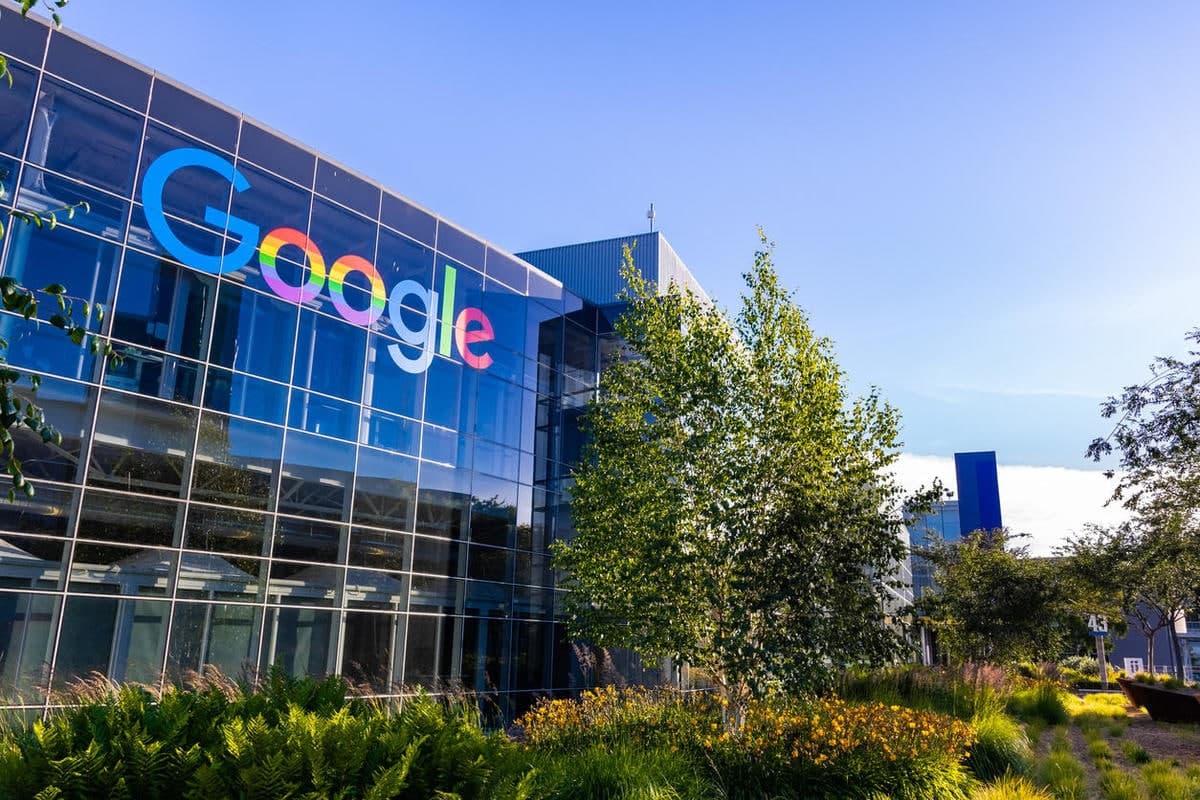
Корпорация является безусловным лидером на международном web-рынке, неизменно радуя миллионов пользователей со всего мира огромным выбором инновационных Интернет — продуктов. С 2015 года Гугл является дочерней компанией холдинга Alphabet, капитализация которого на начало 2021 года достигла 1,66 триллионов долларов США. По прогнозам аналитиков, к началу 2022 года эта цифра вырастет до 1,96 триллионов.
История создания компании Google: с 1995 года до наших дней
В 1995 году Ларри Пейдж решил поступать в магистратуру знаменитого Стэндфордского университета. Показать новичку университет вызвался Сергей Брин. Как потом отмечали многие очевидцы, в день своего знакомства ребята разошлись во мнениях по многим вопросам, однако, уже спустя год их увлекла работа над совместным проектом.
В 1996 году Пейдж по совету профессора Т.Винограда в качестве темы своей диссертационной работы выбирает исследование влияния внешних гиперссылок (текст, фотография, кнопка или любой другой элемент интернет — страницы по нажатию на который открывается другая станица) со сторонних сайтов на различные интернет — ресурсы. По мнению Ларри, уровень доверия к веб-порталу и размещенной на нем информации должен определяться в зависимости от того, насколько часто другие сервисы и сайты ссылаются на него в качестве первоисточника данных. Впоследствии результаты масштабной работы, проведенной аспирантом, легли в основу Page Rank (PR) — одного из ключевых факторов, обеспечивших Гугл лидерство в своей сфере.
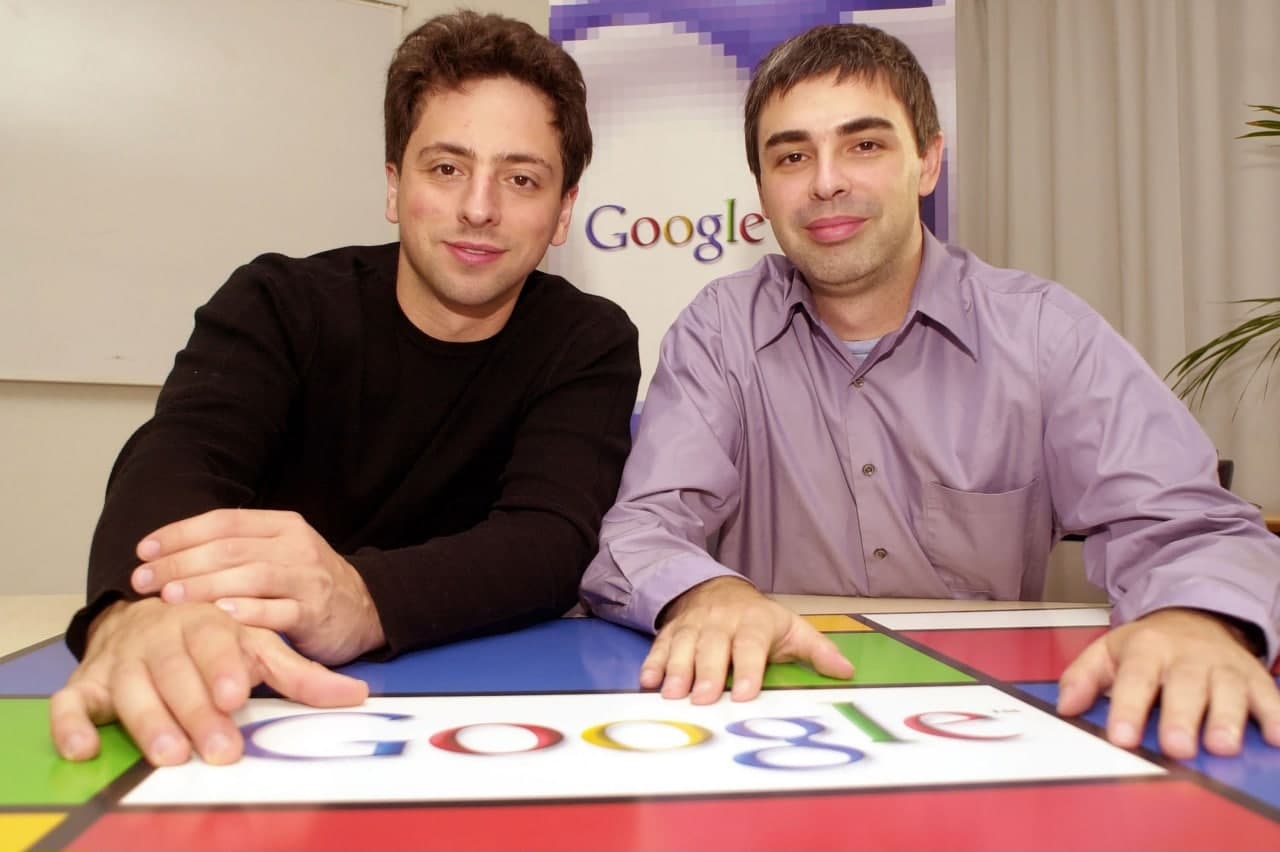
Свой научный проект Ларри назвал «BackRub». Однако, он недолго трудился в одиночку, уже через некоторое время к его исследованию присоединился Сергей Брин. Уже в конце весны 1996 года с домашней страницы Пейджа в университете был запущен первый вариант поискового робота, выполнившего пробную индексацию Всемирной паутины. Для качественного отображения результатов поисковой выдачи друзья использовали уникальный алгоритм Page Rank. Его идея заключалась в том, что при ранжировании страниц учитывается авторитетность того иного сайта, которая формируется на основе количества внешних гиперссылок на него с других ресурсов.
Первоначально поисковик Гугл размещался на сайте Стэндфордского университета по ссылке google.stanford.edu. 15 сентября 1997 года Пейдж и Брин зарегистрировали доменное имя google.com давшее начало самой известной компании нашего времени.
Дата основания Google: 4 сентября 1998 г. в Менло-Парк, Калифорния, США. Ларри Пейдж и Сергей Брин, получившие от Энди Бехтольштейма первое финансирование в размере 100 000 долларов США, официально регистрируют собственную компанию. Уже через четыре месяца, к концу года, поисковик Гугл провел индексацию (проверил и внес в единую базу поисковой системы информацию о контенте сайта) порядка 60 миллионов интернет — страниц, что показало его явное преимущество, перед уже существовавшими на тот момент аналогами.
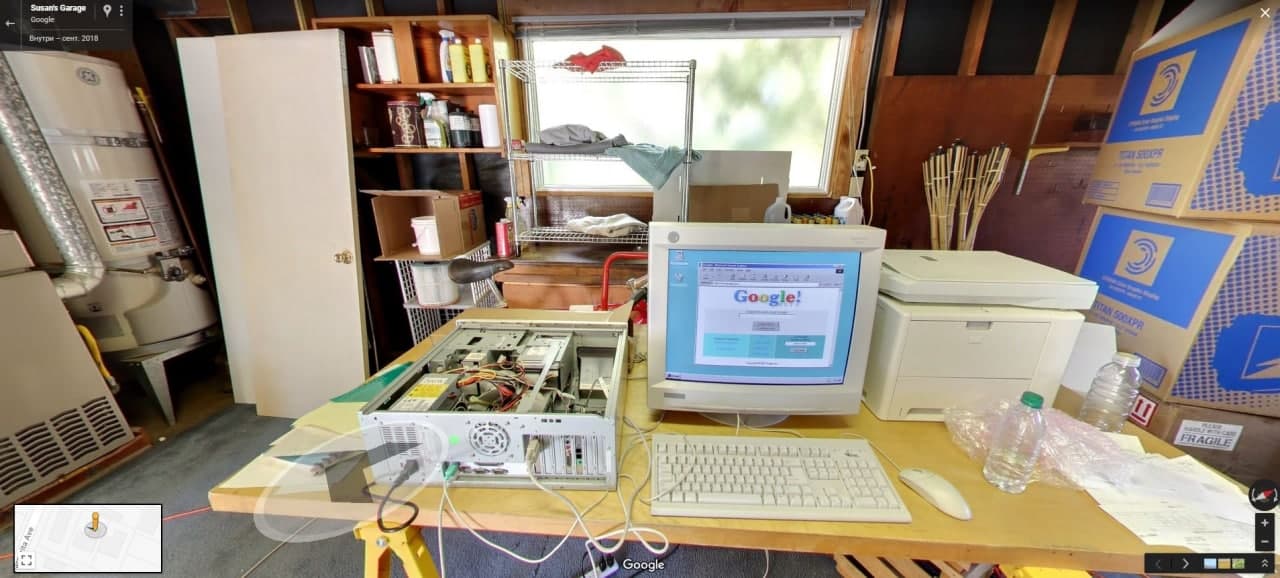
- Начало 1999 года — молодые бизнесмены внезапно осознали, что Бизнес и работа в компании настолько поглотила их, что начала явно мешать учебе. В итоге друзья решают выставить Google на продажу. Им удается договориться о встрече с руководителем Excite, Дж.Беллом. На встрече амбициозные ребята предлагают купить их проект за 1 миллион долларов. Но Белл отказывается от «сомнительной» по его мнению сделки.
- Май 1999 год — Пейдж и Брин решают продолжить работу в компании, после чего Гугл переезжает в город Пало-Альто, где на тот момент уже находились многие другие технологические стартапы Кремниевой долины. К концу 1999 года компания арендовала комплекс зданий в Маунтин-Вью 1600 Amphitheatre Parkway от Silicon Graphics, где продолжает работать вплоть до наших дней.
- Февраль 2002 года — закончилась глобальная модернизация сервиса контекстной рекламы AdWords. Его первая версия представленная миру в 2000 году, функционировала по системе СРМ, предусматривающая оплату за «1000 показов». После выхода второй версии рекламодатели стали платить не за размещение объявлений, а за фактические клики (переходы) по ним. Кроме того в Адвордс 2002 года изменилась система ранжирования, с этого времени она учитывала также релевантность объявления и его кликабельность.
- Сентябрь 2002 года — запущена бета — версия Google News, позволяющая получать быстрый доступ к более, чем 5 тысячам новостным ресурсам.
- 2003 год — покупка компании Pyra Labs и продукта Blogger — своеобразного аналога онлайн — журнала для блогеров.
- Апрель 2004 года — компания представила собственную почтовую службу Gmail, созданную на основе технологии AdSense.
- 2005 год — создана система интерактивных карт Google Maps.
- Осень 2006 года — компания приобретает видеохостинг YouTube за 1,65 миллиардов долларов.
- 2007 год — Гугл презентует собственную ОС Android, предназначенную для мобильных гаджетов.
- Осень 2008 года — запуск браузера Chrome.
- Апрель 2012 года — пользователям становится доступен облачный сервис хранения данных Google Disk.
- Ноябрь 2014 года — Google сообщает об открытии своего 70 офиса. На тот момент отделения и филиалы компании успешно работали более, чем в 40 странах мира.
- 2015 год — масштабная реорганизация Google Inc. и основание холдинга Alphabet. С этого момента Гугл считается дочерним предприятием, а Алфавит принял на себя материнскую роль. Должность СЕО в новом холдинге занял Ларри Пейдж, который к тому моменту уже имел опыт работы главным исполнительным директором в Гугул (с 1998 по 2001 и с 2011 по 2015 гг). Сергей Брин, который в Google занимал пост Президента по технологиям и осуществлял руководство новыми проектами, в Alphabet Inc. примерил на себя роль Президента — второй по значимости должности в компании после СЕО.
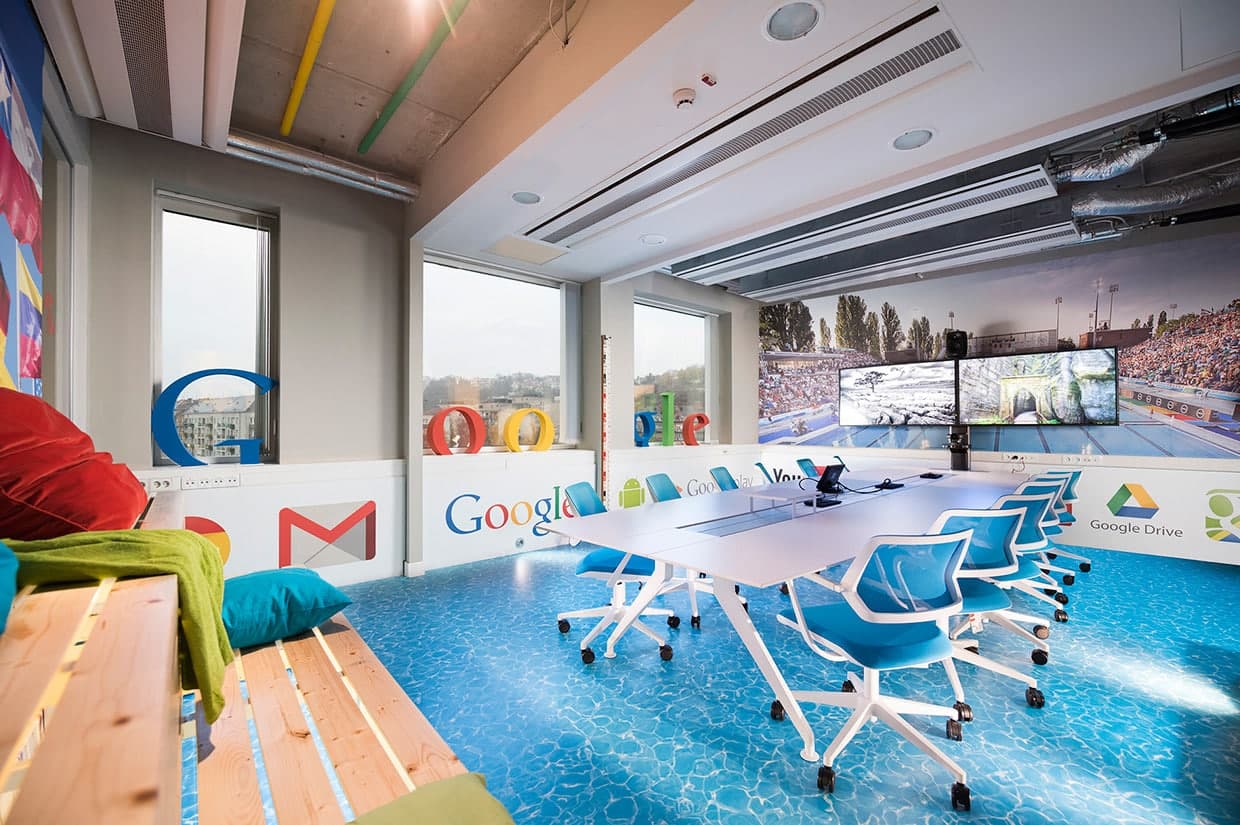
Основной причиной масштабной реорганизации и создания холдинга Alphabet Ларри Пейдж называет тот факт, что это позволило разделить традиционный бизнес и экспериментальные проекты. Кроме того, холдинговая структура позволила сделать процесс покупки-продажи новых компаний более простым, при этом стартапы, присоединившиеся к корпорации, получают максимальную автономию.
С 2016 года в списках ведущих аналитических агентств отражаются финансовые результаты Alphabet, а не отдельно Google. Так в рейтинге «Global 2000» за 2020 год холдинг Алфавит занимает 5-е место в мире по рыночной стоимости и 7- место по совокупной годовой прибыли. По версии Forbes объемы продаж компании в 2020 году составили 166,3 миллиарда долларов США.
Поисковик Google в первые года работы
В середине 90-х годов прошлого века поисковики представляли из себя сайты с огромным количеством ненужной информации, которая попросту отвлекала и даже мешала процессу поиска. Дело в том, что существующие на тот момент поисковые системы с помощью разнообразного визуального «мусора» рассчитывали завлечь пользователя, «заставить» его провести на сайте, как можно больше времени, тем самым увеличив трафик.
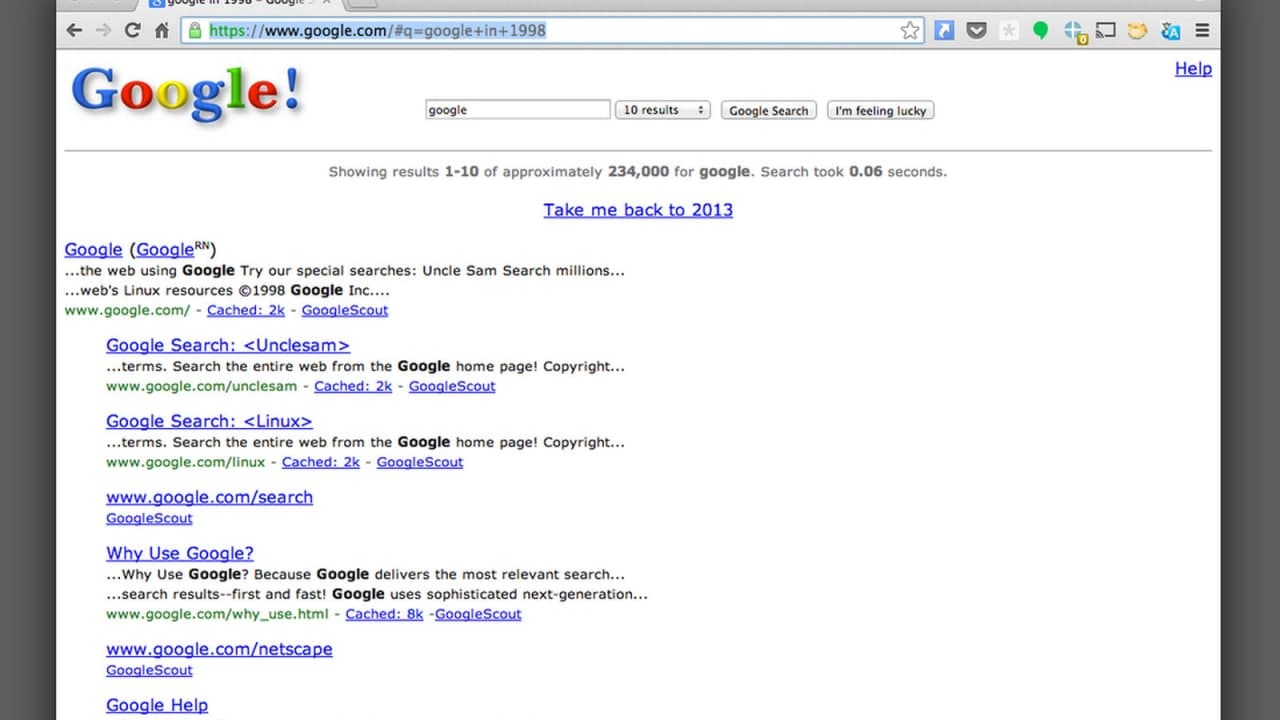
При создании собственной поисковой системы Сергей Брин и Ларри Пейдж решили идти другим путем, сконцентрировав внимание исключительно на качестве и эффективности работы поискового робота. Для этого стартовая страница Гугл получила максимально простое и лаконичное оформление — по сути, внешний вид сайта включал одну поисковую строку с логотипом на белом фоне. Неожиданно для всех такое решение получило невероятный отклик среди пользователей, которые назвали новый поисковик user-friendly — удобным и ориентированным на нужды клиента.
Примечательно, что с тех пор интерфейс стартовой страницы Google остался практически неизменным. Сегодня, как и 24 года назад, на ней нет ничего лишнего — только строка для ввода поискового запроса и логотип Гугл.
Выход компании Google на IPO в 2004 году
Оной из важнейших дат в истории Goggle Inc. считается 19 августа 2004 года — в этот день корпорация стала публичной, выйдя на биржу NASDAQ. Компания выставила на продажу 19 605 052 акций, оценив одну акцию в 85 долларов. Для продажи ценных бумаг был организован уникальный по своему формату онлайн — Аукцион.
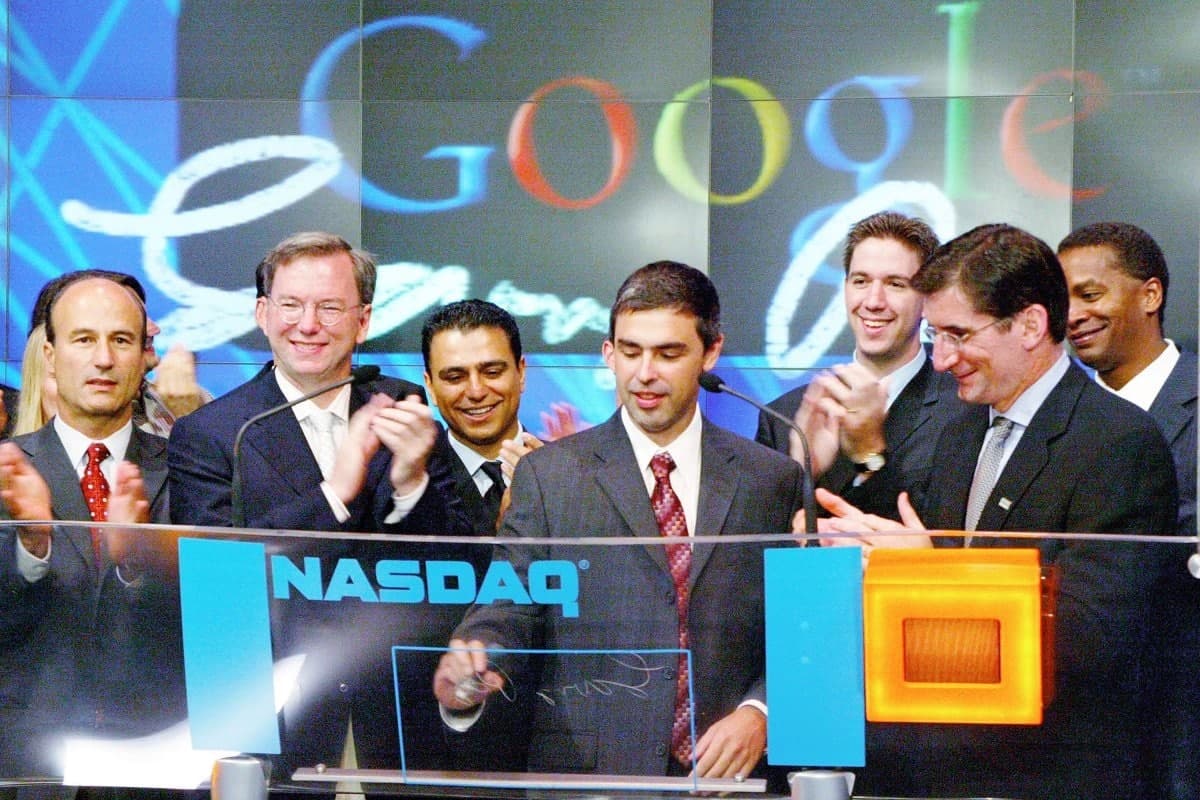
Выручка от IPO составила 1,67 миллиардов долларов, что означало, что ее биржевая стоимость равняется 23,1 миллиарда долларов. Сегодня акции Гугл продаются не только на американской NASDAQ, но и на Франкфуртской фондовой бирже.
Название компании и логотип компании Google
Название компании ««Google» начало использоваться Пейджем и Брином и еще до ее официальной регистрации. Правда, первоначально речь шла о математическом термине googol, с помощью которого обозначается невообразимо больше число со ста нулями. Однако, использовать слово «Гугол» в качестве названия для своего поисковика ребята не смогли, так как домен с таким названием к тому моменту уже существовал, поэтому «googol» трансформировался в «google».
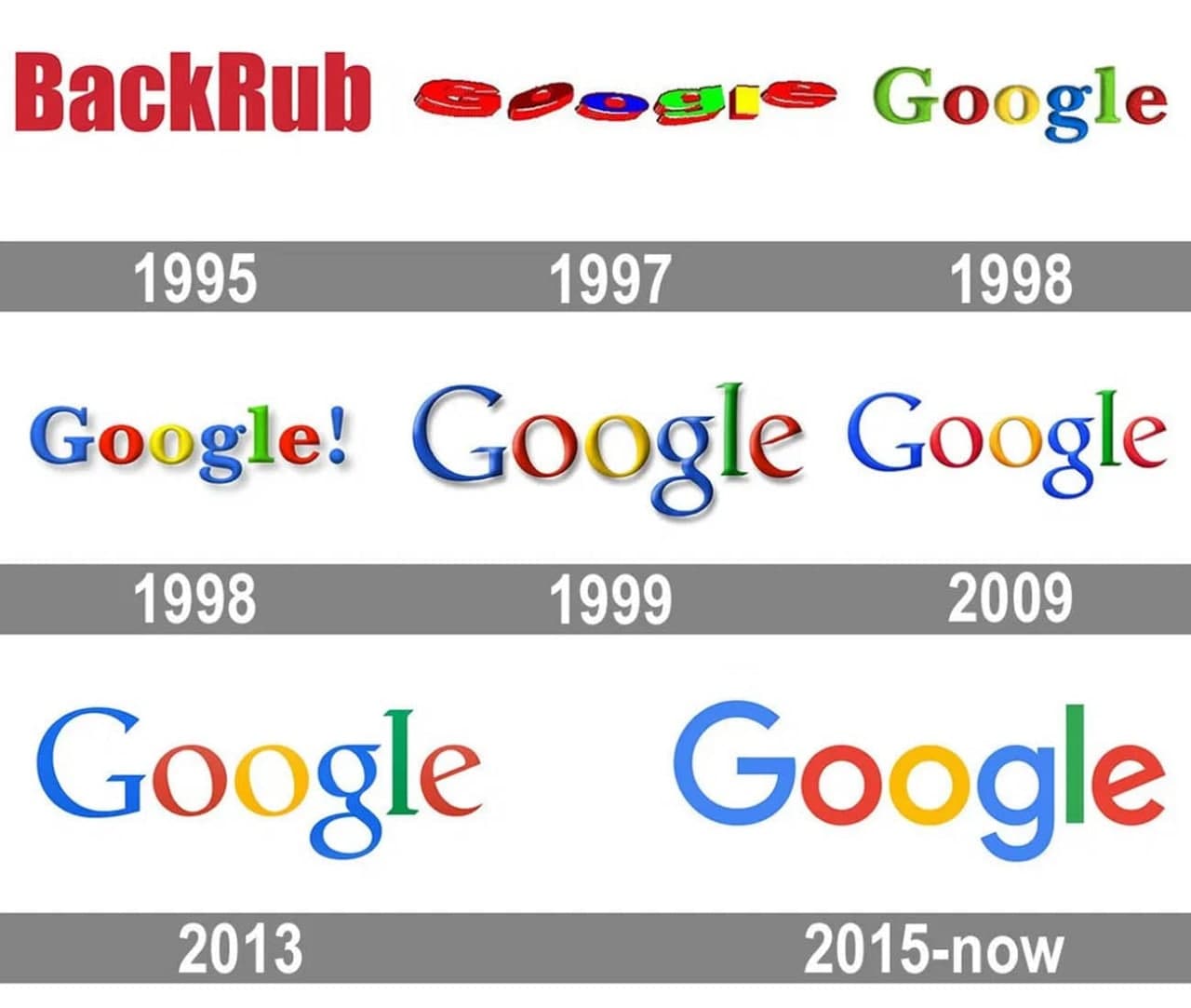
Первый вариант логотипа новой компании был разработан самим Брином в 1998 году. Для этого он воспользовался бесплатной программой для дизайнеров GIMP. На тот момент в конце Лого присутствовал восклицательный знак. В 1999 году друзья решают обратиться за помощью в создании красивого и узнаваемого товарного знака к профессиональному дизайнеру Рут Кедар. Перед ней была поставлена задача — разработать такой логотип для молодого поисковика, который будет с одной стороны простым и лаконичным, с другой легким, дружелюбным и запоминающимся. В итоге Кедар был создан лого, представляющий собой объемные буквы «GOOGLE», раскрашенные в разноцветные, мультяшные цвета.
В 2010 году логотип был обновлен. Было решено убрать тень, а буква «О» из желтого оказалась перекрашена в оранжевый цвет.
В 2013 году фирменный знак вновь изменили, на этот раз компания отказалась от объема букв и слега приглушила оттенки.
В 2015 году для адаптации лого к разным устройствам корпорация отказалась от использования шрифта с засечками Catull в пользу более простого и непритязательного Product Sans. В качестве символа приложений, выпускаемых компанией начал использоваться стильный и лаконичный символ «G».
О Google в цифрах: статистика и финансовые показатели Google
О работе и текущем положении дел в Google могут рассказать следующие цифры:
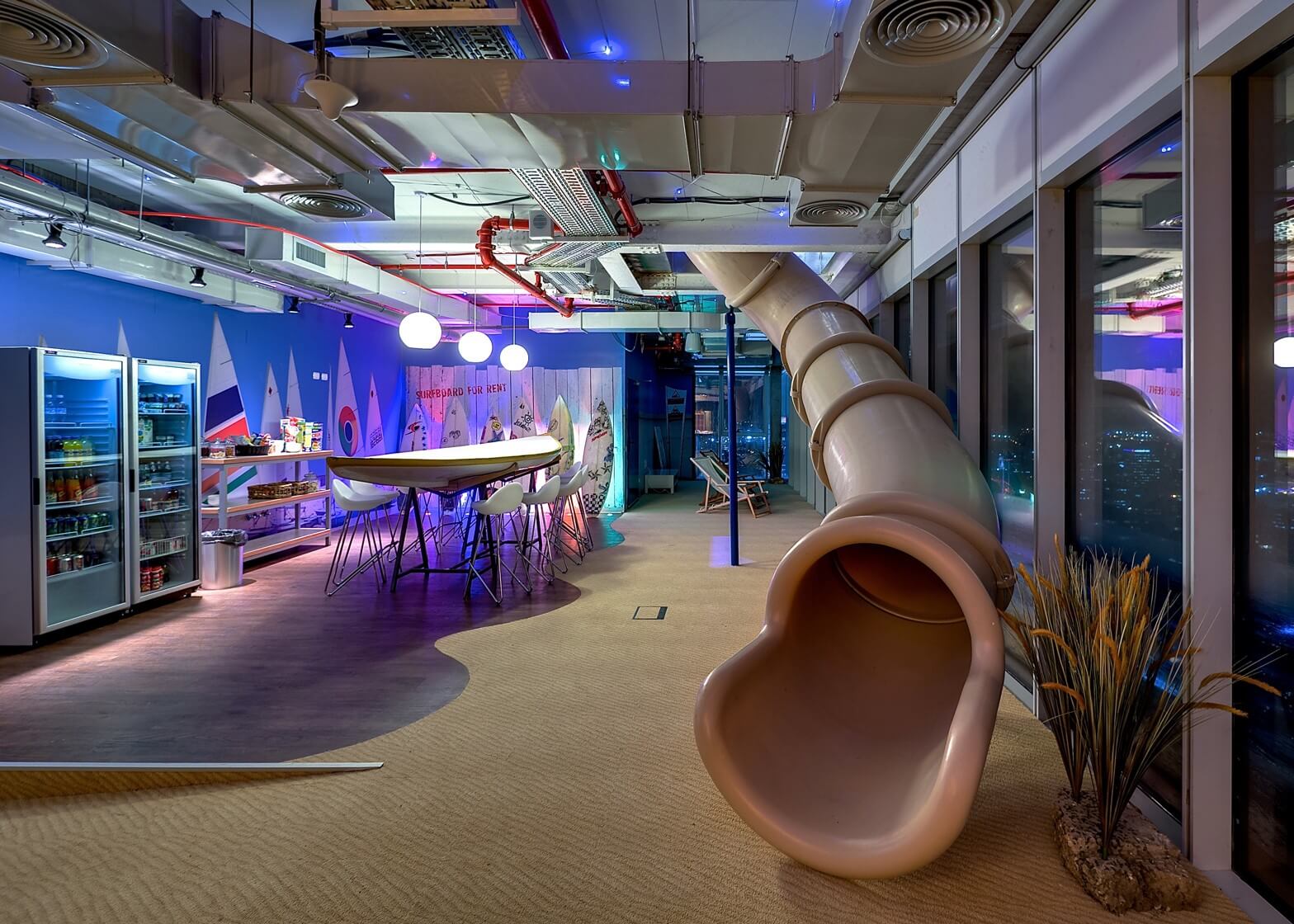
- По стоянию на первое сентября 2021 года стоимость одной акции Google составляет 2893.95 долларов США.
- На конец 2019 года в Гугл работало 118 899 сотрудников, проживающих в 70 странах мира.
- В 2019 году компания заплатила компенсацию в 11 млн долларов по коллективному иску соискателей на должности в Google, которые не смогли получить работу. Иск подписали 227 специалистов различных профессий, достигших возраста 40 лет и выше. Они обвинили бренд в возрастной дискриминации. По мнению истцов, им было отказано в приеме на работу исключительно из-за их возраста, так как все они обладали высокой квалификацией и большим опытом работы.
- Каждую секунду в Google выполняется 40 000 запросов.
- 1,65 миллиардов долларов — именно в эту сумму обошлась компании покупка видеохостинга YouTube.
- Более 60% всех запросов на поиск поступает с мобильных гаджетов.
- Ежемесячно видеохостинг YouTube посещает порядка 2-х миллиардов активных пользователя со всего мира.
- По информации Google, в индексе Google Search представлены сотни миллиардов веб-страниц, вес которых превышает 100 миллионов гигабайт.
- В мире насчитывается более 3 миллиардов постоянно использующихся Android устройств.
- С тех пор как Google запустил сервис Street View в 2007 году, команда проекта сфотографировала более 11,5 миллионов километров дорог.
На сегодняшний день Google является самым посещаемым сайтом во Всемирной паутине, среднее количество поисковых запросов в сутки уже превысило 3,5 миллиарда.
10 принципов компании Google: Философия Гугл
Корпоративная культура Google базируется на философии, состоящей из 10 ключевых принципах:
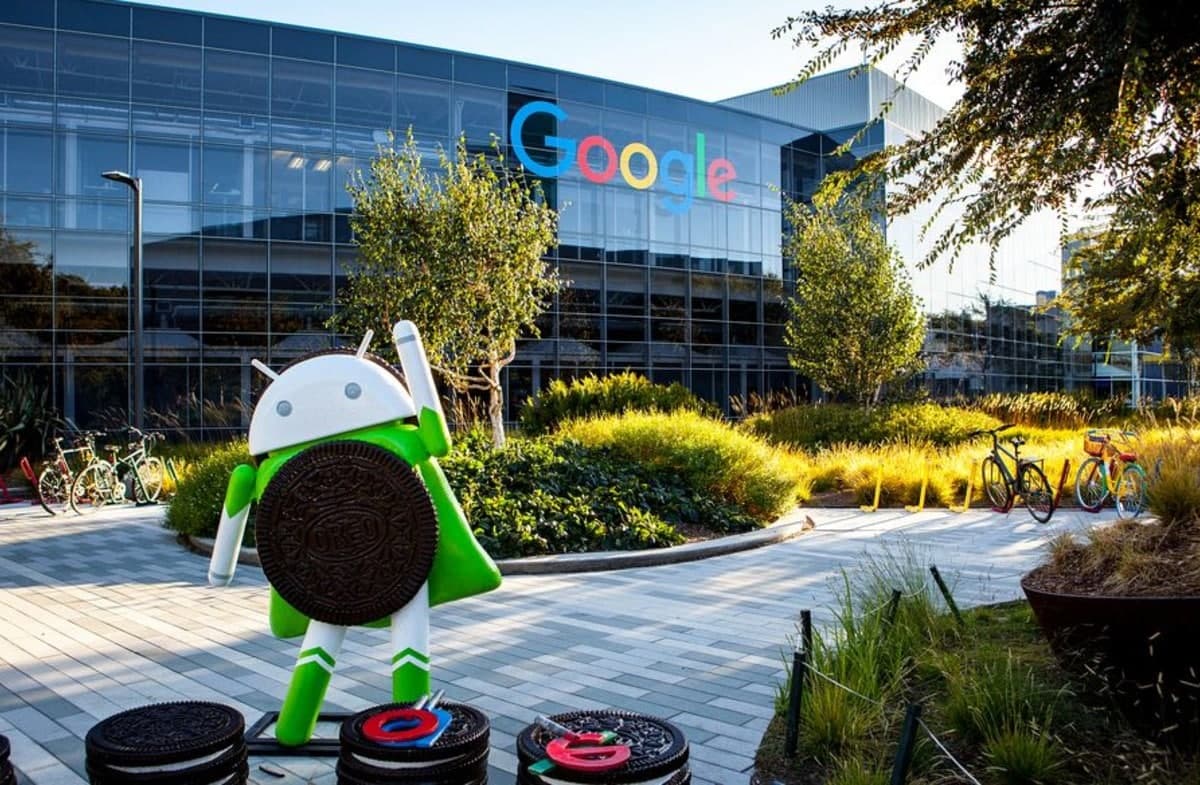
- Все внимание — пользователю. На протяжении всей истории существования компании ее руководство категорически отказывается вносить изменения в работу ее поисковой системы и других продуктов, которые фактически не могут принести пользы конечному потребителю. Создавая новый браузер, разрабатывая Приложения для смартфонов или внося изменения на главную страницу поиска, Гугл, прежде всего, стремится сделать удобнее жизнь своих пользователей.
- Лучше заниматься чем-то одним, делая это идеально. Свей главной задачей корпорация видит создание такой поисковой системы, с помощью которой миллионы пользователей по всему миру смогут за считанные секунды находить нужную им информацию.
- Быстро — это всегда хорошо. Google является единственной компанией в мире, которая заинтересована в том, что бы посетители покидали ее сайт, как можно скорее.
- Продвигаем принципы демократии в интернете. Для оценки важности каждого сайта поисковик с помощью различных методик проводит оценку более 200 параметров, добавляя в результаты поисковой выдачи только действительно полезные ресурсы с актуальной информацией.
- Чтобы получить ответ, больше не нужен компьютер. Получить доступ к поисковику сегодня можно через смартфоны, планшеты и даже бортовые компьютеры легковых автомобилей.
- Зарабатывать деньги можно, не мешая пользователям. Текстовая реклама AdWords никогда не мешает поиску или просмотру страниц сайтов.
- Всемирная паутина — обладает неисчерпаемыми источниками информации. Компания стремится предоставить своим пользователям максимальный объем данных по любому вопросу. В частности, для решения этой задачи в поиск были включены документы, представленные в 12 форматах txt, doc, pdf и т.д.
- Безграничный поиск информации — представительства компании работают по всему миру, интерфейс стартовой страницы поисковика переведен на 150 языков мира.
- Чтобы быть серьезным не нужен галстук. Руководство Гугл уважает интересы и предпочтения сотрудников. Специалисты ценятся за ум, креативность и личные результаты, а не за безупречный внешний вид и наглаженный офисный костюм.
- При грамотном подходе даже отличные результаты можно улучшить. Нет пределов совершенству. Даже став лучшим из лучших бренд продолжил свое развитие, регулярно разрабатывая новейшие методы работы, оптимизируя уже существующие алгоритмы и технологии.
Как неоднократно отмечал в своих интервью Ларри Пейдж, идеальная во всех отношениях поисковая система способна интуитивно понимать, что именно хочет видеть пользователь и показывать только те результаты, которые нужны здесь и сейчас. Сегодня в Гугл трудится огромный штат талантливых и высокопрофессиональных сотрудников, многие из которых являются специалистами экстра класса. Чтобы удержать работников и стимулировать их на новые свершения компания отказалась от общепринятых систем мотивации, предпочитая уделять максимум внимания конкретным людям и их потребностям.
Знания и навыки основателей, которые привели к созданию компании Google
Истории американского бизнеса известно немало примеров ошеломительного успеха и громких провалов. Добиться результатов там, где царит жесткая конкуренция, удается лишь единицам, которые обладают нетрадиционным складом ума и готовы к риску. Что интересно, о Билле Гейтсе или Стиве Джобсе, наверняка, знает, даже самый ленивый и нелюбопытный интернет — пользователь, тогда как имена основателей Гугл — Ларри Пейджа и Сергея Брина, известны лишь единицам. Между тем, они являются наглядным примером того, что имея четкую цель и желание можно свернуть горы.
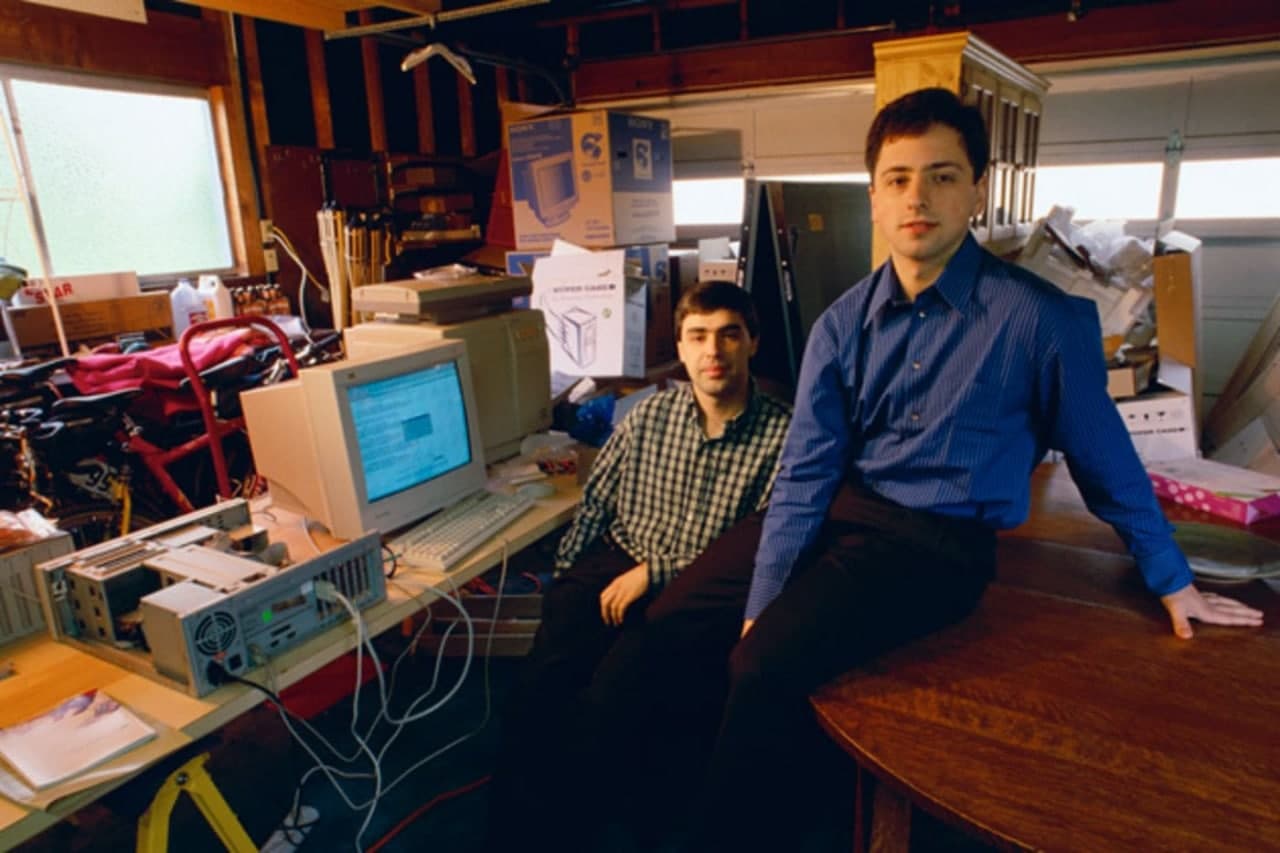
Сергей Брин — провел первые годы жизни в России, позднее он вместе со своими родителями эмигрировал в США. В американской школе он моментально привлек внимание педагогов, которые неизменно отмечали математический склад ума мальчика и его интерес к компьютерам.
Ларри Пейдж — родился в штате Мичиган, в семье преподавателей. Его отец имел научную степень доктора философии по информатике, мама преподавала Программирование в Мичиганском университете. Позднее вспоминая свое детство, Пейдж рассказывал, что в их доме повсюду стояли разобранные компьютеры, валялись различные детали, технические и научные журналы. Образ жизни и увлечения родителей закономерно привели к тому, что Ларри твердо решил связать свою жизнь с компьютерными технологиями.
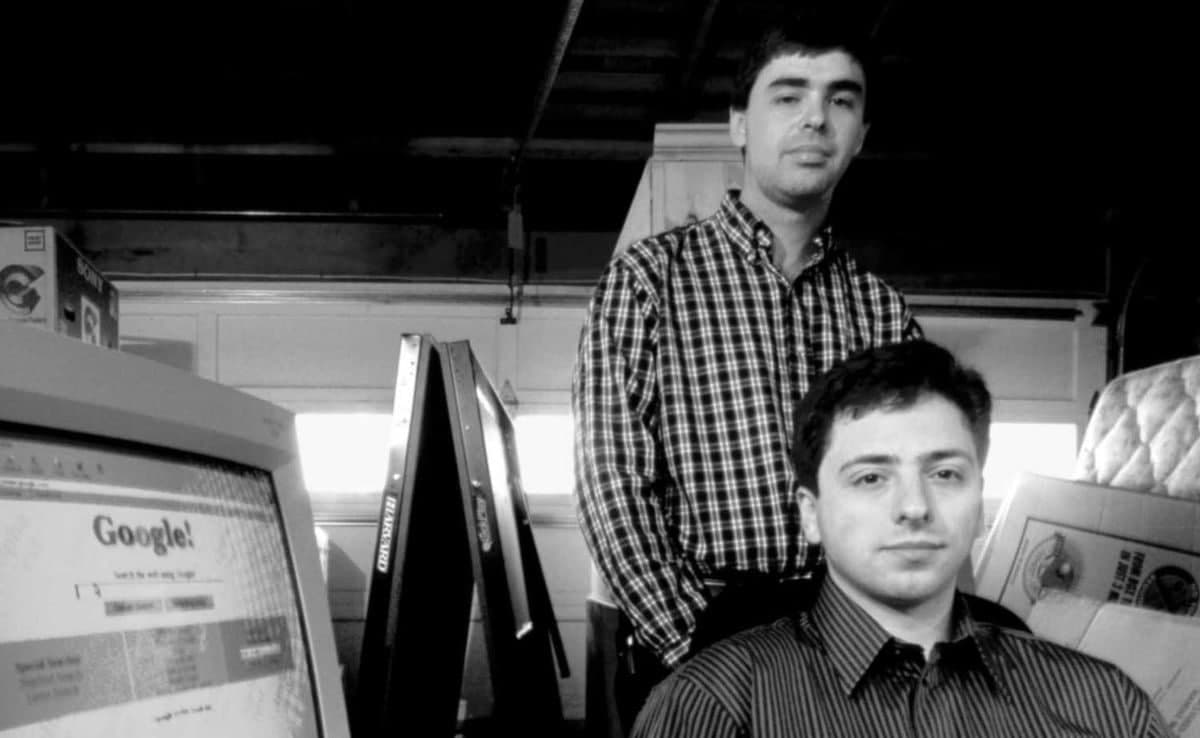
Дорожки, приведшие Пейджа и Брина в Стэндфордский университет, были разными. Однако, они оба специализировались на компьютерных науках и приехали в Калифорнию, чтобы продолжить Образование и получить научную степень. Будущих друзей объединили незаурядные математические способности, любовь к компьютерам, самоуверенность и готовность менять мир вокруг себя. Впоследствии именно эти качества позволили друзьям добиться успехов в бизнесе.
Еще во время учебы в Стэндфорде они постоянно, что-то придумывали и изобретали. Так, например, в 1993 году Брин создал приложение, которое загружало фото с сайта Playboy и автоматически использовало их в качестве заставки для рабочего стола ПК. Поставив перед собой амбициозную цель — упорядочить всю информацию, хранящуюся во всемирной паутине и сделать ее поиск максимально быстрым, будущие миллиардеры с присущим им энтузиазмом и самоуверенностью взялись за ее выполнение.
Ларри Пейдж и Сергей Брин считаются одними из самых либеральных руководителей, стремящихся создать в коллективе благоприятную для работы корпоративную атмосферу. Их суммарный капитал превышает сорок шесть миллиардов долларов, но друзья все равно продолжают упорно трудиться на благо компании, не останавливаясь на достигнутым.
Секреты успеха американской компании Google
Одним из главных секретов успеха Google является наличие глобальной миссии — «упорядочить и сделать доступной всю информацию в мире». Для достижения этой цели компания регулярно разрабатывает и запускает все новые и новые продукты, связанные с информацией: карты Google Maps, электронная библиотека Google Library и т.д.
- Основатели Гугл уверены, что на определенном этапе практически всех успешных стартаперов общество считало безумцами и психами. Их проекты и предложения казались странными. Однако, именно благодаря им наш мир становится другим. Именно поэтому, корпорация Гугл всячески поощряет своих сотрудников высказывать любые идеи, какими бы абсурдными они не казались.
- Важным моментом работы Google является уникальная по целому ряду критериев корпоративная культура, мотивирующая специалистов на успешную и продуктивную работу.
- Гугл не боится рисковать, а ошибки рассматривает как полезный опыт. Если проект оказывается неудачным — его закрывают без лишних сожалений. Более того, за закрытие такие проектов его команда получает премию и возможность подумать, чем она будет заниматься дальше.
- Гугл уважает и ценит своих рекламодателей, ведь именно они являются основным источником получения прибыли компании. Бюджет рекламной кампании напрямую зависит от количества реальных переходов потенциальных клиентов на продвигаемый сайт. Если переходов мало — значит и платить за такую рекламу можно меньше. Честная и прозрачная ценовая политика повышает уровень доверия и лояльности к поисковику со стороны рекламодателей.
- Ориентация на каждого пользователя. Традиционный Маркетинг делит всех потребителей на общие группы — студенты, спортивные болельщики, родители и т.д., так как считается, что запросы у тих людей одинаковые. Вот только Google уверен, что у каждого человека свои предпочтения и интересы. Уникальные алгоритмы анализа поисковых запросов позволяют подбирать рекламу, которая может быть интересна в данный момент времени конкретному покупателю.
- Гугл делает все, что в его силах, чтобы заслужить и удержать доверие своих пользователей. В книге Скотта Гэллоуэй Google названа компанией, которой доверяют. Люди задают поисковику вопросы, с которыми по различным причинам не могут обратиться к близким или знакомым. Доверию также способствует тот факт, что Google честно показывает, какие сайты из результатов поисковой выдачи являются оплаченной рекламой, а какие нет.
- Корпорация не боится отличиться и делать что-то, что может вызвать недоумение или открытое недовольство других людей. Первый стеллаж для сервера компании был построен из Лего, а первый дудл на сайте сообщал посетителям о том, что все сотрудники взяли выходной и уехали на Фестиваль Burning Man. Google открыто публикуют 10 базовых принципов своей работы и следует девизу «Не делай зла!». Она постоянно ищет новые решения и идеи для бизнеса, следуя собственной философии и правилам.
Ошибки — это то без чего нельзя избежать в любом бизнесе. Основатели Гугл это понимают и поэтому ошибка сотрудника расценивается как опыт, который они приобрели.
Alphabet: Google, Android, YouTube и другие дочерние компании
На момент написания статьи корпорация Google входит в холдинг Alphabet, к которому относится и сам «Гугл», и дочерние компании, принадлежавшие ему ранее. Таким образом, в составе «Альфабет» сегодня находятся:
- Google — транснациональная компания, развивающая системы веб-поиска, облачных вычислений и рекламных технологий. Портал google.com — самый посещаемый сайт в интернете (по статистике Alexa).
- Android — операционная система широкого спектра: для смартфонов и планшетов, телевизоров и бытовых роботов, электронных книг и ноутбуков, гейм-приставок и фитнес-браслетов, очков дополненной реальности и умных часов.
- YouTube — самый популярный в мире видеохостинг, второй по посещаемости сайт на планете. Предоставляет услуги хранения, демонстрации и отправки видео.
- Speaktoit (Dialogflow) — платформа, распознающая естественный язык. Используется в разработке и интеграции диалог-пользовательского интерфейса в мобильные приложения, компьютерные программы, чат-боты.
- Kaggle — система организации конкурсов по исследованию данных. Также это соцсеть для специалистов по обработке данных и машинному обучению.
- AdMob — компания, специализацией которой является мобильная реклама. Представляет из себя платформу для распространения рекламы, отображаемой на смартфонах.
- Looker Data Sciences — разработчик ПО. Реализует решения для бизнес-аналитики по исследованию и поиску данных.
- Fitbit — производитель бытовой электроники и смарт-устройств для фитнеса и здоровья. Среди популярных устройств — фитнес-трекеры и «умные» весы.
- DeepMind — компания, разрабатывающая и внедряющая Искусственный интеллект.
- Niantic — фирма, выпускающая Программное обеспечение. Самый известный продукт — игры для смартфонов с возможностями дополненной реальности.
- AppSheet — приложение и площадка для разработки ПО без кода. С ее помощью можно создать приложения для смартфонов, планшетов, компьютеров, используя облачные платформы в роли источников данных.
- Apigee — поставщик ПО для управления API и прогнозной аналитики.
- Sunroof — Стартап, развивающий технологии солярной энергетики. Его глобальная цель — «картирование солнечного потенциала Земли».
- ITA Software — разработка программного обеспечения для индустрии путешествий.
- Neverware — поставщик CloudReady, являющегося дистрибутивом Google Chromium OS, предназначенного для установки на ПК. CloudReady — возможность повторного использования старых компьютеров, что значительно сокращает количество отходов в виде ненужной электроники.
- Crashlytics — компания-разработчик ПО, призванного собирать, анализировать и систематизировать отчеты о сбоях в работе программ и приложений.
- Sidewalk Labs — компания, занимающаяся вопросами городской инфраструктуры и планирования. Ее глобальная цель — качественное улучшение жизни в городе за счет высокотехнологичных решений.
- FeedBurner — веб-сервис, способный пропускать через себя RSS-потоки для исправления в них ошибок, добавления дополнительной функциональности, предоставления статистики подписок.
- Actifio — частная фирма, работающая в сфере информационных технологий.
- Orbitera — поставщик облачных технологий и услуг. Платформа электронной коммерции, способная автоматизировать процессы оформления заказов и выставления счетов.
- Owlchemy Labs — разработчик видеоигр. Среди его самых известных гейм-продуктов — Job Simulator и Rick and Morty Simulator: Virtual Rick-ality.
- Channel Frederator Network — американская многоканальная сеть в области анимации, видеоигр и поп-культуры.
- Xively — компания, занимающаяся разработками в области интернет вещей. Предлагает клиентам решения по подключению электронных продуктов друг к другу, управлению подключенными устройствами и синтезируемыми ими данными, интегрированию этих данных в иные системы.
- Jigsaw — подразделение для инвестирования в проекты для решения геополитических проблем и предотвращения кибератак.
- BufferBox — стартап, предоставляющий киоски для получения посылок. С их помощью можно забирать заказы из интернет-магазинов 24/7.
- Makani — компания, разрабатывающая ветряные воздушные турбины. Приобретена «Гугл» в 2013, закрыта «Альфабет» в 2020.
Также выделяются: Google AI (подразделение для работы с искусственным интеллектом), Chronicle Security (вопросы кибербезопасности), Google Foundation (благотворительный фонд, учрежденный основателями и крупнейшими акционерами «Гугл»).
Google VS Facebook: Конкуренция за пользователей в сети интернет
На первый взгляд, может показаться, что конкуренция Facebook и Google возникла на пустом месте, так как эти IT-гиганты работают в совершенно разных секторах рынка — один сконцентрирован на поиске, другой на развитии социальных сетей и виртуального общения. Вот только на практике интересы корпораций все же пересекаются, так как и Гугл, и Фейсбук кровно заинтересованы в привлечении внимания пользователей, а вместе с ними и рекламодателей.
Открытое противостояние между компаниями началось после того, как Марк Цукерберг официально отказал Google в продаже части социальной сети и предоставлению доступа к поиску внутри Facebook. На это бренд Пейджа и Брина объявил о создании собственной социальной сети Google+, которая позволяет объединять своих друзей в виртуальном пространстве в группы по различным критериям — родные, коллеги по работе, приятели по колледжу и т.д. На реализацию Google+ были задействованы невероятные ресурсы, за счет чего этот проект стал одним из самых масштабных за всю историю компании.
Но Фейсбук не спешит сдавать свои позиции. Социальная сеть регулярно обновляется, предоставляя пользователям все более широкие возможности для безграничного общения. Сегодня аудитория социальной сети, разработанной Цукербергом, насчитывает полтора миллиарда человек, т.е. фактически каждый пятый житель нашей планеты имеет собственный аккаунт на Facebook.
В настоящее время FB с полным правом считается самой используемой в мире социальной сетью, тогда как Google — это самая популярная поисковая система на планете. Ими ежедневно пользуются миллиарды людей, являющихся потенциальными покупателями или клиентами для миллионов рекламодателей.
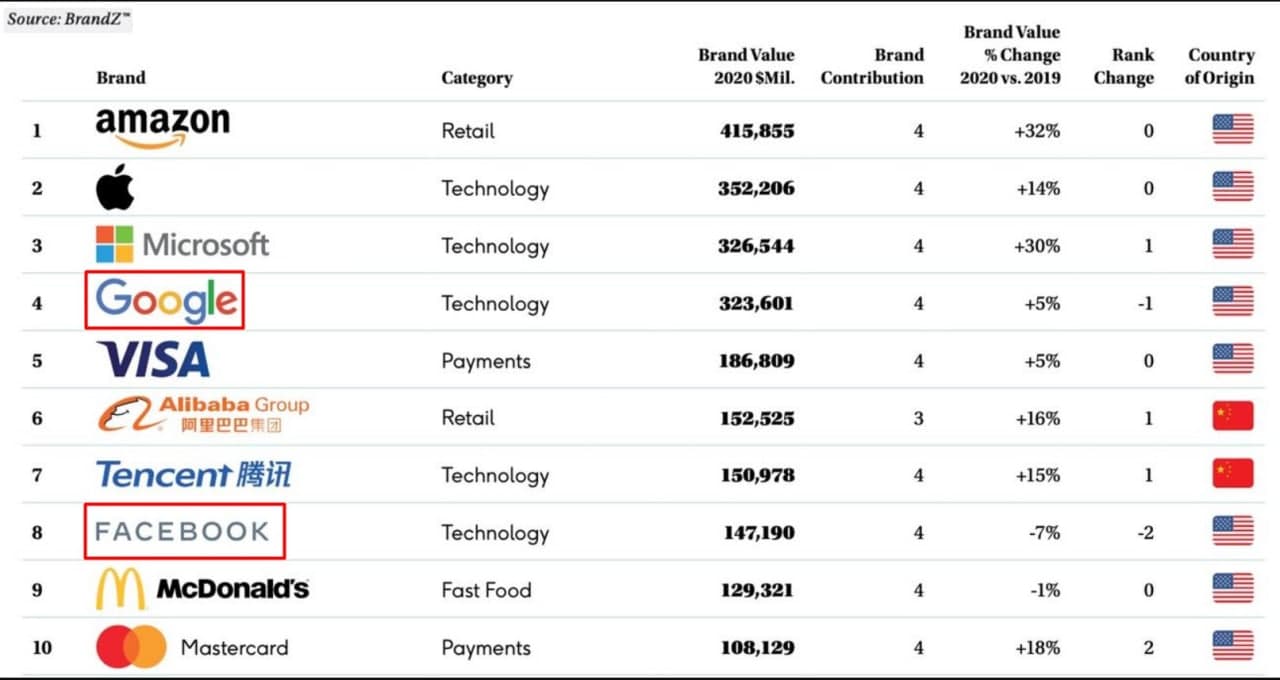
Именно спрос на рекламу, которая является одним из основных источников дохода двух гигантов, регулярно накаляет и так непростые отношения, складывающиеся между ними. Так, вплоть до декабря 2017 года Фейсбук занимал лидирующие позиции по количеству рекламных переходов по ссылкам, размещенным в ленте. Однако, благодаря постоянно увеличивающему пользовательскому контенту в Гугл, уже по итогам 2018 года, поисковик смог существенно опередить соцсети по числу переходов. Руководство Фейсбук на это моментально ужесточило требования к содержанию и качеству контента в постах и рекламных объявлениях, снизив стоимость кампании. Однако, как показало время, конкурентная борьба может быть весьма затратной, поэтому Google и Facebook предпочли искать компромиссы.
В сентябре 2018 года компании заключили соглашение под условным названием «Синий джедай» (отсылка к «Звездным войнам», где синий считался цветом добра). В этом документе FB согласился не конкурировать с инструментами онлайн — рекламы Гугл, за что ему причитались серьезные рекламные преференции. В частности, компании Цукерберга было обещано, что она будет гарантированно выигрывать фиксированное количество рекламных аукционов, организуемых Google.
Прием на работу в компанию Google: Идеальный кандидат для Гугла
Согласно данным статистики, ежегодно порядка трех миллионов человек со всего мира подают свои резюме для трудоустройства в Гугл. На работу же устраивается не более 5-7 тысяч человек. На некоторые должности конкурс доходит до 100-300 человек на место, пройти же удается только тем, кто наиболее полно соответствует критериям отбора:
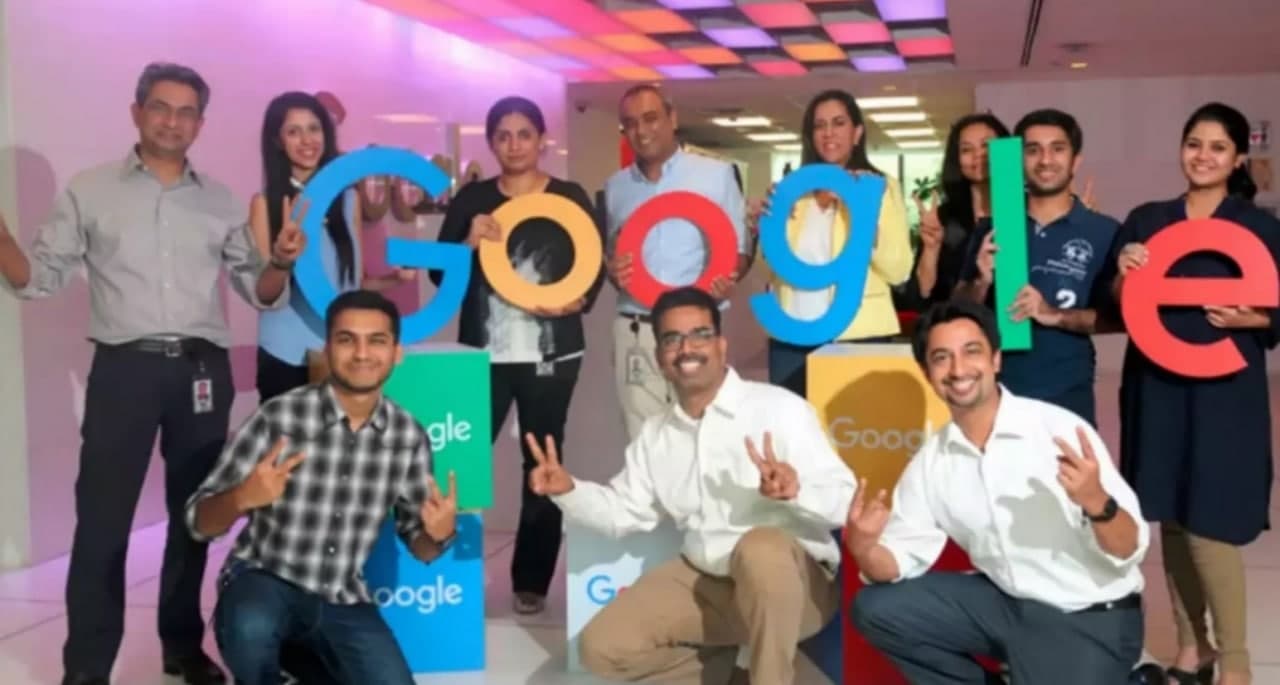
- Гуглерантность кандидата — соответствие соискателя духу компании, готовности к обучению и развитию.
- Наличие в биографии будущего специалиста «траектории» — например, если придется выбирать между выпускником университета Лиги плюса с высоким средним баллом и человеком, ставшим первым в своей семье, кому удалось закончить колледж, несмотря на подработку, то предпочтение будет отдано второму кандидату.
- Способность находить верные решения в сложных ситуациях — в компании трудится немало людей, которые до трудоустройства не обладали реальным опытом или нужным уровнем квалификации, но сумели проявить себя в сложных и нестандартных ситуациях. Например, один из HR-менеджеров Гугл будучи студентом и волонтером сумел организовать работу нескольких тысяч добровольцев, помогавших устранять последствия нефтяного загрязнения.
- Умение работать в команде и готовность признавать собственные ошибки — все время побеждать невозможно и если соискатель на должность рассказывает только о своих достижениях, замалчивая провалы, это может стать веским поводом для отказа в трудоустройстве.
Отдельно стоит отметить, что большинство новых сотрудников Google принимаются по рекомендациям уже существующих работников. Такая практика позволяет работодателю рассчитывать на то, что человек лучше и быстрее освоится в команде, часть которой ему уже знакома.
15 интересных фактов о Google, о которых мало кто знает
Гугл небезосновательно имеет репутацию компании, которая не боится быть не такой как все. Наглядным свидетельством этого могут служить следующие факты:
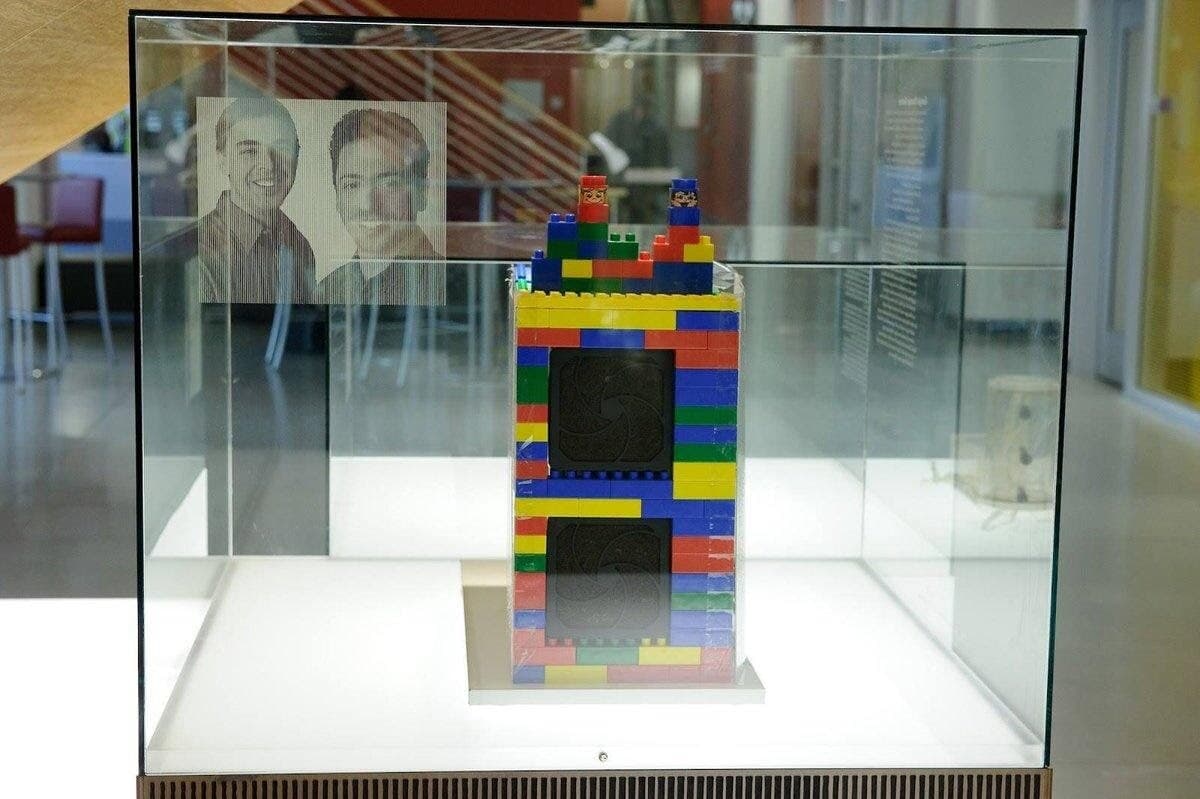
- В 2010 году из-за ошибки Google Maps войска Никарагуа «случайно» перешли границу с Коста-Рика, после чего вырубили на территории сопредельного государства заповедный лес и разбили там военный лагерь.
- Первый сервер Google размещался на стойках, собранных из конструктора Lego, он был размещен на размещение 10 жестких дисков, каждый по 4 Гигабайта.
- Основателям компании сегодня принадлежит только 16% акций.
- Начиная с 2010 года, Google в среднем покупает одну компанию в неделю.
- Сегодня поиск в Гугл доступен на 150 языках мира, в том числе в списке имеется пиратский язык и борк-борк-борк — язык, на котором разговаривал шведский шеф-повар из популярного норвежского мультика.
- После смерти сотрудника фирма платит его супругу 50% от заработной платы покойного в течение 10 лет.
- В Гугл больше любят собак, чем кошек. Более того, в корпоративном кодексе бренд называет себя не иначе, как «собачья компания», так как собственный дог-френдли имеется у каждого 4 сотрудника. Более того, своего питомца можно приводить в офис, правда, с условием, что собака не будет вести себя агрессивно по отношению к другим сотрудникам.
- Корпорация решила перекрасить букву «О» в логотипе в оранжевый цвет, после того, как перфекционист Стив Джобс публично заметил, что желтый цвет в лого смотрится неуместно.
- Сьюзен Войчицки — женщина, у которой Пейдж и Грин, арендовали гараж под свой первый офис, после покупки Youtube, была назначена его генеральным директором.
- Официально порядка 15% сотрудников корпорации являются самоучками и никогда не учились в колледже.
- Региональные офисы имеют оригинальное оформление. Так, например, в московском отделении компании гостей встречает Баба-Яга.
- В компании действует собственный корпоративный сленг. Так, новичков здесь называют нуглерами, а уволившихся сотрудников ксуглерами.
- Google является владельцем доменов типичных опечаток: Gogle.com, Gooogle.com.
- Для передвижения по кампусу корпорации используются разноцветные велосипеды Gbikes.
- Google является владельцем пяти из десяти самых популярных среди населения США мобильных приложений: YouTube, Google Play, Maps, Gmail и Google Search (поиск).
О популярности поисковика также может свидетельствовать тот факт, что на основе его названия было образовано новое слово — «гуглить», с помощью которого пользователи обозначают процесс поиска информации в Интернете.
Как монополизация рынка поисковых систем влияет на работу Google?
Слежка за конкурентами, несправедливая работа поиска, давление на рекламодателей, покупка лояльности пользователей и партнеров — это далеко не все обвинения, в которых обвинялась компания Google за последние несколько лет. Осенью 2020 года Министерством юстиции США был подан антимонопольный иск против поисковика, в котором корпорация объявляется в использовании антиконкурентных методов для сохранения доминантных позиций на рынке рекламы и поиска.
По мнению Правительства, Google тратит миллиарды долларов на то, чтобы производители мобильных устройств, браузеры и операторы связи использовали Гугл в качестве поисковой системы по умолчанию. Власти страны уверены, что такая монополизация рынка поисковых систем наносит вред конечному потребителю, снижает качество поисковых услуг и лишает обычного человека выбора.
К слову сказать, за свои монополистские действия и намерения Google уже выплатила не один миллиард долларов. Так в 2017 году Европейской комиссией в отношении Гугл был выписан штраф в размере 2,4 миллиарда евро за нарушение антимонопольного законодательства ЕС. Причиной санкций стали махинации компании с поисковой выдачей в пользу собственного сервиса Google Shopping.
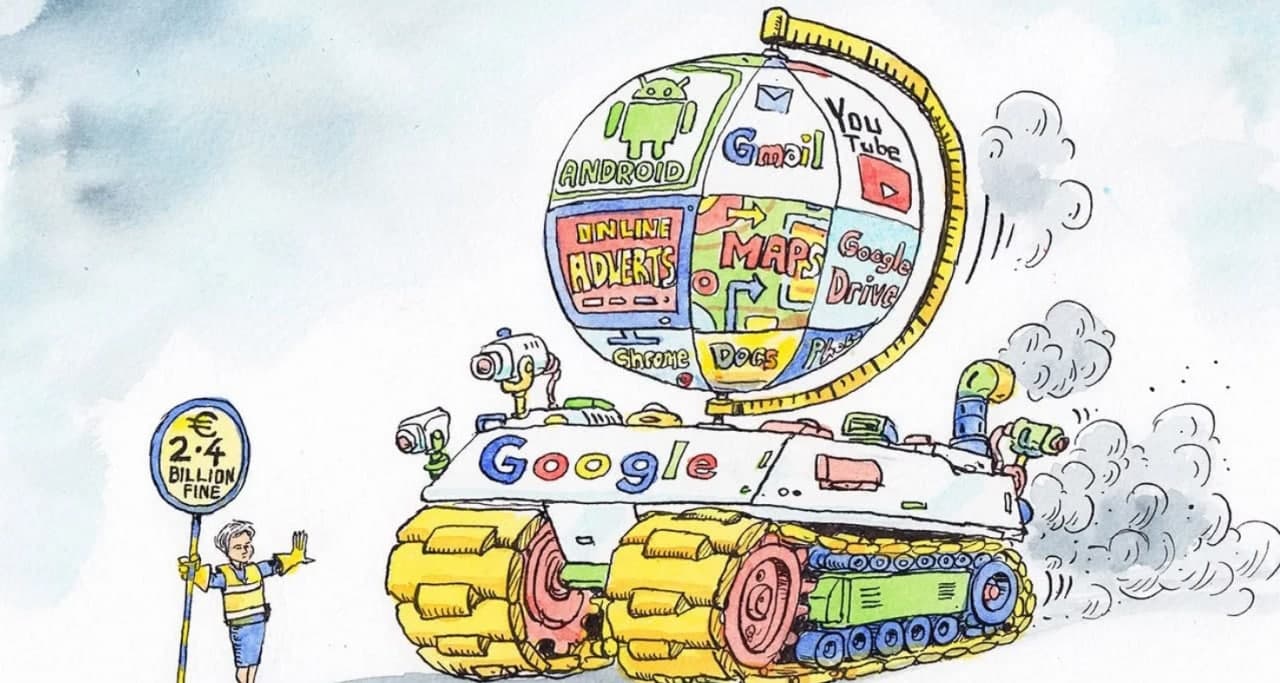
В 2018 году Еврокомиссий вновь был назначен штраф, на этот раз в размере 4,3 миллиардов евро, за злоупотребление главенствующим положением на рынке мобильных устройств на базе Андроид. Как позднее отмечалось в заявлении еврокомиссара по конкуренции, с 2011 года Google самовольно накладывала ограничения на операторов мобильной связи и производителей мобильных гаджетов, с целью укрепить свое положение в поисковиках. Так, например, для получения доступа к магазину приложений Google Play производители смартфонов должны были выпускать устройства с предустановленным браузером Chrome.
В 2019 года Антимонопольная комиссия Евросоюза оштрафовала Google на 1,7 миллиардов долларов за монополистские действия в сфере онлайн — рекламы. Причиной обвинения стал тот факт, что в период с 2006 по 2016 гг. поисковик намеренно блокировал в интернете рекламу, конкурирующих с ним рекламных площадок.
Все продукты и сервисы компании Google: свои проекты и выкупленные
Помимо того, что компания Google владеет крупнейшей поисковой системой в мире, список ее продуктов насчитывает большое количество приложений и сервисов, образующих единую экосистему, для получения доступа к которой используется один аккаунт.
Список продуктов представлен следующими наименованиями:
- Android Auto — удобный сервис, обеспечивающий аудиовизуальную связь между бортовым компьютером автомобиля и приложениями смартфона водителя.
- Chrome — один из самых популярных браузеров на планете.
- Chromebook — компактный ноутбкук, ориентированный исключительно на работу с «облачными» интернет — сервисами.
- Chromecast — миниатюрный медиаплеер, предназначенный для воспроизведения видео и аудио контента.
- Daydream View — простая и удобная в использовании гарнитура, предназначенная для использования совместно с VR — технологиями.
- Gboard — экранная клавиатура с интуитивно понятным управлением.
- Gmail — бесплатный почтовый сервис с собственным хранилищем данных.
- Google Cardboard — уникальная разработка, позволяющая создавать симулятор виртуальной реальности с помощью Андроид — смартфона и подручных материалов.
- Google Cast — специальный протоков, позволяющий транслировать контент на синхронизированных устройствах.
- Google Duo — сервис для видеозвонков.
- Google Express — сервис быстрой доставки товара.
- Google Fi — виртуальной оператор мобильной связи.
- Google Fit — мобильное приложение для людей, ведущих активный образ жизни.
- Google Fonts — самая большая библиотеке бесплатных шрифтов.
- Google Keep — приложение для создания быстрых заметок.
- Google One — усовершенствованное облачное хранилище.
- Google Pay — система мгновенных электронных платежей для мобильных гаджетов.
- Google Play — магазин приложений для Андроид.
- Google Play Books — программа для воспроизведения книг.
- Google Play Игры — полноценный игровой центр для устройств на базе ОС Андроид.
- Google Play Музыка — сервис для прослушивания аудио файлов на мобильных устройствах.
- Google Play Фильмы — сервис для просмотра видео.
- Google Street View — программа для просмотра панорамных снимков из любой точки планеты.
- Google Wi-Fi — смарт-роутер для корпоративной и домашней сети.
- Авиабилеты — удобный сервис по поиску авиабилетов.
- Виртуальный принтер — продукт печатать документы и фото с устройств, синхронизированных с принтером.
- Группы — сервис по созданию тематических групп и сообществ.
- Класс — набор инструментов для онлайн — образования.
- Оповещения — служба автоматической e-mail рассылки.
- Сайты — простой конструктор для создания и редактирования веб-страниц.
- Экспедиции — программа для создания авторских виртуальных туров.
- Hangouts — инструмент для быстрого обмена сообщениями.
- Play Защита — встроенная система безопасности для мобильных гаджетов.
- Tilt Brush — программа для 3D-рисования.
- Voice — бесплатный мессенджер, основанный на протоколе обмена данными VoIP.
- Waze — навигационная служба для создания и редактирования карт.
- YouTube — крупнейший видеохостинг в мире.
- Академия — огромная библиотека научных и студенческих работ.
- Google Диск — виртуальное хранилище данных.
- Документы — набор инструментов для работы с текстовыми файлами.
- Календарь — сервис планирования.
- Карты — удобные интерактивные карты для ПК и мобильных устройств.
- Контакты — адресная книга пользователей.
- Новости — агрегатор актуальных новостей.
- ОС Android — операционная система для мобильных устройств, телевизоров и т.д.
- Переводчик — сервис мгновенного перевода с одного языка на другой.
- Призентации — онлайн — инструмент для создания и редактирования слайдов.
- Рисунки — программа для работы с изображениями, диаграммами и инфографикой.
- Таблицы — набор инструментов для создания и работы с электронными таблицами.
- Умный дом — специальное приложение, позволяющее настраивать и управлять различными устройствами, бытовой техникой и приборами умных домов.
- Финансы — приложение, предназначенное для работы с деньгами, акциями, биржами.
- Фото — инструмент создания и редактирования фото контента.
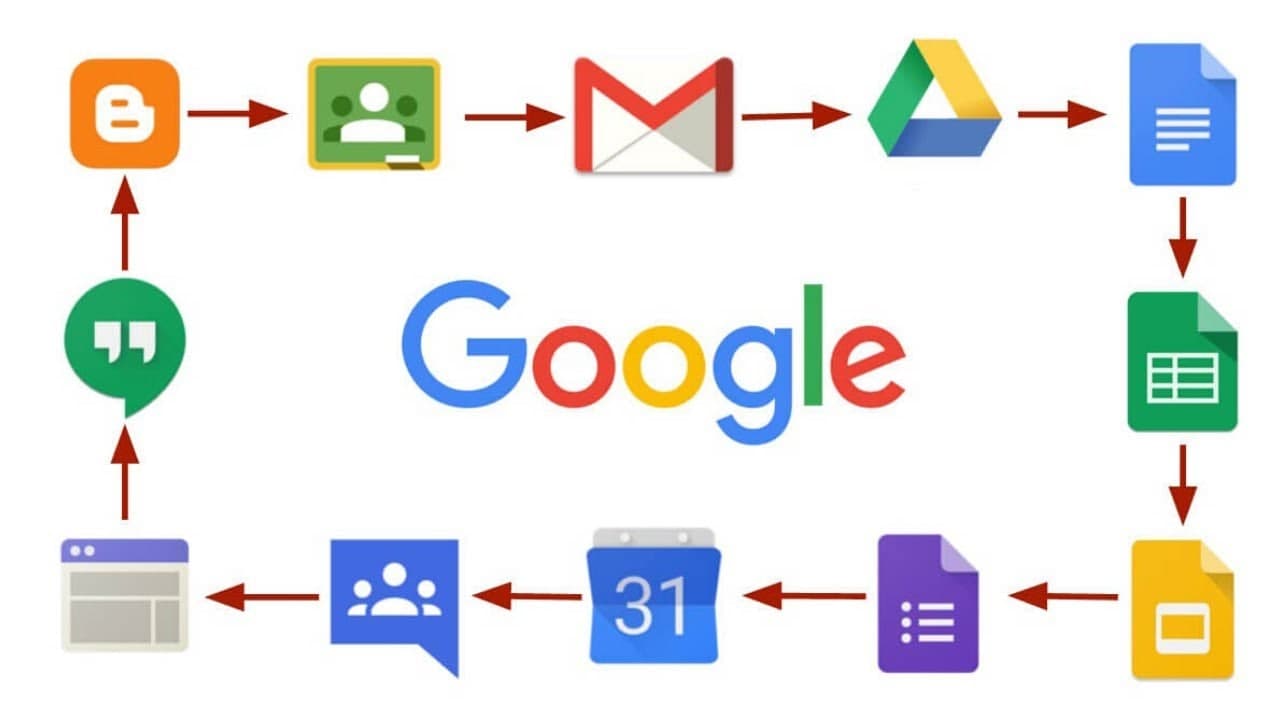
Мы с вами рассмотрим 7 самых популярных сервисов, которые были созданы компанией Google или куплены:
- Gmail — это бесплатная почтовая служба, представленная Google в 2004 году. Электронная почта отличается приятным и современным дизайном, интуитивно понятным интерфейсом, отсутствием докучливой рекламы. По оценкам экспертов Gmail является одним из самых удачных продуктов поисковика. Количество пользователей почтовой службы уже превысило отметку в полтора миллиарда человека.
- Google Maps (Гугл Карты) — бесплатный картографический сервис, позволяющий на основе соответствующего запроса пользователя, получать список организаций, расположенных вблизи него. Год назад Гугл Мапс отпраздновал свой пятнадцатилетний юбилей. Общее количество постоянных пользователей сервиса превышает один миллиард.
- Google Play — лицензионный магазин мобильных приложений, игр, музыки, фильмов и книг, доступных для скачивания на устройства с ОС Android. Размещать новый софт для его бесплатного скачивания или продажи могут разработчики из разных стран. Количество приложений, доступных для скачивания растет с каждым годом, превысив отметку в 2,8 миллиона программ.
- Chrome — бесплатный браузер от Google, предназначенный для доступа к веб-страница. По состоянию на Январь 2021 года является самым популярным браузером в мире. Его рыночная доля равняется 63,63%.
- YouTube — видеохостинг, реализующий услуги хранения, доставки и показа видео. Является вторым по популярности сайтом в интернете. В настоящее время на YouTube зарегистрировано два миллиарда активных пользователей. Google приобрел сервис в 2006 за 1,65 млрд $.
- ОС Android — операционная система для мобильных устройств (смартфонов, планшетов, умных часов и т.д.). Сегодня у Android более 2,8 миллиарда активных пользователей, его доля на мировом рынке составляет 75%. Операционная система была куплена Гугл в 2005 году за 130 миллионов долларов США.
- DoubleClick — крупнейшая рекламная платформа, позволяющая рекламодателям, агентствам, издательствам закупать медийную рекламу и проводить крупные кампании с использованием различных рекламных сетей и методов продвижения. Сервис куплен в 2007 году за 3,1 миллиард долларов.
Помимо перечисленных выше продуктов, в ассортименте предложений Google имеется немало сервисов для частного бизнеса — рекламная площадка AdMob, сервис для блогинга Blogger, рекламная биржа DoubleClick, инструмент аналитики сайтов Google Analytics , облачная платформа для работы с хостингом Google Cloud Platform, электронный Ассистент, Опросы, Мой бизнес и многие другие.
Внедрение искусственного интеллекта: Машинное обучение созданное Гугл
В долгосрочной стратегии развития популярный IT бренд делает ставку на интеграцию искусственного интеллекта во все свои продукты. Более того, ИИ уже сегодня активно внедряется в работу поисковика. Так, например, чтобы найти в Библии стихи не только по ключевому слову, но и по концепции, мы уже сегодня может забить в поиск «Ной» или «месть», после чего сервис найдет нам не только текстовые, но и смысловые совпадения. Подобных алгоритмов пока еще нет ни в одной другой поисковой системе.

В 2017 году американской корпорацией был зарегистрирован Патент на голосовую систему, которая сможет принимать звонки и вести беседу от лица пользователей. Такой помощник, наверняка, позволит значительно разгрузить сотрудников многих компаний. Google последовательно внедряет в свои продукты Инновации в сфере ИИ, уже сегодня предлагая своим пользователям такие инструменты, как Fire Indicators, ML Kit, TensorFlow и др.
Специально для исследователей, специализирующихся на искусственном интеллекте, Гугл запустил возможность осуществления поиска по наборам данных. В результатах выдачи указываются полные сведения о ресурсе, на которой опубликован такой набор: дата обновления, лицензия, доступные для просмотра и скачивания форматы файлов. Для бизнеса компанией был создан инструмент машинного обучения Cloud AutoML, который сегодня широко используется такими известными торговыми марками, как Meredith, Disney, Imagia и др.
ТОП 7 лучших и полезных книг о Google
Тем, кто интересна история самой успешной и быстро растущей корпорации нашего времени, мы советуем почитать книги из нашей подборки:
- «Google. Прорыв в духе времени». Дэвид А. Вайз, Марк Малсид — книга рассказывает об истории одной из самых успешных корпораций в мире.
- «Что сделал бы Google?». Джефф Джарвис — автор книги сделал попытку взглянуть на изменения в современном мире от лица успешной Айти-компании.
- «Поиск». Джон Бэттелл — в произведении представлен интересный взгляд на создание и развитие крупнейшей поисковой системы.
- «Как работает Google». Эрик Шмидт — интересные истории и сюжеты из повседневной жизни компании.
- «Google. Как с помощью безумной идеи завоевать мир». Одри Деангелис, Джина Деангелис — книга раскрывает секреты успеха корпорации и ее основателей.
- «Как тестируют в Google». Джейсон Арбон, Джефф Каролло, и Уиттакер Джеймс — В книге вы узнаете как тестируют продукты Google, как организована работа и кто отвечает за качество.
- «Большая четверка. Секреты успеха Amazon, Apple, Facebook и Google», Скотт Гэллоуэй — В чем секрет компаний гигантов? Что они знают такого, что не знаем мы с вами? Как использовать их интрументы продвижения в своем бизнесе? На эти вопросы ответит вам автор книги, который очень глубоко проанализировал их деятельность.
Большинство из перечисленных литературных произведений являются бестселлерами, переведенными на десятки мировых языков.
Документальные фильмы про компанию Google. Подборка лучших фильмов про компанию Гугл
Едва ли сегодня найдется другая компания, которая была бы окружена таким количеством загадок, легенд и мифов, как Гугл. Документальные фильмы из нашей подборки позволят приоткрыть завесу тайн.
- «Google и всемирный мозг» (2013) — документальный фильм, рассказывающий историю одного из самых амбициозных проектов современности и людях, принимавших участие в его реализации.
- «Взгляд изнутри: Google» (2017 год) — зрители фильма получили уникальный шанс узнать об истории возникновения компании, ее настоящем и планах на будущее.
- «Мальчики «Google» (2005 год) — документальная история о жизни основателей всемирно известного бренда.
- «Google: зловещая черта» — научно-популярный фильм, создатели которого рассматривают деятельность Гугл с совершенно неожиданной стороны.
- Биография: Google (2005 год) — фильм посвящен биографиям создателей самого успешного поисковика — Ларри Пейджу и Сергею Брину.
Ну и конечно, всем поклонникам компании Пейджа и Брина обязательно стоит посмотреть комедию «Кадры», которая вышла на большие экраны в 2013 году. Кинолента рассказывает о стажировке в Google вчерашних выпускников колледжа. Несмотря на то, что фильм не является документальным, компания Гугл принимала в его съемках непосредственное и активное участие.
Посмотреть подборку лучших фильмов про историю успеха компании Google можно по ссылке.
Заключение
Сегодня, как и много лет назад, Google продолжает трудится над созданием лучших решений и предложений для своих клиентов. Поисковой системой и другими продуктами компании пользуется несколько миллиардов людей по всему земному шару. Как уверяют основатели бренда, их детище — это, прежде всего, коллектив единомышленников, которые ежедневно приходят на работу с одной единственной целью — сделать наш мир хотя бы чуточку лучше. Очень здорово, если из информации https://lindeal.com вы взяли что-то полезное и применили это.