
Аналитики «Продажи.рф» оценили спрос на различные газированные напитки
Спустя год после решения американской The Coca-Cola Company приостановить работу в России ее фирменная газировка по-прежнему в топе покупок у российских потребителей колы. На долю импортной Coca-Cola приходится около 14% продаж
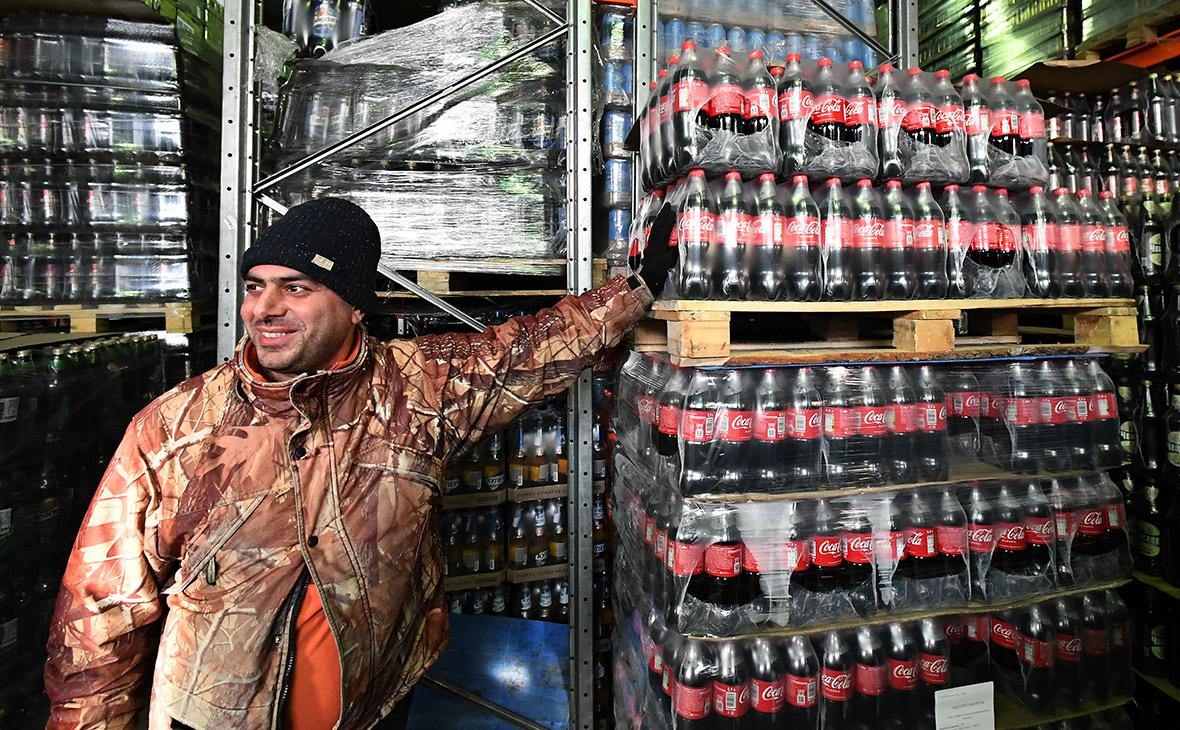
Газировка под брендом Coca-Cola остается одним из лидеров продаж среди напитков со вкусом колы в сетевой и несетевой рознице, несмотря на приостановку производства в России. Это следует из имеющихся у РБК данных сервиса «Продажи.рф» (работает в партнерстве с оператором фискальных данных «Первый ОФД», который входит в группу ВТБ) и ИТ-компании «Эвотор».
В январе и феврале 2023 года больше трети потребителей колы, чьи покупки оценивали аналитики «Продажи.рф», выбирали в магазинах напиток «Добрый Cola» (его производят российские заводы Multon Partners, которые принадлежали боттлеру оригинального напитка — компании «Coca-Cola HBC Россия»). На втором месте по популярности оказался бренд Coca-Cola ушедшей из России The Coca-Cola Company импортного производства, но его доля в продажах по сравнению с 2022 годом упала более чем в три раза, до 14,1%. Замыкали тройку лидеров напитки под брендом «Черноголовка». В десятке наиболее популярных осталась и кола, которую производит PepsiCo (она была шестой по продажам с долей 3,7%).
Год назад абсолютными лидерами по продажам в категории напитков со вкусом колы были международные бренды Coca-Cola и Pepsi: на их долю приходилось соответственно 47,8 и 44,4% продаж в штуках. Из других брендов заметную долю рынка занимала только марка Fresh Bar (ее выпускает российское подразделение швейцарской компании Global Functional Drinks), а доля других участников рынка была менее 1% (в пятерку лидеров входили производившаяся в Челябинске марка Vips и белорусская «Бела-Кола»).
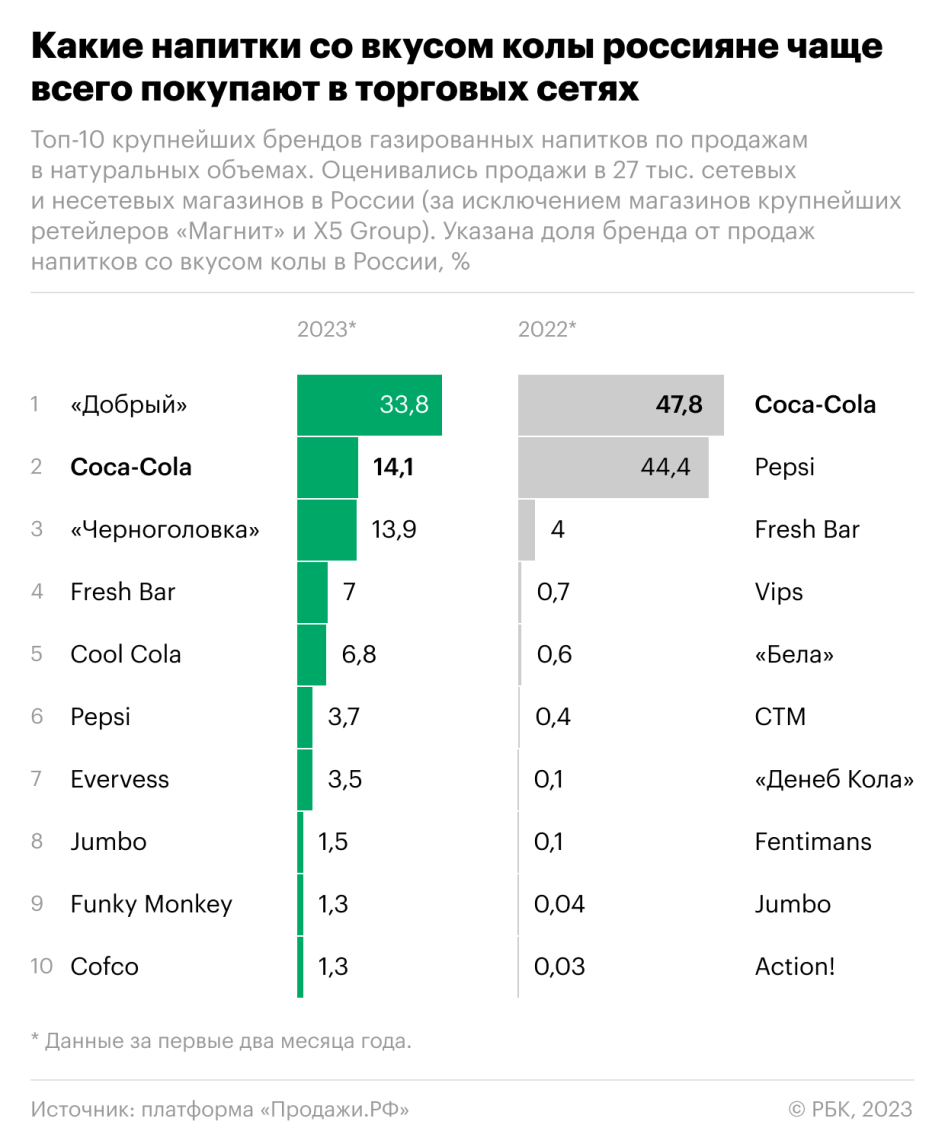
Как считали
Аналитики «Продажи.рф» оценивали предпочтения потребителей, исходя из покупок, совершенных в сопоставимых магазинах в январе и феврале 2022–2023 годов. В исследовании участвовали точки сетевой розницы, супермаркеты, мини-маркеты «магазины у дома», АЗС и т.д., где реализуется газировка — всего 27 тыс. торговых точек по всей стране, работавших также в январе—феврале 2022 года. Данные охватывают покупки в крупных торговых сетях, но не включают магазины двух крупнейших по обороту ретейлеров — X5 Group («Пятерочка», «Перекресток», Чижик») и «Магнит».
Данные о том, что газировка ушедших из России американских компаний по-прежнему занимает заметное место на полке российских магазинов, подтверждает и статистика ИТ-компании «Эвотор», которая отслеживает покупки в несетевой рознице. По его данным, в январе 2023 года импортная Coca-Cola занимала первое место не только в категории колы, но и среди всех сладких газированных напитков — на нее приходилось 32% продаж в денежном выражении (год назад на долю Coca-Cola российского розлива приходилось 60%). Ввезенные из-за рубежа напитки PepsiCo занимают четвертую строчку (9% продаж в денежном выражении), в тройке лидеров по продажам в рублях оказались «Добрый Cola» (26%) и «Черноголовка» (12%).
В ассортименте «Магнита» не представлена импортная Coca-Cola, а произведенная в России газировка оригинального бренда не продается с осени 2022 года, уточнил РБК представитель торговой сети. В 2023 году лидерами по продажам в категории сладких газированных напитков были бренды «Добрый Cola», Cool-Cola, «Черноголовка» и Fresh Bar, указали в пресс-службе «Магнит». Год назад абсолютными лидерами были марки Coca-Cola и Pepsi, в первую пятерку также входили Fresh Bar и напиток со вкусом колы челябинской компании «Ниагара».
У «Азбуки вкуса» ассортимент газированных напитков со вкусом колы по сравнению с 2022 годом не изменился — в топ-10 сохранилась импортная Coca-Cola, а также напитки Dr.Pepper, San Pellegrino, уточнили в компании.
РБК направил запросы в X5 Group (сети «Пятерочка», «Перекресток», «Чижик»), «Верный», «Лента», Metro Cash&Carry, «Ашан», а также в The Coca-Cola Company, Coca-Cola HBC и PepsiCo.
Как Coca-Cola ушла из России и чем ее заменили
В марте 2022 года крупнейшие мировые производители газированных напитков The Coca-Cola Company и PepsiCo приняли решение о приостановке работы в России на фоне начавшейся специальной военной операции на Украине. Российские заводы, которые производили напитки Coca-Cola, еще в марте перестали получать сироп, необходимый для производства фирменной газировки. В августе боттлер предупредил, что, как только складские запасы напитков истощатся, Coca-Cola HBC больше не будет производить и продавать их в России, а сосредоточится на выпуске напитков локальных брендов соков — «Добрый», Rich, «Моя Семья». В конце июля российское подразделение Coca-Cola (ООО «Кока-Кола ЭйчБиСи Евразия») сменила название на ООО «Мултон Партнерс», а затем запустила производство аналога Coca-Cola — «Добрый кола». PepsiCo также прекратила производство и продажу на российском рынке напитков Pepsi, 7Up, Mirinda, сохранив только поставки товаров первой необходимости, такие как молочные продукты и детское питание. Запасы произведенной в России Coca-Cola в торговых сетях Москвы и Петербурга начали подходить к концу еще летом, в первую очередь в продаже закончились бутылки больше объема 1–2 л.
После ухода крупнейших международных игроков их нишу на рынке начали занимать локальные производители газировки, которые стали выпускать напитки-аналоги. Только за семь месяцев 2022 года ассортимент напитков со вкусом колы в торговых сетях увеличился со 169 до 186 брендов, оценивала исследовательская компания NielsenIQ. Но продажи газировки в России в 2022 году в целом упали: за 12 месяцев по ноябрь 2022 года сокращение составило 9,8% (в рублях продажи выросли на 3,6% из-за роста цен).
Наряду с аналогами популярной газировки в рознице стали появляться и товары, полностью имитирующие оригинальную Coca-Cola. Так, в ноябре-декабре в сети «Светофор» и некоторых магазинах несетевой розницы появился напиток, бутылка и этикетка которого полностью совпадают с оригинальной Coca-Cola российского производства. В Multon Partners заверили, что этот напиток не может быть оригинальным, так как компания прекратила выпуск этих напитков еще в апреле 2022 года.
Почему Coca-Cola по-прежнему одна из самых продаваемых
Оригинальная Coca-Cola по-прежнему занимает заметную долю российского рынка, даже несмотря на то что ее продажи в штуках, по данным «Продажи.рф», в первые два месяца 2023 года упали год к году на 78%, а цена выросла в среднем на 68%. После ухода из России международных брендов газировки активизировались не только локальные производители, но и поставщики этой продукции из соседних стран. Например, в магазинах и точках общественного питания появилась Coca-Cola из Германии, Польши, Великобритании, Албании, Белоруссии и Ирана. Правда, в случае с газировкой из Ирана Coca-Cola в красной алюминиевой баночке похожа на оригинальную только внешне: напиток разливает иранская Khoshgovar Tehran Co, указывал РБК.
В ассортименте «Азбуки вкуса» — Coca-Cola, которая производится в Азербайджане, Дании, Турции, Польше, Италии и Великобритании. «Мы не шли по пути замещения ушедших импортных брендов различными отечественными аналогами, а возвращали их», — поясняет представитель сети.
Новые аналоги колы на российском рынке не провели серьезных маркетинговых кампаний, поэтому не смогли сформировать значимую группу лояльных потребителей, считает исполнительный директор ассоциации «Русбренд» Алексей Поповичев. Поэтому покупатель отдает предпочтение знакомому бренду Coca-Cola, который долгое время сохранял лидирующие позиции на российском рынке, полагает эксперт. По его словам, импортную Coca-Cola могут легально поставлять в Россию другие страны по параллельному импорту, а также имеющие с Россией общее таможенное пространство страны Евразийского экономического союза, в которых есть собственное производство оригинального напитка на заводах боттлера Coca-Cola HBC — например, Казахстан.
Дистрибьюторы ввозят импортную Coca-Cola в Россию не напрямую, а перекупают стоковые поставки, то есть излишки продукции на складах, с рынка любой страны, которая может свободно поставлять товары в Россию, говорит источник РБК на рынке безалкогольных напитков. «Груз может идти через ОАЭ, Иран или Турцию, но она сейчас закрыта. По сути, это не системные поставки, а спотовые партии колы, которые могут продаваться в четыре раза дороже. Это повышает маржинальность товара», — говорит эксперт. Компаниям из Казахстана также выгодны поставки в Россию: заказывая больший объем товара, сеть продает основную партию на внутреннем рынке, а излишек переправляет в Россию, получая при этом скидку за счет объемов, поясняет собеседник РБК.
Авторы:
Анна Левинская, Анна Захарова.
Coca-Cola, транснациональная корпорация, функционирующая в сфере производства безалкогольных напитков и сиропов. Штаб-квартира расположена в г. Атланта (штат Джорджия, США).
Общая информация
В структуру компании Coca-Cola входят более 700 тыс. сотрудников и 225 партнёров по розливу на 900 заводах в мире (по состоянию на конец 2021). Компания производит продукцию под следующими торговыми марками: безалкогольные газированные напитки (Coca-Cola, Diet Coke/Coca-Cola Light, Coca-Cola Zero Sugar, Fanta, Fresca, Schweppes, Sprite и Thums Up), энергетические напитки, кофе и чай (Aquarius, Ayataka, Bodyarmor, Ciel, Costa, doğadan, Dasani, Fuze tea, Georgia, glacéau smartwater, glacéau Vitaminwater, Gold Peak, Ice Dew, I Lohas, Powerade и Topo Chico), соки, молочные и растительные напитки (AdeS, Del Valle, Fairlife, Invinity, Minute Maid, Minute Maid Pulpy и Simply). Также Coca-Cola участвует в продаже напитков других компаний через лицензии, поддержку совместных предприятий и стратегические партнёрства, например, определённых брендов компании Monster Beverage, включая Monster Energy.
История развития
Вкусовую основу безалкогольного сильногазированного напитка Coca-Cola составляет сироп, рецептура которого была предложена в 1886 г. фармацевтом Дж. Пембертоном (1831–1888). Изначально сироп изготавливался из листьев коки и орехов тропического дерева колы и продавался в одной из аптек Атланты как лекарственное средство от нервных расстройств. Логотип и название Coca-Cola для напитка придуманы партнёром и бухгалтером Пембертона – Ф. Робинсоном. 8 мая 1886 г. продан первый в мире напиток Coca-cola за 5 центов США. В первый год производства реализовывалось не более 9 порций напитка в день, поэтому создатель рецепта, не видя особой перспективы для этого продукта, по частям распродавал связанный с ним бизнес.
В 1888 г. Пембертон продал все активы компании Coca-Cola А. Кандлеру (1851–1929). В 1892 г. продажи сиропа возросли в 10 раз. В том же году Кандлер учредил предприятие под названием Coca-Cola, а в 1893 г. зарегистрировал соответствующую торговую марку. В 1894 г. открыт первый за пределами штата Джорджия завод по производству сиропа – в Далласе (штат Техас). В 1899 г. начался массовый розлив напитка в бутылки. К этому времени заводы по производству сиропа были открыты в Далласе, Лос-Анджелесе и Чикаго, а напиток продавался не только по всей территории США, но и в Канаде. В 1899 г. Coca-Cola подписала своё первое соглашение с независимой компанией, которой было разрешено покупать сироп, производить и продавать напиток Coca-Cola. К 1900 г. продажи напитка возросли в 40 раз.
В 1903 г. из производственной формулы напитка Coca-Cola были исключены листья коки. За последующие 20 лет количество заводов по розливу Coca-Cola возросло с 2 до 1000, производственные мощности компании появились на Кубе, в Панаме, Пуэрто-Рико, на Филиппинах и Гуаме. Однако рост продаж и повсеместная популярность напитка сопровождались производством различного рода подделок. Одним из эффективных способов борьбы с недобросовестными конкурентами стала предложенная в 1916 г. компанией Root Glass бутылка с непохожим на другие характерным контуром. Немного изменившаяся бутылка такой формы и поныне часть фирменного стиля компании.
В 1919 г. группа инвесторов во главе с Э. Вудруффом и У. Брадли выкупила Coca-Cola за 25 млн долл. США. В том же году открылся первый европейский завод компании – во Франции. Торговая марка Coke, впервые использованная в рекламе в 1941 г., была зарегистрирована в 1945 г. В 1946 г. компания получила права на разработанный в Германии безалкогольный напиток под торговой маркой Fanta, в 1960 г. приобрела бренд фруктовых соков и концентратов Minute Maid, а в 1961 г. представила лимонно-лаймовый напиток Sprite. Спустя 2 года Coca-Cola выпустила свой 1-й диетический напиток под торговой маркой Tab, а в 1966 г. запустила проект «Питание» с целью производить менее сладкие, богатые белком напитки, что привело к массовому производству и распространению диетических и энергетических напитков. В 1978 г. Coca-Cola стала единственной иностранной компанией, которой было разрешено продавать напитки в Китайской Народной Республике. В 1982 г. состоялся запуск производства диетического напитка Diet Coke, в результате чего спрос на Tab начал стремительно падать. В период 1982–1989 гг. Coca-Cola владела контрольным пакетом акций кинокомпании Columbia Pictures. В 1990-х гг. Coca-Cola начала продавать продукцию в Восточной Германии (1990) и в Индии (1993). В начале 21 в. линейка продукции компании Coca-Cola была представлена 450 торговыми марками и выпускалась более чем в 200 странах.
Деятельность в России
Компания Coca-Cola впервые вышла на советский рынок в 1979 г., в преддверии летних Игр XXII Олимпиады в Москве. В том же году на Московском пивобезалкогольном комбинате «Очаково» началось производство напитка Fanta. В 1988 г. был установлен первый в Советском Союзе автомат по продаже напитков Coca‑Cola. К этому времени общий объём инвестиций, произведённых компанией в советскую экономику, превысил 1,8 млрд долл. США. В 1992 г. в России открылись первые заводы, производящие Coca‑Cola, – в Ставрополе и Волгограде. В 2005 г. компания представила бескалорийный напиток Coca-Cola Zero. В том же году Coca‑Cola приобрела одного из крупнейших производителей соков в России – «Мултон», а в 2010 г. – российскую компанию «Нидан». В январе 2006 г. предприятия по розливу, принадлежащие компании Сoca-Cola, были объединены в группу Bottling Investments. Спустя год Coca-Cola приобрела компанию по производству безалкогольных напитков Energy Brands. В 2020 г. из-за кризиса, вызванного пандемией коронавируса, Coca-Cola прекратила производство диетического напитка Tab. В июне 2022 г. в рамках санкций, введённых странами Запада, в связи с проведением Россией специальной военной операции на Украине компания объявила о полном прекращении производства и продажи своих фирменных напитков в России.
Финансовые показатели
По состоянию на май 2022 г. в свободном обращении находится 3,9 млрд акций Coca-Cola, всего в обращении 4,34 млрд акций. 70,73 % акций принадлежит институциональным инвесторам. Крупнейшие из них (на 30 марта 2022): Berkshire Hathaway (9,23 %), Vanguard Group (8,1 %), BlackRock (6,44 %). Акции компании котируются на Нью-Йоркской фондовой бирже: входили в промышленный индекс Доу Джонса в 1932–1935 гг., вновь включены в него в 1987 г.
В 2021 г. компания заняла 37-е место в рейтинге Forbes Global 2000 по капитализации – 231,3 млрд долл. США. В 2022 г. Coca-Cola поднялась на 28-ю строчку рейтинга по рыночной капитализации, которая достигла 282,9 млрд долл. США. В целом в 2022 г. компания заняла 114-е место в рейтинге Forbes Global 2000.
По итогам 2021 г. выручка компании составила 38,66 млрд долл. США, чистая прибыль – 9,8 млрд долл. США, совокупные активы – 94,35 млрд долл. США.
Дата публикации: 7 сентября 2022 г. в 17:37 (GMT+3)
Аудиоверсия этой статьи
История
компании Coca-Cola — не просто классическая американская история успеха.
Это образец упорства и умения использовать возможности для любого
предпринимателя, который развивает собственный бренд. Изучить историю
Coca-Cola любопытно и полезно
Содержание
Как возникла идея создания компании
Становление компании Coca-Cola
Развитие компании в XX веке
Coca-Cola в конце XX — начале XXI века
Компания сегодня
Coca-Cola в России в
настоящее время
🚀 Сервис для быстрого старта бизнеса
Зарегистрируйте бизнес бесплатно и без визита в налоговую — через сервис от Деловой среды
Подать заявку онлайн
Как возникла идея создания компании
В середине XIX века медики Европы во время операций использовали
для анестезии спиртовую настойку листьев коки —
растения, произрастающего в Центральных Андах. Химики Ф. Гадке и А. Ниман
изучали его и получили активный алкалоид, который в настоящее время известен
как кокаин.
История
бренда Кока-Кола
начинается в 1886 году, когда фармацевт Джон Стит Пембертон изобрел рецепт
бодрящего напитка.
Он хотел создать чудо-эликсир на основе алкоголя, на котором можно
было бы разбогатеть. Но тут вмешался случай: начал действовать сухой закон, и
Пембертону пришлось экспериментировать.
В результате получился первый напиток. Фармацевт смешал для него
экстракты из листьев коки и орехов колы. В полученную смесь добавил
жженый сахар с лаймом и эфирными маслами для снижения горечи кофеина. Последний
содержится в орехах колы. Приятный на вкус напиток, по утверждению создателя, должен
был нести человеку бодрость и купировать головную боль, лечить гастрит и
импотенцию. Так 8 мая 1886 года в Атланте появилась на свет знаменитая кока-кола.
Становление компании Coca-Cola
Первое время напиток продавался в аптеке на розлив по пять центов
за стакан. Реализация была несущественная — до 10
порций в день. Дело пошло несколько лучше, когда вместо воды стали использовать
содовую.
Чтобы увеличить продажи, бухгалтер и напарник Пембертона Фрэнк
Робинсон предложил дать имя новому продукту. Он объединил названия двух
основных ингредиентов, а также нарисовал красными буквами логотип с
использованием двух латинских букв «С». Так в истории бренда появилась
символика.
Наличие в составе снадобья кокаина, который в тот период не был
запрещен, и кофеина располагало к росту продаж. В местной газете разместили
первую рекламу, где характеризовали напиток как «изысканный и освежающий».
Однако особого эффекта это не дало.
По
воле случая ирландец Аза Кэндлер увидел маркетинговый потенциал сладкой воды.
Это повлияло на дальнейшую историю компании.
Тем временем Пембертон в патентном бюро США зарегистрировал марку «Coca‑Cola Syrup and Extract». Кэндлер
пытался узнать рецептуру напитка, но безуспешно. В 1888 году Пембертон
скончался в нищете. Вдова покойного за 2300 долларов продала рецепт напитка
Кэндлеру.
Он уже знал, какие шаги
предпримет в торговле кока-колой, и
начал активно продвигать газировку. Вместе с Робинсоном они изменили рецептуру,
полностью убрав из состава экстракт колы и уменьшив количество коки. Это улучшило вкус продукта и увеличило
срок годности.
В 1893 году Аза
зарегистрировал торговый знак «Coca-Cola» и
открыл The Coca-Cola Company. Именно Кэндлер и стал юридическим
отцом-основателем компании,
вложив в нее деньги и превратив в успешный бизнес.
Предприниматель удачно
применял нестандартные решения. Так, он безвозмездно поставлял в аптеку колу в обмен на адреса состоятельных
покупателей. Затем Кэндлер по почте отправлял им ваучеры на одну порцию
газировки. Попробовав бесплатный продукт, люди начинали его покупать. Также
бизнесмен активно сбывал календари, часы и сувениры с логотипом, что тогда было
в диковинку и с лихвой окупалось.
Кока-кола
стала достойной альтернативой алкоголю. В рекламных слоганах тех лет содержался
призыв употреблять напиток, который восстанавливает силы, лечит, утоляет жажду
и освежает.
Поставка сиропа в розницу в аптечные точки приносила
мало дохода, и Кэндлер нашел коммерсантов, которым сбывал его оптовыми
партиями. А в 1894 году предприниматель Джозеф Биденхарн начал разливать колу по бутылкам.
В 1899 году всего за один
доллар Кэндлер продал права на бутилирование и продажу. И не прогадал:
реализация Coca-Cola
резко пошла в гору.
🚀 Сервис для быстрого старта бизнеса
Зарегистрируйте бизнес бесплатно и без визита в налоговую — через сервис от Деловой среды
Подать заявку онлайн
Развитие компании
в XX веке
В основе бизнес-модели Coca-Cola на протяжении почти всего XX
столетия лежит создание концентрата. Предприятие продавало его партнерам,
которые занимались розливом и продажами. А головная компания обеспечивала
маркетинговую поддержку.
История
развития бренда Кока-Колы с самого начала была связана с участием
звезд в рекламе. В 1900 году Аза Кэндлер на взаимовыгодных условиях договорился
с популярной актрисой Хильдой Кларк, что ее образ будет использоваться в
рекламных целях. Это помогло бренду
повысить узнаваемость.
Уже через два года кока-кола становится самой популярной сладкой безалкогольной
газировкой на американском континенте. Кэндлер и Робинсон сделали вкус напитка
более насыщенным, полностью убрав из состава кокаин.
Впервые в истории Кока-Колы годовой оборот компании достиг фантастических 120 000 долларов,
а напиток появился в рекламных рубриках всех печатных изданий в США.
Вскоре кока-колу начинают разливать на Кубе, в Панаме и
Канаде. Затем компания
завоевывает азиатский рынок: на Филиппинах вводится в эксплуатацию линия по
розливу.
В середине 1910-х меняется
дизайн бутылки. В конкурсе побеждает проект инженера Александра Самуэльсона, и
изящная контурная бутылка становится символом бренда Кока-Кола. На бутылках появляется узнаваемая
этикетка в виде ромба.
Концерн не экономит на
рекламе, привлекая популярных спортсменов. К 1911 году рекламные расходы
доходят почти до 1 млн долларов.
Вскоре Coca-Cola раскручивает
продажи в осенне-зимний период под лозунгом «У жажды нет сезонов». Ранее Сola позиционировалась как летний продукт.
В 1916 году Аза Кэндлер
выдвигается на пост мэра Атланты и заканчивает свою предпринимательскую
деятельность. История Coca-Cola не
обходится без очередной смены собственника. Большую часть акций Кэндлер передал
своим детям, но сын Говард оказался некомпетентным управленцем. Через три года компанию Кока-Кола пришлось продать банкиру
Эрнесту Вудраффу за 25 млн долларов.
В этом же году концерн вышел
на IPO на Нью-Йоркской фондовой бирже, продав 500 тысяч акций по 40 долларов.
Coca-Cola до сих пор считается одним из старейших
и надежных эмитентов на фондовом рынке США.
Через три года сын Эрнеста
Вудраффа Роберт занимает пост президента компании и
внедряет картонную упаковку вместимостью шесть бутылок. С легкой руки
Вудраффа-младшего устанавливаются первые уличные билборды, появляется
департамент для поставки концентратов за рубеж, стартует рекламная деятельность
на радио.
Летом 1928 года команда США
привезла на Олимпийские игры в Амстердам 100 ящиков кока-колы. С того времени бренд Coca-Cola и
спорт идут рука об руку на всех значимых соревнованиях. В 2013 году компания взаимодействовала с олимпийскими
комитетами из 190 стран, а в 2022-м поддержала Чемпионат мира по футболу в
Катаре.
На рубеже 30-х годов XX века
стартовали продажи напитка из холодильного кулера. Публике представлен
фирменный стакан, до сегодняшнего дня он практически не претерпел изменений.
В рамках истории бренда Кока-Кола придумали новый образ:
красно-белый Санта, которого художник Хэддон Сандблом изобразил добродушным
стариком. Благодаря Сандблому, нарисовавшему, к слову, в образе самого себя,
теперь каждый американец знает, что новогодний волшебник выглядит именно так. До
1931 года на новогодних открытках изображались разноцветные эльфы и прочие
мифические существа.
Концерн не снижал обороты, и
вскоре в Чикаго на Всемирной выставке был установлен первый электрический
автомат по розливу.
В 1934 году к рекламной
кампании привлекают кинозвезд первой величины. Среди них — Джонни Вайсмюллер,
олимпийский чемпион по плаванию, исполнитель роли Тарзана. Следом художник
Норман Роквелл создает серию календарей для Coca-Cola. Все рекламные ходы
окупаются с лихвой.
Перед Второй мировой войной кока-кола продавалась уже в полусотне стран.
Благодаря гибкой стратегии продукт удавалось продавать даже гитлеровской
Германии, хотя вспоминать об этом в Америке не любят. В то же время колу начали продавать в Африке.
В послевоенное время на канале CBS в День
благодарения вышла первая телевизионная реклама напитка. В ней задействовали
известных афроамериканских спортсменов: бегунов и баскетболистов.
В 1955 году в Неаполе начали
разливать апельсиновую фанту, которую будут продавать в Америке только через
пять лет. А на предприятиях США появились алюминиевые банки и бутылки объемом
10, 12 и 26 унций. Через два года автомат по розливу колы установили даже на
подводной лодке «Наутилус».
К концу 50-х годов XX
столетия количество стран, где продавали продукцию концерна, достигло 100.
Следующие 10 лет большое
внимание компания уделяет расширению ассортимента. На рынке появляются новые
напитки, не уступающие по популярности кока-коле. Один из них — Sprite.
🚀 Сервис для быстрого старта бизнеса
Зарегистрируйте бизнес бесплатно и без визита в налоговую — через сервис от Деловой среды
Подать заявку онлайн
С 1970 года до середины
1990-х руководство Coca-Cola предприняло серьезные шаги, чтобы усилить позиции
на рынке:
-
Наладили
выпуск спортивного напитка Olympade с эмблемой Олимпийского комитета США. -
Провели
рекламную кампанию, основанную на шлягере I’d Like to Buy the World a
Coke. До сих пор она считается одной из самых успешных. -
В
Японии продали первую кофейную колу. -
Заключили
договор о сотрудничестве Coca-Сola
с футбольной ассоциацией FIFA. -
Подписали
соглашение с Китаем. Кока-колу
разливают в бутылки ПЭТ объемом два литра. -
Компания
купила киностудию Columbia Pictures. В тот же год новый
фильм «Ганди» сразу же завоевал Оскар в номинации «Лучшая картина». -
Начали
сотрудничество с Walt Disney Company. -
Впервые
за 100-летнюю историю изменили рецептуру напитка, что породило массовое
недовольство, и «классику» через 80 дней вернули на полки магазинов.
Классической коле
стали отдавать предпочтение и на борту космической станции «Челленджер». -
В
1986 году с помпой отметили 100-летний юбилей. -
На
Пушкинской площади в России установили неоновый знак «Coca-Cola». Студию Columbia Pictures
продали. -
После
падения Берлинской стены Coca-Cola
начали продавать в Восточном Берлине. -
В середине 1990-х сняли ролик про кока-колу с мультяшными белыми
медведями «Северное сияние». Мэр Москвы Юрий Лужков открыл в столице
первый завод по производству напитка.
Coca-Cola в конце XX —
начале XXI века
К
1997 году количество продаж возросло настолько, что стало соизмеримо с
суммарным объемом реализации за последние три четверти века.
К
концу столетия компания наращивает
обороты: покупает перуанскую Inca Kola и бренд
Schweppes. На рынках США впервые представлена Coca-Cola Vanilla, объявлена продажа кока-колы без сахара,
покупается российский завод «Мултон» по производству соков. Для продажи в
клубах и для специальных мероприятий изготавливается алюминиевая банка нового
контура, приобретается бренд Glacéau.
Руководство
мирового лидера не забывает и об экологии. В 2009 году компания получила премию
за производство бутылки, разработанной на основе растительного сырья. Примерно
тогда же Coca-Cola Company представила фристайл-автомат, позволяющий получить в
розлив любой вид напитка.
Coca-Cola занимается и мировыми социальными
программами. Так, на Гаити после фатальных землетрясений в аграрном секторе
создаются рабочие места.
Компания сегодня
В
преддверии сочинской Олимпиады компания
становится ее официальным партнером, а через четыре года поддерживает Чемпионат
мира по футболу в России. Также был дан старт акции «Мир без отходов». Ее цель — к
2030 году отправить на переработку каждую бутылку/банку, произведенную компанией Кока-Кола.
За
4,9 млрд долларов в 2019-м Coca-Cola приобрела одну из крупнейших сетей кофеен
Costa Coffee, ведущую свою деятельность в 30 странах мира. Это позволило
освоить новый вид рынка и конкурировать со Starbucks и прочими кофейными
операторами.
Благодаря
огромной сети и проработанной дистрибьюции продукцию Кока-Кола можно приобрести практически в любой точке земного
шара. Поддерживают инфраструктуру партнеры, а компания инвестирует в данный
сектор относительно мало. Таким способом она покрывает все рынки и регионы, что
является серьезным конкурентным преимуществом, поскольку создать такую
эффективную глобальную систему чрезвычайно дорого и затратно по времени.
Сегодня
компания изменила стратегию ведения бизнеса. Она больше не поддерживает полный
технологический цикл, а специализируется на производстве концентрата, на основе
которого и выпускается Coca-Cola на 900 заводах по всему миру.
Такая система (Coca-Cola System) позволяет расширять рынок сбыта,
существенно снижать затраты и логистические расходы.
Концерн определил следующие направления развития:
-
брендинг,
-
дизайн и размер бутылок,
-
маркетинг,
-
вкусовая
палитра.
В 2022 году компания увеличила выручку на 11%, до 43 млрд долларов, а также успешно провела рекламную
кампанию на Чемпионате мира по футболу — 2022 в Катаре. Для болельщиков создали
цифровую платформу Coca-Cola Fan Zone. Ей воспользовалось 5 миллионов фанатов
из 41 страны.
Coca-Cola
в России в настоящее время
В 2022 году
Coca-Cola объявила о завершении
деятельности на
территории России. Продажи напитков под брендами компании приостановлены, но
заводы по розливу остались у нее в собственности. Российский филиал Coca-Cola HBC был
переименован в Multon Partners.
Теперь вместо
привычных брендов
концерна на полках магазинов начали появляться другие виды напитков с похожими
названиями, этикетками и вкусами. Multon Partners продает аналог под брендом «Добрый Кола».
🚀 Сервис для быстрого старта бизнеса
Зарегистрируйте бизнес бесплатно и без визита в налоговую — через сервис от Деловой среды
Подать заявку онлайн
| The Coca-Cola Company | |
 |
|
| Тип |
Публичная компания |
|---|---|
| Листинг на бирже |
NYSE: KO |
| Год основания |
1892 |
| Основатели |
Дж. Пембертон, Эд Холленд |
| Расположение |
|
| Ключевые фигуры |
Мухтар Кент (председатель совета директоров и генеральный директор) |
| Отрасль |
Производство прохладительных напитков |
| Продукция |
Безалкогольные напитки |
| Собственный капитал |
▲ $31,317 млрд (2010 год) |
| Оборот |
▲ $35,119 млрд (2010 год)[1] |
| Операционная прибыль |
▲ $8,449 млрд (2010 год)[1] |
| Чистая прибыль |
▲ $11,809 млрд (2010 год)[1] |
| Число сотрудников |
139 600 (2010 год)[1] |
| Сайт |
www.thecoca-colacompany.com |

The Coca-Cola Company (произносится Кока-Кола кампани; NYSE: KO) — американская пищевая компания, крупнейший мировой производитель и поставщик концентратов, сиропов и безалкогольных напитков. Наиболее известным продуктом компании является напиток Coca-Cola. Входит в список Fortune 1000 по итогам 2007 года (83-е место). Штаб-квартира — в столице штата Джорджия — Атланте.
Содержание
- 1 Собственники и руководство
- 2 Деятельность
- 2.1 Финансовые показатели
- 2.2 The Coca-Cola Company в России
- 2.2.1 Производство The Coca-Cola Company в России
- 2.2.2 Положение рабочих на заводах Coca-Cola в России
- 2.2.3 Продукция в России
- 3 См. также
- 4 Примечания
- 5 Ссылки
Собственники и руководство
Компания является одной из крупнейших в США, её акции допущены к торговле на площадке NYSE и входят в индексы DJIA и S&P 500.
Согласно данным Yahoo! Finance 67 % акций принадлежит 1302 инстуциональным и взаимным фондам[2]. Крупнейшими из них являются фонды:
- Berkshire Hathaway, Inc — 8,61 %,
- Suntrust Banks, Inc. — 3,68 %,
- Capital World Investors — 3,29 %,
- Barclays Global Investors UK Holdings Ltd — 3,19 %,
- State Street Corporation — 3,02 %.
Другим фондам по отдельности принадлежит менее 3 % акций.
Председатель совета директоров и генеральный директор с июля 2008 года — Мухтар Кент (до этого времени эти должности занимал Невилл Изделл).

Одно из зданий The Coca-Cola Company в Атланте
Деятельность
Основной бизнес компании — безалкогольные напитки. Компания продаёт концентраты, сиропы и напитки более чем в 200 странах. Концентраты и сиропы продаются компаниям, непосредственно производящим напитки.
В 2007 году продажи концентратов и сиропов под маркой «Coca-Cola» (и её вариаций) составили примерно 53 % в общем объёме выручки.
Компании принадлежит 5 из 6 самых продаваемых мировых брендов безалкогольных напитков — Coca-Cola, Diet Coke, Fanta, Schweppes и Sprite.
Основным сырьем для компании являются пищевые и непищевые подсластители. Используемые пищевые подсластители в США — это фруктозный кукурузный сироп, вне США — сахароза. Основные непищевые подсластители — аспартам, сахарин и др.
Финансовые показатели
Выручка компании за 2009 год составила $30,99 млрд (в 2008 году — $31,944 млрд), чистая прибыль — $6,91 млрд ($5,807 млрд)[3][4].
На протяжении последних двенадцати лет (2000—2012) Соса-Cola является самым дорогостоящим брендом в мире. В 2009 году компании удалось увеличить стоимость бренда на 3 % и она составила $ 68,7 млрд.[5]
The Coca-Cola Company в России
Деятельность компании в России до июля 2008 года относилась к операционному сегменту «Евразия» (куда включались страны СНГ, Ближнего Востока, Индии). Выручка всего сегмента «Евразия» в 2007 году составила $1,084 млрд[6] С июля 2008 года группа «Евразия» была реорганизована, и сейчас Россия относится к группе «Евразия и Африка». Интересы компании в России представляет российское представительство компании The Coca-Cola Export Corporation (ООО «Coca-Cola Export Corporation») офис которого расположен в Москве.
В России компания продает около 17 % собственной продукции в мире. По оценке Nestle, продажи Coca-Cola в России в 2007 году составили около $1,3 млрд[7]/ Совокупные инвестиции Coca-Cola в российскую экономику (включая покупку и строительство заводов, развитие дистрибуции и т. п.) с 1990 по 2011 годы составили $3 млрд. В 2011 году компанией было заявлено о намерении вложить в экономику страны ещё $3 млрд за период с 2012 по 2016 год[8].
Производство The Coca-Cola Company в России
Производством продукции с разрешения и под контролем The Coca-Cola Company занимается ЗАО «Кока-Кола ЭйчБиСи Евразия», 100%-ная дочка греческой Соса-Cola Hellenic Bottling Company S.A. The Coca-Cola Company владеет лишь 23 % Соса-Cola Hellenic Bottling Company S.A. (по состоянию на конец 2011 года[9]). Остальные акции частично находятся в свободном обращении, а частично принадлежат Kar-Tess Group (23 %). Генеральный директор Соса-Cola Hellenic в России — Стефанос Вафеидис.
В России ООО «Кока-Кола ЭйчБиСи Евразия» владеет 16 заводами (в Москве и Московской области, Санкт-Петербурге, Орле, Нижнем Новгороде, Самаре, Ставропольском крае, Волжском, Екатеринбурге, Новосибирске, Красноярске, Владивостоке и Ростовской области)[8]. Компания владеет более чем 80 дистрибуционными центрами.[10][11] Крупнейшие заводы находятся в Нижнем Новгороде и Орле. Орловский филиал ЗАО «Кока-Кола ЭйчБиСи Евразия» обеспечивает продукцией всю южную часть Центрального федерального округа относительно Москвы.
В 2010 году ирландская European refreshments (дочерняя компания The Coca-Cola Company) получила 100%-ный контроль над российским производителем соков «Нидан соки» (торговые марки «Да!» и «Моя семья»)[12].
Также греческая Соса-Cola HBC в России владеет 50 % акций производителя соков «Мултон» и c 2007 года — 100 % акций производителя безалкогольных напитков «Aqua Vision».
Положение рабочих на заводах Coca-Cola в России
На заводах и в офисах The Coca-Cola Company в России на 2007 год было занято около 5 тысяч человек.
В 2007 году работники завода компании в Санкт-Петербурге бастовали. Причиной забастовки по версии её организаторов, стали недостаточные темпы роста заработной платы сотрудников предприятия, принадлежащего Соса-Cola Hellenic Botling Company[13].
Продукция в России
Список продуктов, выпускаемых The Coca-Cola Company в России:
- Coca-Cola
- Coca-Cola Light — низкокалорийный напиток, по вкусу повторяющий Coca-Cola.
- Coca-Cola Vanilla — Coca-Cola с ароматом ванили.
- Fanta — напиток с апельсиновым вкусом, также выпускается Fanta с другими фруктовыми вкусами (яблоко, лимон, манго и др.).
- Sprite — напиток с лимонным вкусом, не содержащий красителей.
- Powerade — изотонический напиток.
- Фруктайм — Буратино, Лимонад, Дюшес и Крем-Сода.
- Nestea — холодный чай (производится совместно с компанией Nestle).
- Кружка и бочка — квас.
- Schweppes — серия газированных напитков (Тоник, Имбирный эль и др.), с разрешения «Швеппс Холдингс Лимитед»
- Добрый — фруктовый сок.
- Pulpy — сокосодержащий напиток.
- Rich — фруктовый сок.
- Nico — фруктовый сок.
- BonAqua — вода.
- Burn — энергетический напиток.
- Gladiator — энергетический напиток.
В разных странах продукты, производимые компанией, различаются.
См. также
- Dr. Pepper Snapple Group
- PepsiCo, Incorporated
Примечания
- ↑ 1 2 3 4 2010 Form 10-K, The Coca-Cola Company . United States Securities and Exchange Commission.
- ↑ Yahoo! Finance Major Holders for Coca-Cola Co. (KO) (по состоянию на 12.08.2008)
- ↑ Юлия Шмидт, Иван Васильев. «Моя семья» для Coca-Cola // Ведомости, № 48 (2566), 19 марта 2010
- ↑ Соса-Cola снизила квартальную чистую прибыль на 18 %
- ↑ Соса-Cola — самый дорогостоящий бренд в мире
- ↑ The Coca-Cola Company. Annual Report (Form 10-K) for the fiscal year ended December 31, 2007, с. 126 (проверено 12.08.2008)
- ↑ Анна Рябова, Сергей Соболев. Все будет не Coca-Cola // Коммерсантъ, № 179 (3996), 03 октября 2008
- ↑ 1 2 Рустем Фаляхов. «Мы всегда получаем помощь от властей». Глава Coca-Cola рассказал «Газете.Ru» о планах, кризисе и Путине. // gazeta.ru. Архивировано из первоисточника 14 февраля 2012. Проверено 26 сентября 2011.
- ↑ Отчет. // csrreport.2011.coca-colahellenic.com. Архивировано из первоисточника 19 декабря 2012. Проверено 17 декабря 2012.
- ↑ Анастасия Любарская. Земля Coca-Cola // Ведомости, № 160 (1934), 28 августа 2007
- ↑ http://www.coca-colahellenic.ru/reports/Social%20Report%20Russia%202008.pdf
- ↑ Ирина Скрынник. Американская семья // Ведомости, № 164 (2862), 02 сентября 2010
- ↑ Николай Донсков. «Кока-Кола» забродила, как пиво // Новая газета, 23.04.2007
Ссылки
- Официальный сайт компании в России (рус.)
- Официальный сайт компании (англ.)
- Официальный сайт дочерней компании Coca-Cola Hellenic Bottling Company S.A. в РФ (рус.)
 База расчёта индекса Dow Jones Industrial Average База расчёта индекса Dow Jones Industrial Average |
|---|
|
3M • Alcoa • American Express • AT&T • Bank of America • Boeing • Caterpillar • Chevron • Cisco Systems • Coca-Cola • DuPont • ExxonMobil • General Electric • Hewlett-Packard • The Home Depot • Intel • IBM • Johnson & Johnson • JPMorgan Chase • Kraft Foods • McDonald’s • Merck & Co. • Microsoft • Pfizer • Procter & Gamble • The Travelers Companies • United Technologies • Verizon Communications • Wal-Mart Stores • Walt Disney |
|
База расчёта индекса Dow Jones Global Titans 50 |
|---|
|
Abbott Laboratories · Allianz · Apple · AT&T · Banco Santander · Bank of America · BHP Billiton · BNP Paribas · BP · Chevron · Cisco Systems · Coca-Cola · ConocoPhillips · E.ON · Eni · Exxon Mobil · France Télécom · General Electric · GlaxoSmithKline · Google · Hewlett-Packard · HSBC · IBM · Intel · Johnson & Johnson · JPMorgan Chase · Merck & Co. · Microsoft · Mitsubishi UFJ Financial Group · Nestlé · Nokia · Novartis · Oracle · PepsiCo · Petrobras · Pfizer · Philip Morris International · Procter & Gamble · Roche · Royal Dutch Shell · Samsung Electronics · Sanofi-Aventis · Schlumberger · Siemens · Telefónica · Total · Toyota · Verizon Communications · Vodafone · Wal-Mart |
С марта 2022 года заводы Coca-Cola на территории России не работают, то есть выпуск новой продукции прекращен, а все складские запасы распродали практически полностью. На фоне подобного положения дел множество российских брендов, включая «Очаково» и «Черноголовка», начали выпускать свою версию «Колы», активно конкурирую друг с другом с целью захвата как можно большей доли освободившегося рынка. Однако, тем не менее, идеального аналога зарубежного напитка нет, потому что создать такой пока что никому не удалось. Все российские версии «Колы» сильно отличаются от оригинала как по вкусу, так и по количеству газов в воде, причем в меньшую сторону. Впрочем, все это временные трудности, так как уже в самое ближайшее время в продажу поступит первая партия новых зарубежных напитков, выпущенных под другим названием.
Теперь использовать бренд Coca-Cola в России нельзя, так как компания решила фактически уйти с российского рынка. Однако при этом полностью покидать его она не захотела, решив формально передать все свои активы на территории страны местной компании, которой она собственно и владеет. Эта самая компания будет выпускать продукцию под новым брендом, а выпуск такой уже начался. Первые поставки в российские магазины ожидаются до конца августа, то есть в самые ближайшие дни легендарный напиток Coca-Cola, который известен по всему миру, вернется в продажу и вновь окажется доступен всем, кто проживают на российской территории. Купить такой окажется возможно как в розничных магазинах, так и в онлайн-магазинах, так как все необходимые договоры на поставку уже заключены.

При этом нужно понимать, что складские запасы российских магазинов опустели, поэтому в один момент новая «Кола» не появится в продаже сразу по всей России. На процесс заполнения складов может уйти до трех месяцев, и это не считая времени на заполнение магазинов. Теперь, когда новая Coca-Cola поступит в продажу, на нее ожидается повышенный спрос, который может привести к временному дефициту данного продукта. Для продвижения напитков компания не стала использовать совершенно новый бренд, а выбрала уже знакомый многие десятки лет всем тем, кто проживают на территории России. Так, новая Coca-Cola будет официально продаваться в стране под названием «Добрый Кола». Под брендом «Добрый», которым владеет корпорация Coca-Cola, в России уже много-много лет выпускаются разного рода соки из доступной ценовой категории.

В настоящее время российские рестораны и различные заведения ведут переговоры с новой компанией, чтобы заключить договор на поставку «Колы» с целью добавить этот напиток в ассортимент меню. Помимо «Добрый Колы», россиян ждут аналоги напитков Sprite и Schweppes, называться которые будут «Добрый Orange» и «Добрый Тоник». Кроме того, до конца 2022 года в продажу поступят напитки «Добрый Дюшес», «Добрый Черри», «Добрый Манго» и «Добрый Сибирские Травы», за выпуск которых фактически также будет отвечать американская корпорация Coca-Cola. Все эти напитки будут доступны в пластиковых бутылках объемом пол-литра, литр, полтора и два литра. Таким образом, уже совсем скоро все и каждый, кто проживают в России или просто окажутся в стране, смогут купить привычный всем напиток. Однако данных о его стоимости, а также о калорийности, пока что нет.
Ранее сообщалось о том, что Funky Money – это новый российский бренд газировки Coca-Cola и Fanta.
Присоединяйтесь к нам в Google News, Twitter, Facebook*, Instagram* (*площадки признаны в России экстремистскими), ВКонтакте, YouTube и RSS чтобы следить за новостями и оперативно получать интересные материалы.
 |
|

Coca-Cola headquarters in Atlanta |
|
| Type | Public |
|---|---|
|
Traded as |
|
| ISIN | US1912161007 |
| Industry | Beverage |
| Founded | January 29, 1892; 131 years ago Atlanta, Georgia, U.S. |
| Founders |
|
| Headquarters |
Atlanta, Georgia , U.S. |
|
Area served |
Worldwide |
|
Key people |
|
| Products | List of The Coca-Cola Company products |
| Revenue |  US$43.0 billion (2022) US$43.0 billion (2022) |
|
Operating income |
US$10.9 billion (2022) |
|
Net income |
 US$9.6 billion (2022) US$9.6 billion (2022) |
| Total assets | US$92.7 billion (2022) |
| Total equity | US$25.8 billion (2022) |
| Owners |
|
|
Number of employees |
86,200 (2019)[2] |
| Subsidiaries | List of the Coca-Cola Company subsidiaries |
| Website | coca-colacompany.com |
The Coca-Cola Company is an American multinational corporation founded in 1892, best known as the producer of Coca-Cola. The drink industry company also manufactures, sells, and markets other non-alcoholic beverage concentrates and syrups, and alcoholic beverages. The company’s stock is listed on the NYSE and is part of the DJIA and the S&P 500 and S&P 100 indexes.
The soft drink was developed in 1886 by pharmacist John Stith Pemberton. At the time it was introduced, the product contained cocaine from coca leaves and caffeine from kola nuts which together acted as a stimulant. The coca and the kola are the source of the product name, and led to Coca-Cola’s promotion as a «healthy tonic». Pemberton had been severely wounded in the American Civil War, and had become addicted to the pain medication morphine. He developed the beverage as a patent medicine in an effort to control his addiction.
In 1889, the formula and brand were sold for $2,300 (roughly $71,000 in 2022) to Asa Griggs Candler, who incorporated the Coca-Cola Company in Atlanta in 1892. The company has operated a franchised distribution system since 1889.[3] The company largely produces syrup concentrate, which is then sold to various bottlers throughout the world who hold exclusive territories. The company owns its anchor bottler in North America, Coca-Cola Refreshments.[4]
History[edit]
In July 1886, pharmacist John Stith Pemberton from Columbus, Georgia invented the original Coca-Cola drink, which was advertised as helpful in the relief of headache, to be placed on sale primarily in drugstores as a medicinal beverage.[5] Pemberton had made many mixing experiments and reached his goal during the month of May, but the new product was as yet unnamed and uncarbonated.[6] Pemberton’s bookkeeper, Frank Mason Robinson, is credited with naming the product and creating its logo.[7] Robinson chose the name Coca-Cola because of its two main ingredients (coca leaves and kola nuts) and because it is an alliteration. John Pemberton had taken a break and left Robinson to make, promote, and sell Coca-Cola on his own. Robinson promoted the drink with the limited budget that he had, and succeeded.[8]
American businessman Asa Griggs Candler purchased the Coca-Cola formula and brand, forming the Coca-Cola Company in Atlanta in 1892. By 1895, Coca-Cola was being sold nationwide.[9] In 1919, the company was sold to Ernest Woodruff’s Trust Company of Georgia.[10]
Coca-Cola’s first ad read «Coca Cola. Delicious! Refreshing! Exhilarating! Invigorating!»[8] Candler was one of the first businessmen to use merchandising in his advertising strategy.[citation needed] As of 1948, Coca-Cola had claimed about 60% of its market share.[9] By 1984, the Coca-Cola Company’s market share decreased to 21.8% due to new competitors.[9]
Acquisitions[edit]
Coca-Cola acquired Minute Maid in 1960 for an undisclosed amount.[11][12] In 1982, it acquired the movie studio Columbia Pictures for $692 million.[13] Coca-Cola then launched a series of entertainment takeovers, namely Merv Griffin Enterprises and Embassy Communications in the mid-1980s, forming the Entertainment Business Sector, which would later merge with Tri-Star Pictures to start out Columbia Pictures Entertainment, with CPE holding a stake in the company.[14][15] Coca-Cola sold Columbia to Sony for $3 billion in 1989.[13] In 1986, Coke sold off two assets, namely Presto Products and Winker-Flexible Products to an investment group led by E.O. Gaylord for $38 million.[16]
The company acquired the Indian cola brand Thums Up in 1993,[17] and Barq’s in 1995.[18] In 1999, Coca-Cola purchased 50% of the shares of Inca Kola for $200 million, subsequently taking control of overseas marketing and production for the brand.[19] In 2001, it acquired the Odwalla brand of fruit juices, smoothies, and bars for $181 million.[20][21] It announced Odwalla’s discontinuation in 2020.[22] In 2007, it acquired Fuze Beverage from founder Lance Collins and Castanea Partners for an estimated $250 million.[23][24]
The company’s 2009 bid to buy Chinese juice maker Huiyuan Juice Group ended when China rejected its $2.4 billion bid, on the grounds the resulting company would be a virtual monopoly.[25] Nationalism was also thought to be a reason for aborting the deal.[26]
In 2011, it acquired the remaining stake in Honest Tea, having bought a 40% stake in 2008 for $43 million.[27] In 2013, it finalized its purchase of ZICO, a coconut water company.[28][29][30] In August 2014, it acquired a 16.7% (currently 19.36% due to stock buy backs) stake in Monster Beverage for $2.15 billion with an option to increase it to 25%, as part of a long-term strategic partnership that includes marketing and distribution alliance, and product line swap.[31] In 2015, the company took a minority stake ownership in the cold pressed juice manufacturer, Suja Life LLC.[32][33] In December 2016, it bought many of the former SABMiller’s Coca-Cola operations.[34] The Coca-Cola Company owns a 68.3% stake in Coca-Cola Bottlers Africa. Coca-Cola Bottlers Africa’s headquarters located in Port Elizabeth South Africa.
The Coca-Cola Company acquired a 40% stake in Chi Ltd on January 30, 2016. The Coca-Cola Company acquired the remaining 60% stake in Chi Ltd on January 30, 2019.
In 2017, the Coca-Cola Company acquired Mexican sparkling water brand Topo Chico.[35]
On August 31, 2018, it agreed to acquire Costa Coffee from Whitbread for £3.9bn. The acquisition closed on January 3, 2019.[36] During August 2018, The Coca-Cola Company acquired Moxie for an undisclosed amount.[37] On August 14, 2018, the Coca-Cola Company announced a minority interest in Body Armor.[38] On September 19, 2018, the Coca-Cola Company acquired Organic & Raw Trading Co. Pty Ltd the manufacturer of MOJO Kombucha in Willunga, Australia.
Revenue and sales[edit]

According to the Coca-Cola Company’s 2005 annual report, it had sold beverage products in more than 200 countries that year.[39] The 2005 report further states that of the approximately 50 billion beverage servings of all types consumed worldwide, daily, beverages bearing the trademarks owned by or licensed to Coca-Cola account for more than 1.3 billion. Of these, beverages bearing the trademark «Coca-Cola» or «Coke» accounted for approximately 55% of the company’s total gallon sales.[39]
In 2010, it was announced that Coca-Cola had become the first brand to top £1 billion in annual UK grocery sales.[40] In 2017, Coca-Cola sales were down 11% from the year before due to consumer tastes shifting away from sugary drinks.[41]
| Year | Revenue in mil. USD |
Net income in mil. USD |
Price per Share in USD |
Employees |
|---|---|---|---|---|
| 2000[42] | 17,354 | 2,177 | 27.71 | |
| 2001[42] | 17,545 | 3,969 | 24.35 | |
| 2002[42] | 19,394 | 3,050 | 24.88 | |
| 2003[42] | 20,857 | 4,347 | 22.04 | |
| 2004[43] | 21,742 | 4,847 | 23.22 | |
| 2005[44] | 23,104 | 4,872 | 21.38 | |
| 2006[45] | 24,088 | 5,080 | 21.94 | |
| 2007[46] | 28,857 | 5,981 | 26.89 | 90,500 |
| 2008[47] | 31,944 | 5,807 | 26.91 | 92,400 |
| 2009[48] | 30,990 | 6,824 | 24.38 | 92,800 |
| 2010[49] | 35,119 | 11,787 | 28.26 | 139,600 |
| 2011[50] | 46,542 | 8,584 | 33.32 | 146,200 |
| 2012[51] | 48,017 | 9,019 | 37.06 | 150,900 |
| 2013[52] | 46,854 | 8,584 | 39.66 | 130,600 |
| 2014[53] | 45,998 | 7,098 | 40.84 | 129,200 |
| 2015[54] | 44,294 | 7,351 | 41.24 | 123,200 |
| 2016[55] | 41,863 | 6,527 | 43.54 | 100,300 |
| 2017[56] | 35,410 | 1,248 | 44.34 | 61,800 |
| 2018[57] | 34,300 | 6,434 | 45.41 | 62,600 |
| 2019[58] | 37,266 | 8,920 | 50.82 | 86,200 |
| 2020[59] | 33,014 | 7,747 | 49.95 | 80,300 |
Stock[edit]

Certificate of Purchase Class A Stock for 20 Shares of the Coca-Cola Company, issued February 20, 1929
Since 1919, Coca-Cola has been a publicly traded company.[60] Its stock is listed on the New York Stock Exchange under the ticker symbol «KO».[61] One share of stock purchased in 1919 for $40, with all dividends reinvested, would have been worth $9.8 million in 2012, a 10.7% annual increase adjusted for inflation.[62] A predecessor bank of SunTrust received $100,000 for underwriting Coca-Cola’s 1919 public offering; the bank sold that stock for over $2 billion in 2012.[63] In 1987, Coca-Cola once again became one of the 30 stocks which makes up the Dow Jones Industrial Average, which is commonly referenced as a proxy for stock market performance; it had previously been a Dow stock from 1932 to 1935.[64] Coca-Cola has paid a dividend since 1920 and, as of 2019, had increased it each year for 57 years straight.[65][66][67][68]
Staff and management[edit]
The following are key management as of July 2021 (excluding VP positions and regional leaders):[69]
- James Quincey (Chairman of the Board and chief executive officer)
- Brian Smith (president and chief operating officer)
- Manuel Arroyo (chief marketing officer)
- Alfredo Rivera (President, North America Operating Unit)
- Lisa Chang (chief people officer)
- Marcelo Boffi (president, Bottling Investments Group)
- Monica Howard Douglas (general counsel)
- Nancy Quan (chief technical officer)
- Barry Simpson (chief information officer)
- Beatriz Perez (chief of communications, sustainability & strategic partnerships)
- John Murphy (chief financial officer)
- Giles Leclerc (President, The McDonald’s Division)
The following are all directors as of November 2016:[69]
- Muhtar Kent
- Herbert A. Allen Jr.
- Ronald W. Allen
- Marc Bolland
- Ana Botín
- Howard G. Buffett
- Richard M. Daley
- Barry Diller
- Helene D. Gayle
- Alexis M. Herman
- Bobby Kotick
- Maria Elena Lagomasino
- Sam Nunn
- David B. Weinberg
Bottlers[edit]
In general, the Coca-Cola Company and its subsidiaries only produce syrup concentrate, as well as sourcing beverage base including coffee beans, tea leaf, juices, etc., which is then sold to various bottlers throughout the world who hold a local Coca-Cola franchise.[70] Coca-Cola bottlers, who hold territorially exclusive contracts with the company, produce the finished product in packages from the concentrate and beverage base, in combination with filtered water and sweeteners. The bottlers then sell, distribute, and merchandise the Coca-Cola product to retail stores, vending machines, restaurants, and food service distributors.[70] Outside the United States, these bottlers also control the fountain business.[citation needed]
Since the 1980s, the company has actively encouraged the consolidation of bottlers, with the company often owning a share of these «anchor bottlers.»[71]
In January 2006, the company formed the Bottling Investments Group (BIG), by bringing company-owned bottling operations together to strategically invest in select bottling operations, temporarily taking them under Coca-Cola ownership, and utilizing the leadership and resources of the company. Also, the company has accelerated refranchising both company-owned bottlers and independent bottling partners to consolidate their operations and move away from the capital-intensive and low-margin business of bottling, with maintaining minor share ownership of these consolidated bottlers and secure the right to nominate directors and/or executives through shareholders agreement and/or capital and business alliance agreement.[72][73]
As a result of the refranchising and bottler consolidations, multi-national/large-scale bottlers and three U.S.-based bottlers now dominate the manufacturing and distribution of the company’s products except the territories managed by BIG bottlers.
Multi-national/large-scale bottlers
- Coca-Cola Europacific Partners PLC: Headquartered in the UK, operates 29 countries in Western Europe, Oceania, Indonesia, and Papua New Guinea. The company owns 19.36%.
- Coca-Cola FEMSA: Headquartered in Mexico, operating in Argentina, Brazil, Costa Rica, Guatemala, Nicaragua, Panama, Colombia, Mexico, Uruguay, and Venezuela. The company owns 27.8%.
- Arca Continental: Headquartered in Mexico, operating in Mexico, Ecuador, Peru, Argentina, and the southwestern U.S. (Texas and parts of New Mexico, Oklahoma, and Arkansas). (Independent)
- Embotelladora Andina (Coca-Cola Andina): Headquartered in Chile, operating in Argentine, Chile, Brazil, and Paraguay. The company owns 14.7% of series A common stock outstanding & 14.7% of series B common stock outstanding.
- Coca-Cola HBC AG: Headquartered in Switzerland, operating 28 countries in Western, Central, and Eastern Europe, Russia, and Nigeria. The company owns 23.2%.
- Coca-Cola Icecek: Headquartered in Turkey, operates in the Middle East and Central Asian Countries (Turkey, Pakistan, Kazakhstan, Iraq, Uzbekistan, Azerbaijan, Jordan, Turkmenistan, Kyrgyzstan, Tajikistan, and Syria). The company owns 20.1%.
- Swire Coca-Cola: Headquartered in Hong Kong, operates in 11 provinces and Shanghai municipality in China, Hong Kong, Macau, Taiwan, Vietnam, Cambodia, and 13 states in the U.S.[74]
- COFCO Coca-Cola: Operates 19 provinces and municipalities in China, a joint venture between COFCO Corporation and The Coca-Cola Company with 35% ownership.
- Coca-Cola Bottlers Japan Holdings: Headquartered and operates in Japan, covering ~90% of the volume sold in Japan. The company owns 18.88%.
Bottlers headquartered and operated in the U.S.
- Coca-Cola Bottling Co. Consolidated, based in Charlotte, North Carolina. the company owns 34.8% and is listed on NASDAQ.
- Coca-Cola Beverages Northeast, based in Bedford, New Hampshire, and owned by Kirin Holdings.
- Coca-Cola Bottling Company United, based in Birmingham, Alabama (independent)
Company-owned bottling operation is now managed under BIG, which covers operations in Bangladesh, Cambodia, India, Malaysia, Myanmar, Nepal, Oman, Philippines, Singapore, and Sri Lanka as well as eastern African operation by Coca-Cola Beverages Africa in Port Elizabeth, South Africa. In 2021, the company announced its intention to list Coca-Cola Beverages Africa as a publicly traded company. However, in June 2022 it annouced that it was delaying this plan, pending an evaluation of macroeconomic conditions. [75]
Consumer relations and civic involvement[edit]
After Martin Luther King Jr. won the 1964 Nobel Peace Prize, plans for an interracial celebratory dinner in still-segregated Atlanta were not initially well supported by the city’s business elite until Coca-Cola intervened.[76]
J. Paul Austin, the chairman and CEO of Coca-Cola, and Mayor Ivan Allen summoned key Atlanta business leaders to the Commerce Club’s eighteenth-floor dining room, where Austin told them flatly, ‘It is embarrassing for Coca-Cola to be located in a city that refuses to honor its Nobel Prize winner. We are an international business. The Coca-Cola Company does not need Atlanta. You all need to decide whether Atlanta needs the Coca-Cola Company.’ Within two hours of the end of that meeting, every ticket to the dinner was sold.
Throughout 2012, Coca-Cola contributed $1,700,500 to a $46 million political campaign known as «The Coalition Against The Costly Food Labeling Proposition, sponsored by Farmers and Food Producers».[78] This organization was set up to oppose a citizen’s initiative, known as Proposition 37, demanding mandatory labeling of foods containing genetically modified ingredients.[79]
In 2012, Coca-Cola was listed as a partner of the (RED) campaign, together with other brands such as Nike, Girl, American Express, and Converse. The campaign’s mission is to prevent the transmission of the HIV virus from mother to child by 2015 (the campaign’s byline is «Fighting for an AIDS Free Generation»).[80]
Criticism[edit]
Since the early 2000s, the criticisms over the use of Coca-Cola products as well as the company itself, escalated with concerns over health effects, environmental issues, animal testing, economic business practices and employee issues.[81] The Coca-Cola Company has been faced with multiple lawsuits concerning these various criticisms.[82]
Plastic production and waste[edit]
-
Discussion about plastic waste with Coca-Cola CEO James Quincey
The Coca-Cola Company produces over 3 million tonnes of plastic packaging each year including 110 billion plastic bottles.[83][84][85]
The company’s global chief executive stated that Coca-Cola has no plans to reduce its use of plastic bottles;[83] and opposes bottle bill legislation.[86] as consumers prefer the plastic bottles that «reseal and are lightweight». They also contribute to plastic waste producing up to 3 million tons of plastic packaging a year including over 110 billion plastic bottles.
The company has been referenced as «the worst plastic polluter in the world» pumping out 200,000 plastic bottles a minute.[87] Problems have also arose in places such as Samoa where Coca-Cola switched away from reusable glass bottles to one time use plastic bottles. Residents of Samoa have seen an increase in plastic pollution since this switch has been made. Alternatives to plastic such as aluminum have also been overlooked with Coca-Cola releasing a new plastic bottle slightly bigger than a can size.[88]
The magazine Forbes has labeled Coca-Cola as the world’s most polluting brand.[89]
Energy usage of corn syrup manufacturing[edit]
Coca-Cola using high fructose corn syrup has a lower sustainability compared to producing sugary dinks with sugar cane. High fructose corn syrup is carbon intensive due to the substantial amounts of fossil fuels required to power heavy machinery. Turning corn into high fructose corn syrup is an energy intensive process requiring large amounts of carbon to be expended especially during corn growth. Burning fossil fuels releases Co2 and CH4 which is the main source of energy for producing high fructose corn syrup. The environmental impact of corn production can be attributed to 3 primary effects of field emissions, irrigation and grain decay.[90]
Water Usage[edit]
Coca-Cola has also been under fire for depleting water sources through their high water usages. Local villagers have testified that Coca-Cola’s entry in Kaladera Rajasthan intensified lower water sources. Documents from the government’s water ministry reveal water levels remained stable from 1995 until 2000, when the Coca-Cola was first operational. Water levels then dropped by almost 10 meter’s during the next five years. Other communities in India that are located around Coca-Cola’s bottling plants are experiencing water shortages as well as environmental damage taking heavy tolls on harvests as well as drying up wells. [91]
Racial discrimination[edit]
In November 2000, Coca-Cola agreed to pay $192.5 million to settle a class action racial discrimination lawsuit and promised to change the way it manages, promotes, and treats minority employees in the US. In 2003, protesters at Coca-Cola’s annual meeting claimed that black people remained underrepresented in top management at the company, were paid less than white employees, and fired more often.[92] In 2004, Luke Visconti, a co-founder of DiversityInc, which rates companies on their diversity efforts, said: «Because of the settlement decree, Coca-Cola was forced to put in management practices that have put the company in the top 10 for diversity.»[93]
In March 2012, 16 workers of color sued Coca-Cola, claiming they had to work in a “cesspool of racial discrimination.”[94][95]
In February 2021, recordings of an employee training course were leaked on social media. The course instructed employees to «be less white», which the course equated with being less «arrogant» and «oppressive.»[96]
Advertising[edit]
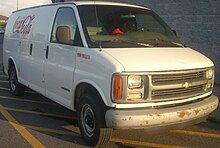
Coca-Cola advertising has «been among the most prolific in marketing history,» with a notable and major impact on popular culture and society as a whole.[97] The company in recent years has spent approximately an annual $4 billion globally to promote its drinks to the public; and spent approximately $4.24 billion on advertising in fiscal year 2019, the lion’s share of which was spent to advertise Coca-Cola.[98]
Coca-Cola advertises through direct marketing, web-based media, social media, text messaging, and sales promotions. The company also markets via mobile marketing in text messages, e.g. viral marketing campaigns.[97]
Fan engagement spans 86 million globally across social media channels: online interaction, and social, cultural, or sporting events.[97]
In the retail setting, direct store beverage delivery trucks (mobile advertising) as well as point of sale coolers and vending machines have bright red logo blazoned branding. In terms of foodservice, Coca-Cola is a food pairing suggestion that is now ingrained as a food match, e.g., for popcorn, hamburgers, french fries, and hot dog combos.[97]
Products and brands[edit]

Coca-Cola Company’s office building in Madrid (Spain)
As of 2020, the Coca-Cola Company offers more than 500 brands in over 200 countries. In September 2020, the company announced that it would cut more than half of its brands, as a result of the economic effects caused by the COVID-19 pandemic.[99]
Non-food assets[edit]
Columbia Pictures[edit]
Coca-Cola bought Columbia Pictures in 1982, owing to the low monetary value of the studio. The film company was the first and only studio ever be owned by Coca-Cola. During its ownership of the studio, Columbia released many popular films including Ghostbusters, Stripes, The Karate Kid, and some others. However, two years after the critical and commercial failure of the 1987 film Ishtar, Columbia was spun-off and then sold to Tokyo-based Sony in 1989.[13]
World of Coca-Cola[edit]
Coca-Cola operates a soft drink themed tourist attraction in Atlanta, Georgia; the World of Coca-Cola is a multi-storied exhibition. It features flavor sampling and a history museum, with locations in Las Vegas, Nevada, and Lake Buena Vista, Florida.[100][101]
Brands[edit]
Other soft drinks[edit]

Vendor machine in Berlin, Germany
The Coca-Cola Company also produces a number of other soft drinks including Fanta (introduced circa 1941) and Sprite. Fanta’s origins date back to World War II during a trade embargo against Germany on cola syrup, making it impossible to sell Coca-Cola in Germany. Max Keith, the head of Coca-Cola’s German office during the war, decided to create a new product for the German market, made only from products available in Germany at the time, which they named Fanta.[102] The drink proved to be a hit, and when Coke took over again after the war, it adopted the Fanta brand as well. Fanta was originally an orange-flavored soft drink that can come in plastic bottles or cans. It has become available in many different flavors now such as grape, peach, grapefruit, apple, pineapple, and strawberry.
In 1961, Coca-Cola introduced Sprite, a lemon-lime soft drink, another of the company’s bestsellers and its response to 7 Up.
Tab was Coca-Cola’s first attempt to develop a diet soft drink, using saccharin as a sugar substitute. Introduced in 1963, the product was sold until fall 2020,[103] although its sales had dwindled since the introduction of Diet Coke.[104]
Coca-Cola South Africa also released Valpre Bottled «still» and «sparkling» water.
In 1969, the company released Simba, which was a take on Mountain Dew, and had packaging that was African desert-themed, replete with an African Lion as the symbol of the brand. The tagline was «Simba – It Conquers the African Thirst.»
Also in 1969, the company released a line of products under the name of Santiba, which was targeted for mixing cocktails and party usage, products including Quinine water and Ginger Ale. Like the above-mentioned Simba, the Santiba line of products was short-lived in the marketplace.
BreakMate[edit]
No longer manufactured, the Coca-Cola BreakMate was a three-flavor dispenser introduced by Coca-Cola and Siemens in 1988. Intended for use in offices with five to fifty people,[105] its refrigerated compartment held three individual one-litre plastic containers of soda syrup and a CO2 tank. Like a soda fountain, it mixed syrup in a 1:5 ratio with carbonated water. In North America, Coca-Cola discontinued spare BreakMate parts in 2007 and stopped distributing the syrup in 2010.[106]
Healthy beverages[edit]
During the 1990s, the company responded to the growing consumer interest in healthy beverages by introducing several new non-carbonated beverage brands. These included Minute Maid Juices to Go, Powerade sports beverage, flavored tea Nestea (in a joint venture with Nestlé), Fruitopia fruit drink, and Dasani water, among others. In 2001, the Minute Maid division launched the Simply Orange brand of juices including orange juice. In 2016, Coca-Cola India introduced Vio to enter into the value-added dairy category. The product lays the foundation for Coca-Cola’s new segment after carbonated beverages, water and juices.[107]
In 2004, perhaps in response to the burgeoning popularity of low-carbohydrate diets such as the Atkins diet, Coca-Cola announced its intention to develop and sell a low-carbohydrate alternative to Coke Classic, dubbed C2 Cola. C2 contains a mix of high fructose corn syrup, aspartame, sucralose, and Acesulfame potassium. C2 is designed to more closely emulate the taste of Coca-Cola Classic. Even with less than half of the food energy and carbohydrates of standard soft drinks, C2 is not a replacement for zero-calorie soft drinks such as Diet Coke. C2 went on sale in the U.S. on June 11, 2004, and in Canada in August 2004; it was replaced in 2013 by Coca-Cola Life.
Starting in 2009, the Coca-Cola Company invested in Innocent Drinks, first with a minor stake, increasing to 90% in the first quarter of 2013.[108]
It was in May 2014 when Finley, a sparkling fruit-flavored drink, was launched in France. It was launched in other countries later,[109] including Belgium and Luxembourg in September 2014. Coca-Cola first started developing the drink in Belgium in 2001.[110] As of 2014, the drink is targeted for adults, and is low in sugar with four flavors.[109]
Best selling[edit]
Coca-Cola is the best-selling soft drink in most countries, and was recognized as the number one global brand in 2010.[111] While the Middle East is one of the few regions in the world where Coca-Cola is not the number one soda drink, Coca-Cola nonetheless holds almost 25% market share (to Pepsi’s 75%) and had double-digit growth in 2003.[112] Similarly, in Scotland, where the locally produced Irn-Bru was once more popular, 2005 figures show that both Coca-Cola and Diet Coke now outsell Irn-Bru.[113] In Peru, the native Inca Kola has been more popular than Coca-Cola, which prompted Coca-Cola to enter in negotiations with the soft drink’s company and buy 50% of its stakes. In Japan, the best selling soft drink is not cola, as (canned) tea and coffee are more popular.[114] As such, the Coca-Cola Company’s best selling brand there is not Coca-Cola, but Georgia.[115] In May 2016, the Coca-Cola Company temporarily halted production of its signature drink in Venezuela due to sugar shortages.[116] Since then, the Coca-Cola Company has been using «minimum inventories of raw material» to make their signature drinks at two production plants in Venezuela.[117]
Information[edit]
On July 6, 2006, a Coca-Cola employee and two other people were arrested and charged with trying to sell trade secret information to the soft drink maker’s competitor PepsiCo for $1.5 million. The recipe for Coca-Cola, perhaps the company’s most closely guarded secret, was never in jeopardy; instead, the information was related to a new beverage in development. Coca-Cola executives verified that the trade secret documents in question were genuine and proprietary to the company. At least one glass vial containing a sample of a new drink was offered for sale, court documents said. The conspiracy was revealed by PepsiCo, which notified authorities when it was approached by the conspirators.[118]
Green tea[edit]
The company announced a new «negative calorie» green tea drink, Enviga, in 2006, along with trying coffee retail concepts Far Coast and Chaqwa.
Glaceau[edit]
On May 25, 2007, Coca-Cola announced it would purchase Glaceau, a maker of flavored vitamin-enhanced drinks (vitamin water), flavored waters, and Burn energy drinks, for $4.1 billion in cash.[119]
Huiyuan Juice[edit]
On September 3, 2008, Coca-Cola announced its intention to make cash offers to purchase China Huiyuan Juice Group Limited (which had a 42% share of the Chinese pure fruit juice market[120]) for US$2.4bn (HK$12.20 per share).[121] China’s ministry of commerce blocked the deal on March 18, 2009, arguing that the deal would hurt small local juice companies, could have pushed up juice market prices, and limited consumers’ choices.[122]
Coke Mini can[edit]
In October 2009, Coca-Cola revealed its new 90-calorie mini can that holds 7.5 fluid ounces.[123] The mini can is often sold in 8 packs. Despite costing nearly 30 percent more per ounce, the mini cans have been met with positive sales figures.[124]
Holiday can[edit]
In November 2011, Coca-Cola revealed a seasonal design for its regular Coke cans as part of a partnership with the World Wildlife Fund. However, it was withdrawn only a month after release due to consumer complaints about a similar look to the silver cans commonly used for Diet Coke. There were also complaints about deviating from traditional red as the color of Coca-Cola cans previously.[125]
Stake in Monster Beverage[edit]
It was announced on August 14, 2014, that the Coca-Cola Company was making a cash payment of $2.15 billion for a 16.7 percent stake in Monster Beverage Corp to expand its market for energy drinks, with Coke to transfer ownership in Full Throttle and Burn to Monster and Monster to transfer its ownership in Hansen’s Natural Sodas, Peace Iced Tea, and Blue Sky Soda to the Coca-Cola Company. Muhtar Kent, Coke’s former chief executive officer, stated that the company has the option to increase its stake to 25 percent but could not exceed that percentage in the next four years.[126][127]
Alcoholic beverages[edit]
In 2021, the Coca-Cola Co used its Mexican[128] sparkling mineral water brand Topo Chico to launch a range of vegan friendly[129] alcoholic hard seltzers in the United Kingdom and in the United States.[130][131][132]
Front groups[edit]
As part of its corporate propaganda campaign to deflect public attention away from the harmful health effects of its sugary drinks, the Coca-Cola Company has funded front organizations. The company funded creation of the front organization the Global Energy Balance Network (GEBN) to address the growing evidence that the company’s products are a leading cause of the epidemic of childhood obesity in the United States and the growing number of Americans, including children, with type 2 diabetes. GEBN designed its own studies to arrive at conclusions set in advance and cherry picked data to support its corporate public relations agenda. After an August 2015 investigative report exposed the GEBN as a Coca-Cola Company front organization, GEBN was shut down.[133]
Three years after the shutdown of GEBN, the company, together with several other junk food giants, was revealed to be behind an initiative in China called «Happy 10 Minutes,» funded through a group called the International Life Sciences Institute (ILSI). The aim of the initiative was to address decades of research on diet-related diseases, such as Type 2 diabetes and hypertension, by promoting physical exercise to the population but avoiding discussion of the link between such diseases and junk foods, including sugary drinks.[133][134] ILSI through the 1980s and 1990s had been promoting the tobacco industry’s agenda in Europe and the United States.[135]
[edit]
Coca-Cola’s advertising expenses accounted for US$3.256 billion in 2011.[136]
Sports[edit]
Coca-Cola sponsored the English Football League from the beginning of the 2004–05 season (beginning August 2004) to the start of 2010–11 season, when the Football League replaced it with NPower.[citation needed] Along with this, Coca-Cola sponsored the Coca-Cola Football Camp, that took place in Pretoria, South Africa during the 2010 FIFA World Cup.[citation needed]
Other major sponsorships include the AFL, NHRA, NASCAR, the PGA Tour, NCAA Championships, the Olympic Games, the NRL, the FIFA World Cups, Premier League and the UEFA European Championships.[citation needed] The company partnered with Panini to produce the first virtual sticker album for the 2006 FIFA World Cup, and they have collaborated for every World Cup since.[137] Each fall, Coca-Cola is the sponsor of the TOUR Championship by Coca-Cola held at the East Lake Golf Club in Atlanta, Georgia. The Tour Championship is the season ending tournament of the PGA Tour.[citation needed] In the Philippines, it has a team in the Philippine Basketball Association, the Powerade Tigers.[citation needed]
In 2017, Major League Baseball signed a multi-year deal with Coca-Cola to be the official soft drink, replacing Pepsi. Nineteen MLB teams (Los Angeles Angels, Houston Astros, Toronto Blue Jays, Atlanta Braves, St. Louis Cardinals, Los Angeles Dodgers, San Francisco Giants, Seattle Mariners,[138] New York Mets, Washington Nationals, San Diego Padres, Philadelphia Phillies, Pittsburgh Pirates, Texas Rangers, Tampa Bay Rays, Cincinnati Reds, Boston Red Sox, Colorado Rockies and Chicago White Sox ) have Coca-Cola products sold in their ballparks.
Since the season of 2019 is the title sponsor of the Uzbekistan Super League in football, and this league is officially called Coca-Cola Uzbekistan Super League.
Coca-Cola has also sponsored the Overwatch league since season two. They also sponsor all major Overwatch tournaments such as the world cup
.[139] In February 2020, Coca-Cola became the title sponsor for the eNASCAR iRacing series.[140][141] In October 2018, Coca-Cola started sponsoring the Formula 1 team McLaren with several 1 year deals being signed since then.[142][143]
Television[edit]
The company sponsored the popular Fox singing-competition series American Idol from 2002 until 2014.[citation needed]
Coca-Cola was a sponsor of the nightly talk show on PBS, Charlie Rose in the US.[144]
Coca-Cola is also an executive producer of Coke Studio (Pakistan). It was a franchising that started in Brazil, broadcast by MTV Brasil and there are various adaptations of Coke Studio such as Coke Studio (India), Coke Studio Bangla and Coke Studio (Africa).[145]
Theme parks[edit]
While not necessarily having naming rights to anything in all locations, the company does sponsor and provide beverages in many theme parks, usually in an exclusive capacity. This includes the Walt Disney Parks and Resorts,[a] Merlin Entertainment, Universal Destinations & Experiences, Six Flags, Cedar Fair, and SeaWorld Entertainment which are six of the nine largest theme park operators worldwide (it is unknown whether OCT Parks China, the Chimelong Group, or Fantawild, the fourth, seventh, and eighth largest theme park operators respectively, use Coca-Cola).[148]
The company also directly sponsors, with naming rights, the Coca-Cola London Eye and formerly, the Coca-Cola Orlando Eye.[149][150]
The company also operates «Coca-Cola» visitor centers in Israel, Belgium and Turkey.[151][152][153]
See also[edit]
- List of assets owned by the Coca-Cola Company
- Stepan Company – produces coca leaf extract
References[edit]
Notes[edit]
- ^ Shanghai Disney Resort uses Pepsi. It is the only Disney Parks location to serve Pepsi and not Coca-Cola.[146][147]
Citations[edit]
- ^ «2022 Proxy Statement» (PDF). The Coca Cola Company. Retrieved April 26, 2022.
- ^ «2019 Annual Report (Form 10-K)» (PDF). The Coca-Cola Company. February 24, 2020. Retrieved September 5, 2020.
- ^ «The Story of Coca-Cola: A Successful Franchising Strategy». Prestige Franchising Limited. April 27, 2017. Retrieved November 30, 2020.
- ^ Merced, Michael J. de la (February 25, 2010). «Coke Acquires North American Unit of Bottler (Published 2010)». The New York Times. ISSN 0362-4331. Retrieved November 30, 2020.
- ^ Boville Luca de Tena, Belén (2004). The Cocaine War: In Context: Drugs and Politics. Algora Publishing. pp. 61–62. ISBN 978-0-87586-294-1.
- ^ Garrett 1969, p. 121.
- ^ «Where did Coca-Cola really come from? Company responds to surprising rumor». TODAY.com. Archived from the original on September 7, 2018. Retrieved September 6, 2018.
- ^ a b Pendergrast, Mark (2013). For God, Country, and Coca-Cola: The Definitive History of the Great American Soft Drink and the Company That Makes It, 3d ed. New York: Basic Books.
- ^ a b c «What Coca-Cola’s Marketing Blunder Can Teach Us About America». Time. Archived from the original on August 21, 2018. Retrieved September 6, 2018.
- ^ «7 strategies Coca-Cola used to become one of the world’s most recognizable brands». Business Insider. Archived from the original on September 7, 2018. Retrieved September 6, 2018.
- ^ «History of The Minute Maid Company». Fundinguniverse.com. Archived from the original on January 5, 2012. Retrieved July 29, 2012.
- ^ «Merger Discussions Being Held By Coca-Cola and Minute Maid; Soft Drink Company Would Issue 1 Share for 2.2 of Citras Juice Concern COCA-COLA HOLDS TALKS ON MERGER (Published 1960)». The New York Times. September 9, 1960. ISSN 0362-4331. Retrieved November 30, 2020.
- ^ a b c Sellers, Patricia; Woods, Wilton (October 13, 1997). «WHERE COKE GOES FROM HERE». Fortune. Archived from the original on August 21, 2011. Retrieved October 10, 2011.
- ^ «Coke’s EBS & Tri-Star Merge TV Biz, Forming Col Pictures TV». Variety. October 21, 1987. pp. 512, 528.
- ^ «Coke Reorganizing TV Division After Merging It With Tri-Star; Two Execs Seek Syndie Rights». Variety. October 28, 1987. pp. 43, 72.
- ^ «Coke Sells 2 Subsids». Variety. January 15, 1986. p. 34.
- ^ «Strong Cola Taste, Macho Personality». Archived from the original on February 26, 2009.
- ^ Barq’s Root Beer: History Archived September 21, 2012, at the Wayback Machine, Coca-Cola. Retrieved January 2, 2013.
- ^ «Branding Lessons from Inca Kola, the Peruvian Soda That Bested Coca-Cola». Knowledge@Wharton.
- ^ «Coca Cola, Form SC TO-T, Filing Date Oct 30, 2001». secdatabase.com. Archived from the original on May 13, 2013. Retrieved March 27, 2013.
- ^ «Coke Buys Odwalla» Archived May 15, 2010, at the Wayback Machine. (October 30, 2001).CNN Money.
- ^ Alicia Wallace (July 21, 2020). «Coke says it will kill more ‘zombie’ brands, weeks after dropping Odwalla». CNN. Retrieved July 22, 2020.
- ^ «Coca Cola, Form 10-K, Annual Report, Filing Date Feb 21, 2007» (PDF). secdatabase.com. Archived (PDF) from the original on May 13, 2013. Retrieved March 27, 2013.
- ^ «Coca-Cola Buys Fuze Beverage» Archived May 11, 2011, at the Wayback Machine. (February 12, 2007) Boulder Daily Camera.
- ^ «Coca-Cola, Form 10-Q, Quarterly Report, Filing Date Apr 30, 2009». secdatabase.com. Archived from the original on May 13, 2013. Retrieved March 27, 2013.
- ^ «Coke’s China juice move collapses». BBC News. March 18, 2009. Archived from the original on February 26, 2011. Retrieved May 25, 2010.
- ^ Geller, Martinne (March 2011). «Coke buys remaining stake in Honest Tea». Reuters. Archived from the original on July 30, 2018. Retrieved July 30, 2018.
- ^ «Coke Finishes Buyout of Zico; Uzzell Becomes President, Rampolla to Advise». BevNET.com. November 22, 2013. Archived from the original on March 8, 2016. Retrieved March 8, 2016.
- ^ «Coca-Cola all in on coconut water maker». Archived from the original on March 8, 2016. Retrieved March 8, 2016.
- ^ «ZICO™ Beverages Joins The Coca-Cola Family». The Coca-Cola Company. Archived from the original on March 8, 2016. Retrieved March 8, 2016.
- ^ «Beverages giant Coca-Cola acquires 16.7pc stake in Monster for $2.15bn». Pittsburgh News.Net. August 15, 2014. Archived from the original on August 19, 2014. Retrieved August 15, 2014.
- ^ Esterl, Mike. «Coca-Cola Buys Minority Stake in Suja Life». The Wall Street Journal. ISSN 0099-9660. Archived from the original on March 8, 2016. Retrieved March 8, 2016.
- ^ «Organic Juice Startup Suja Adds Unlikely Partners: Coca-Cola, Goldman Sachs». Forbes. Archived from the original on March 8, 2016. Retrieved March 8, 2016.
- ^ Jarvis, Paul (December 21, 2016). «Coca-Cola Buys AB InBev Out of Africa Unit for $3.2 Billion». Bloomberg News. Bloomberg. Archived from the original on February 1, 2017. Retrieved February 1, 2017.
Coca-Cola Co. will pay $3.15 billion to buy Anheuser-Busch InBev NV out of an African bottling joint venture … Coca-Cola also agreed to buy AB InBev’s interest in bottling operations in Zambia, Zimbabwe, Botswana, Swaziland, Lesotho, El Salvador, and Honduras for an undisclosed sum.
- ^ «Topo Chico Acquired by Coca-Cola». Food & Wine. Archived from the original on August 11, 2019. Retrieved August 11, 2019.
- ^ «Coca-Cola to buy Costa coffee for £3.9bn or $4.9bn». BBC News. August 31, 2018. Archived from the original on August 31, 2018. Retrieved August 31, 2018.
- ^ «Coca-Cola acquires beloved Maine soda Moxie». The Boston Globe. Archived from the original on April 24, 2019. Retrieved February 17, 2019.
- ^ Wiener-Bronner, Danielle (August 14, 2018). «Coca Cola is fighting Gatorade by investing in BodyArmor». CNN Business. Retrieved May 26, 2020.
- ^ a b «Coca-Cola Company Form 10-K 2005». SEC. Archived from the original on June 4, 2011. Retrieved May 11, 2006.
- ^ «Coke sales first to top £1bn». Edinburgh Evening News. March 19, 2010. Archived from the original on September 9, 2010. Retrieved March 20, 2010.
- ^ «Coca-Cola to cut 1,200 jobs as sales slump». CNN. April 25, 2017. Archived from the original on July 11, 2017. Retrieved July 13, 2017.
- ^ a b c d «2003 Annual Report» (PDF). Archived (PDF) from the original on May 16, 2019. Retrieved November 11, 2018.
- ^ «2004 Annual Report» (PDF). Archived (PDF) from the original on May 16, 2019. Retrieved November 11, 2018.
- ^ «2005 Annual Report» (PDF). Archived (PDF) from the original on May 16, 2019. Retrieved November 11, 2018.
- ^ «2006 Annual Report» (PDF). Archived (PDF) from the original on May 16, 2019. Retrieved November 11, 2018.
- ^ «2007 Annual Report» (PDF). Archived (PDF) from the original on May 16, 2019. Retrieved November 11, 2018.
- ^ «2008 Annual Report» (PDF). Archived (PDF) from the original on May 16, 2019. Retrieved November 11, 2018.
- ^ «2009 Annual Report» (PDF). Archived (PDF) from the original on May 16, 2019. Retrieved November 11, 2018.
- ^ «2010 Annual Report» (PDF). Archived (PDF) from the original on February 7, 2016. Retrieved November 11, 2018.
- ^ «2011 Annual Report» (PDF). Archived (PDF) from the original on May 8, 2016. Retrieved November 11, 2018.
- ^ «2012 Annual Report» (PDF). Archived (PDF) from the original on April 11, 2016. Retrieved November 11, 2018.
- ^ «2013 Annual Report» (PDF). Archived (PDF) from the original on April 2, 2019. Retrieved November 11, 2018.
- ^ «2014 Annual Report» (PDF). Archived (PDF) from the original on January 14, 2019. Retrieved November 11, 2018.
- ^ «2015 Annual Report» (PDF). Archived (PDF) from the original on April 25, 2016. Retrieved November 11, 2018.
- ^ «2016 Annual Report» (PDF). Archived (PDF) from the original on February 9, 2018. Retrieved November 11, 2018.
- ^ «2017 Annual Report» (PDF). Archived (PDF) from the original on May 16, 2019. Retrieved November 11, 2018.
- ^ «Annual Report 2018» (PDF). The Coca-Cola Company.
- ^ «2019 Integrated Annual Report». cch Group Website. Retrieved December 23, 2020.
- ^ «2020 Annual Report» (PDF).
{{cite web}}: CS1 maint: url-status (link) - ^ Butler & Tischler 2015, p. 38.
- ^ «The Coco-Cola Company». Archived from the original on February 28, 2019.
- ^ Wiederman, Adam J. (August 14, 2012). «One Share of Stock Now Worth $9.8 Million – Is It Really Possible?». DailyFinance.com. Archived from the original on November 15, 2012. Retrieved November 1, 2012.
- ^ Schaefer, Steve. «SunTrust Sells Coca-Cola Stake After 93 Years, Collects A Tidy Two Million Percent Return». Forbes. Archived from the original on October 30, 2019. Retrieved October 30, 2019.
- ^ «Decades of Great Performance From 9 Dow Stocks». DailyFinance.com. November 5, 2011. Archived from the original on November 4, 2012. Retrieved November 1, 2012.
- ^ «KO: Dividend Date & History for Coca-Cola Co». Dividend.com. Archived from the original on June 6, 2019. Retrieved June 6, 2019.
- ^ Owusu, Tony (February 21, 2019). «Coca-Cola Raises Dividend for 57th Consecutive Year». TheStreet. Archived from the original on February 28, 2019.
- ^ «Coca-Cola shareholders OK 2-for-1 stock split». USA Today. Archived from the original on October 9, 2012. Retrieved November 1, 2012.
- ^ «Investors Info: Dividends». coca-colacompany.com. Archived from the original on April 22, 2019. Retrieved February 27, 2019.
- ^ a b «Coca-Cola Leaders». Coca-colacompany.com. Archived from the original on July 30, 2018. Retrieved July 30, 2018.
- ^ a b «The Coca-Cola Company | History, Products, & Facts». Encyclopedia Britannica. Retrieved November 30, 2020.
- ^ Harris, Rosemary. «From humble beginnings». Brent Wheeler Group Limited. Archived from the original on September 19, 2016. Retrieved August 10, 2016.
- ^ Coca-Cola European Partners F-4 Registration of securities, foreign private issuers, business combinations, December 15, 2015
- ^ Coca-Cola Bottlers Japan, F-4, February 24, 2027, ENGLISH TRANSLATION OF CAPITAL AND BUSINESS ALLIANCE AGREEMENT
- ^ Swire buys Coca-Cola bottlers in Vietnam, Cambodia for $1bn
- ^ Delay Listing of Coca-Cola Beverages Africa as a Publicly Traded Company
- ^ «NOBEL PEACE PRIZE: In 1964, award to King stirred a storm». Atlanta Journal-Constitution. December 10, 2002.
- ^ Young, Andrew (1996). An Easy Burden. HarperCollins. ISBN 978-0-06-092890-2. OCLC 34782719.
- ^ Who’s Funding Prop 37, Labeling for Genetically Engineered Foods? | Propositions | Elections 2012 Archived November 26, 2012, at the Wayback Machine. KCET. Retrieved December 23, 2013.
- ^ Westervelt, Amy (August 22, 2012). «Monsanto, DuPont Spending Millions to Oppose California’s GMO Labeling Law». Forbes. Archived from the original on September 11, 2016. Retrieved August 10, 2016.
- ^ «(RED) Partners». (RED). The ONE Campaign. 2012. Archived from the original on May 24, 2012. Retrieved October 14, 2012.
- ^ Nace, Trevor. «Coca-Cola Named The World’s Most Polluting Brand in Plastic Waste Audit». Forbes. Retrieved November 30, 2020.
- ^ «Group sues to hold Coca-Cola, Pepsi and others liable for plastics fouling California waters». Los Angeles Times. February 27, 2020. Retrieved November 30, 2020.
- ^ a b Jack, Simon (October 25, 2019). «In the war on plastic is Coca-Cola friend or foe?». BBC News. Retrieved February 4, 2020.
- ^ «The Coca-Cola Company and PepsiCo named top plastic polluters for the fourth year in a row». Break Free From Plastic. October 25, 2021. Retrieved June 22, 2022.
- ^ Russ, Hilary (February 15, 2022). «Coca-Cola, criticized for plastic pollution, pledges 25% reusable packaging». Reuters. Retrieved June 22, 2022.
- ^ Lerner, Sharon (October 18, 2019). «Leaked Audio Reveals How Coca-Cola Undermines Plastic Recycling Efforts». The Intercept. Retrieved January 23, 2020.
- ^ «Study Finds That These Companies Are The Biggest Plastic Polluters Of 2022». IndiaTimes. November 15, 2022.
- ^ «Coca-Cola’s Plastic Pollution Problem». www.sierraclub.org. Retrieved April 2, 2023.
- ^ Nace, Trevor. «Coca-Cola Named The World’s Most Polluting Brand in Plastic Waste Audit». Forbes.
- ^ Eyre, Timothy (2010). «PDFdiff: A PDF File Comparison Script». Zpravodaj Československého sdružení uživatelů TeXu (3): 208–214. doi:10.5300/2010-3/208. ISSN 1211-6661.
- ^ «Coca-Cola: drinking the world dry | War on Want». waronwant.org. Retrieved April 2, 2023.
- ^ White, Ben (April 18, 2002). «Black Coca-Cola Workers Still Angry». Washington Post. ISSN 0190-8286. Retrieved March 11, 2022.
- ^ Annys Shin (June 10, 2004). «Foundation Helps Sodexho Counter Discrimination Suit». Washington Post.
- ^ «Coca-Cola Unit Sued for Alleged Racial Discrimination». Workforce.com. Retrieved March 11, 2022.
- ^ Haskin, On Behalf of Employment Law Office of John H.; Associates; LLC (March 26, 2012). «Coca-Cola sued for racial discrimination». Employment Law Office of John H. Haskin & Associates, LLC. Retrieved March 11, 2022.
- ^ Río, Mairem Del (May 7, 2021). «Coca-Cola Asks Its Workers to Be ‘Less White’ to Fight Racism». Beaumont Enterprise. Retrieved March 11, 2022.
- ^ a b c d Stringer, G. (2015). Case Study: Coca Cola Integrated Marketing Communications.
- ^ Investopedia, August 10, 2021 «A Look at Coca-Cola’s Advertising Expenses»
- ^ Maloney, Jennifer (October 16, 2020). «Tab, Coca-Cola’s Diet-Soda Pioneer and a ’70s Icon, Is Going Away». The Wall Street Journal. Retrieved October 16, 2020.
- ^ «Coca-Cola Store». World of Coca-Cola. World of Coca-Cola. Archived from the original on February 2, 2017. Retrieved January 26, 2017.
- ^ Caslin, Yvette (January 19, 2017). «Creative artists, social media masters inspire new World of Coca-Cola gallery». Rolling Out. Archived from the original on January 29, 2017. Retrieved January 26, 2017.
- ^ Mikkelson, Barbara (April 29, 2011). «The Reich Stuff?». Snopes. Retrieved May 8, 2014.
- ^ James, Leggate (October 16, 2020). «Coca-Cola will stop making Tab diet soda, company announces». Fox Business.
- ^ Estes, Adam. «A Brief History of Racist Soft Drinks». The Wire. Archived from the original on August 22, 2016. Retrieved August 10, 2016.
- ^ «Coca-Cola seeping into coffee breaks». Eugene Register-Guard. November 19, 1988. Archived from the original on April 3, 2016. Retrieved March 16, 2016.
- ^ «Coca Cola Refreshments Discontinues BreakMate Syrup». VendingMarketWatch. Archived from the original on August 14, 2014. Retrieved September 21, 2014.
- ^ «Coca-Cola India Enters Dairy Market With VIO Flavored Milk». The Coca-Cola Company. Archived from the original on April 7, 2017. Retrieved June 22, 2016.
- ^ Neate, Rupert (February 22, 2013), Coca-Cola takes full control of Innocent, London (I believe): ‘’The Guardian’’, archived from the original on July 29, 2017, retrieved June 28, 2017
- ^ a b Inge, Sophie (May 5, 2014), «Coca-Cola launches new soft drink in France», The Local France, thelocal.fr, archived from the original on August 20, 2017, retrieved June 28, 2017
- ^ Bouchkley, Ben (September 4, 2014), «Coke Launches adult soft drink Finley in Belgium to stem adult soft drinks age decline», Beverage Daily, archived from the original on July 30, 2017, retrieved June 28, 2017
- ^ «Best Global Brands Ranking for 2010». Interbrand.com. Archived from the original on February 12, 2011. Retrieved July 29, 2012.
- ^ «Coke and Pepsi battle it out». AME Info. April 8, 2004. Archived from the original on April 8, 2006. Retrieved May 11, 2006.
- ^ Murden, Terry (January 30, 2005). «Coke adds life to health drinks sector». The Scotsman. Scotland on Sunday. UK. Archived from the original on March 4, 2005. Retrieved May 11, 2006.
- ^ «Japan Soft Drink Association». Archived from the original on February 14, 2007.
- ^ Coca-Cola West Japan Archived September 23, 2008, at the Wayback Machine IR report (in Japanese), 2008.
- ^ «Sugar shortage hits Coke in Venezuela». BBC. May 24, 2016. Archived from the original on May 27, 2016. Retrieved July 30, 2018.
- ^ «Coca-Cola lanza en Venezuela bebida sin caloría». Elestimulo.com. July 1, 2016. Archived from the original on June 23, 2018. Retrieved July 30, 2018.
- ^ Day, Kathleen (July 6, 2006). «3 Accused in Theft of Coke Secrets». The Washington Post. Archived from the original on July 26, 2008. Retrieved July 15, 2006.
- ^ McWilliams, Jeremiah (January 30, 2010). «Coke, Pepsi battle over bottled water». Atlanta Journal-Constitution. Retrieved August 18, 2021.
- ^ Tucker, Sundeep (March 17, 2009). «Coca-Cola’s $2.4bn China deal at risk». Financial Times. Hong Kong. Archived from the original on September 24, 2015. Retrieved March 17, 2009.
- ^ «THE COCA-COLA COMPANY Media Center». Archived from the original on December 26, 2012. Retrieved December 19, 2012.
- ^ Tucker, Sundeep (March 18, 2009). «China blocks Coca-Cola bid for Huiyuan». Financial Times. Hong Kong. Archived from the original on May 22, 2009. Retrieved March 18, 2009.
- ^ Plumb, Tierney (October 14, 2009). «Coca-Cola to unveil mini cans in D.C.» Washington Business Journal/Bizjournals.com.
- ^ Tuttle, Brad (January 15, 2015). «How Coke Convinced Us to Pay More … for Less Soda». MONEY.com. Archived from the original on May 2, 2022. Retrieved October 5, 2015.
- ^ Esterl, Mike (December 1, 2011). «A Frosty Reception for Coca-Cola’s White Christmas Cans». The Wall Street Journal. Archived from the original on February 7, 2012. Retrieved February 6, 2012.
- ^ ATHAVALEY, ANJALI (August 15, 2014). «Coca-Cola pays $2.2 billion for major stake in Monster Beverage». Reuters. Archived from the original on August 15, 2014. Retrieved August 15, 2014.
- ^ Gelles, David (August 14, 2014). «Coke to Buy Stake in Monster Beverage for $2.15 Billion». The New York Times. Archived from the original on April 20, 2018. Retrieved August 15, 2014.
- ^ «Topo Chico — Brands & Products». The Coca-Cola Company.
- ^ «Coca Cola’s First Alcoholic Drink — Topo Chico Hard Seltzer — Off To a «Promising Start»«. May 3, 2021.
- ^ «Age Verification | Topo Chico Hard Seltzer». www.topochicohardseltzerusa.com.
- ^ Woolfson2020-10-27T11:40:00+00:00, Daniel. «Coca-Cola enters UK booze market with Topo Chico hard seltzer». The Grocer.
- ^ «We Taste-Tested Topo Chico’s 4 New Spiked Seltzers, So You Don’t Have To». Southern Living.
- ^ a b Clifford D. Conner, «The Tragedy of American Science, from Truman to Trump» (Chicago: Haymarket Books, 2020), pp. 14-16
- ^ New York Times, January 9, 2019 «How Chummy Are Junk Food Giants and China’s Health Officials? They Share Offices»
- ^ New York Times, September 16, 2019 «A Shadowy Industry Group Shapes Food Policy Around the World»
- ^ 2011 Annual Report (PDF), archived from the original on February 15, 2013, retrieved January 4, 2013
- ^ «12 Years Running: Panini’s FIFA World Cup™ Digital Sticker Album is More Popular Than Ever». Coca Cola Company. Archived from the original on October 5, 2018. Retrieved October 5, 2018.
- ^ «Coca-Cola joins T-Mobile Park lineup as Mariners «official fan refreshment»«. MLB.com. Retrieved August 17, 2022.
- ^ «Coca-Cola – титульный спонсор Суперлиги и Кубка Узбекистана» (in Russian). pfl.uz. Archived from the original on March 6, 2019. Retrieved March 7, 2019.
- ^ «Coca-Cola named entitlement sponsor of iRacing Series | NASCAR». Official Site Of NASCAR. February 5, 2020.
- ^ «Coca-Cola becomes title sponsor of NASCAR’s esports race». Marketing Dive.
- ^ «McLaren signs Coca-Cola sponsor deal for rest of 2018 F1 season». www.autosport.com.
- ^ «McLaren Racing — McLaren Racing extends partnership with The Coca-Cola Company». www.mclaren.com.
- ^ «About the program». Charlie Rose. Archived from the original on September 19, 2012. Retrieved July 29, 2012.
- ^ «Inside the growth of Coca-Cola’s music TV show in Africa». August 17, 2017.
- ^ «PepsiCo Chairman & CEO Congratulates Disney on Grand Opening of the World-Class Shanghai Disney Resort». PepsiCo. Archived from the original on January 31, 2017. Retrieved January 31, 2017.
- ^ Jourdan, Adam (February 27, 2017). «PepsiCo re-enters ‘Magic Kingdom’ with Shanghai Disney deal». Reuters. Archived from the original on January 31, 2017. Retrieved January 31, 2017.
- ^ «TEA/AECOM 2015 Global Attractions Attendance Report» (PDF). Themed Entertainment Association. 2015. Archived (PDF) from the original on July 3, 2016. Retrieved May 25, 2016.
- ^ «Orlando Eye is renamed the Coca-Cola Orlando Eye». July 28, 2016. Archived from the original on July 29, 2016. Retrieved July 28, 2016.
- ^ Dineen, Caitlin. «Orlando Eye officially flies Coca-Cola banner». Orlando Sentinel. Archived from the original on July 29, 2016. Retrieved July 28, 2016.
- ^ «Interview about the attractions park for Coca-Cola Turkey». café.themarker.com. Archived from the original on June 26, 2015. Retrieved July 6, 2015.
- ^ «Coca-Cola Visitors Centre Turkey». mefik.co.il. Archived from the original on June 27, 2015. Retrieved July 6, 2015.
- ^ «Coca Cola Visitors». Coca Cola Visitors (in Dutch). Archived from the original on December 15, 2017. Retrieved December 14, 2017.
Further reading[edit]
- Butler, David; Tischler, Linda (February 10, 2015). Design to Grow: How Coca-Cola Learned to Combine Scale and Agility (and How You Can Too) (1st ed.). New York, NY: Simon & Schuster. ISBN 978-1-4516-7627-3.
- Garrett, Franklin Miller (1969). «The Eighteen-Eighties». Atlanta and Environs: A Chronicle of Its People and Events, 1880s-1930s (2nd ed.). Athens, Georgia.: University of Georgia Press. ISBN 978-0-8203-3128-7.
- Giebelhaus, August W. (May 13, 2008). «Coca-Cola Company». The New Georgia Encyclopedia. Georgia Humanities Council.
- «Robinson, William E.: Papers, 1935–69». Abilene, Kansas: Dwight D. Eisenhower Library.
- Zyman, Sergio (June 1, 1999). The End of Marketing as We Know It. New York: HarperBusiness. ISBN 0-88730-986-0.